Chemistry XII Reference Guide – Inorganic and Organic Concepts
Chemistry XII Reference Guide explores essential inorganic and organic chemistry concepts for students. It covers topics such as d-block elements, ligands, and mass spectrometry, along with detailed explanations of organic compounds and their reactions. This guide is designed for high school chemistry students preparing for exams or seeking to reinforce their understanding of key concepts. It includes practice problems and solutions to enhance learning outcomes.
Key Points
Covers key inorganic chemistry topics including d-block elements and ligands.
Explains mass spectrometry and its applications in molecular structure analysis.
Details organic chemistry concepts such as functional groups and reaction mechanisms.
Includes practice problems for students to test their understanding of the material.
This link leads to an external site. We do not know or endorse its content, and are not responsible for its safety. Click the link to proceed only if you trust this site.
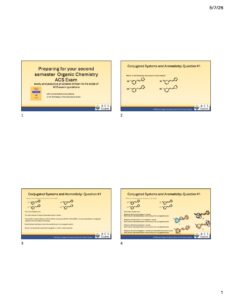
ACS Exams Organic Chemistry Second Semester Practice PowerPointStudy Guide
PDFStudy Guide
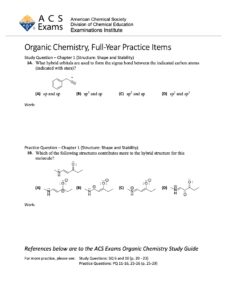
ACS Organic Chemistry Second Term Exam PracticeStudy Guide
PDFStudy Guide
NEET Chemistry Study Guide for Aspiring Medical StudentsStudy Guide
PDFStudy Guide
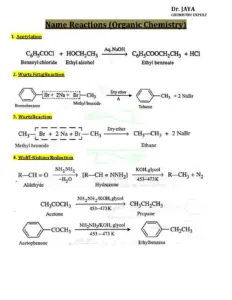
Name Reactions for JEE 2026 Organic ChemistryStudy Guide
PDFSolution Manual
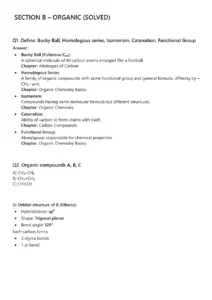
Organic Chemistry Study Guide – Isomerism, Functional Groups, and ReactionsSolution Manual
PDFStudy Guide
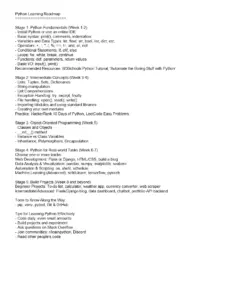
Python Learning Roadmap: A Comprehensive Guide to Mastering PythonStudy Guide
FAQs
What are the key properties of d-block elements?
D-block elements, also known as transition metals, are characterized by their ability to form variable oxidation states and complex ions. They typically exhibit high melting and boiling points, along with good conductivity of heat and electricity. Additionally, these elements are known for their catalytic properties and the formation of colored compounds, which are a result of d-d electron transitions. The document emphasizes the importance of these properties in various chemical reactions and applications.
What is the process of preparing nylon and polyvinyl chloride?
The preparation of nylon involves the condensation polymerization of diamines and dicarboxylic acids or their derivatives. This process results in the formation of long-chain polyamide molecules, which are then processed into fibers or other forms. For polyvinyl chloride (PVC), the polymerization of vinyl chloride monomers is carried out, often using radical initiators. The document outlines the steps involved in these processes, highlighting their significance in the production of synthetic fibers and plastics.
How does mass spectrometry work in identifying molecules?
Mass spectrometry is a technique used to determine the molecular structure of compounds by measuring the mass-to-charge ratio of ions. The process involves ionizing the sample, accelerating the ions through an electric field, and then analyzing their flight times in a mass analyzer. This allows for the identification of the molecular weight and structure of the molecule. The document details the applications of mass spectrometry in various fields, including organic chemistry and biochemistry, emphasizing its role in molecular identification.
What is the significance of ligands in coordination compounds?
Ligands are ions or molecules that can donate a pair of electrons to a central metal atom in coordination compounds. They play a crucial role in determining the properties and reactivity of these compounds. The document classifies ligands based on the number of donor sites, distinguishing between monodentate, bidentate, and polydentate ligands. Understanding the nature of ligands is essential for predicting the behavior of coordination complexes in various chemical reactions.
What are the steps in the preparation of caustic soda?
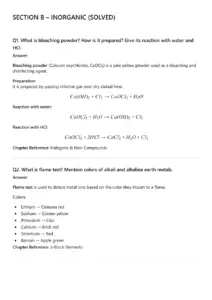
The document describes the manufacturing of caustic soda through the electrolysis of sodium chloride solution, known as brine. The process involves the separation of chlorine gas and hydrogen gas from the brine, with sodium hydroxide being produced as a byproduct. This method is significant for its efficiency and the purity of the caustic soda produced. The document outlines the chemical reactions involved and the industrial significance of caustic soda in various applications.
What is β-elimination and its mechanism?
β-elimination is a reaction mechanism where a β-hydrogen atom is removed along with a leaving group, resulting in the formation of a double bond. The document discusses the mechanisms of E1 and E2 reactions, highlighting the differences between them. In E1 reactions, the process involves the formation of a carbocation intermediate, while E2 reactions occur via a concerted mechanism. Understanding these mechanisms is crucial for predicting the outcomes of elimination reactions in organic synthesis.