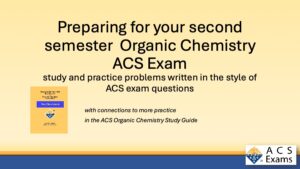
Organic Chemistry Second Semester Practice PowerPoint from ACS Exams provides essential study materials for students preparing for their ACS Organic Chemistry exams. This resource includes practice problems and questions modeled after actual ACS exam formats, covering key topics such as conjugated systems, aromaticity, and reaction mechanisms. Ideal for students aiming to strengthen their understanding of organic chemistry concepts and improve their exam performance. The PowerPoint format allows for easy navigation and review of critical content.

Key Points

  • Includes practice problems aligned with ACS Organic Chemistry exam formats.
  • Covers essential topics such as conjugated systems and aromaticity.
  • Designed for students preparing for their second semester organic chemistry exams.
  • Provides a comprehensive review of key organic chemistry concepts.
Kayla Tomasik
14 pages
Language:English
Type:Study Guide
Kayla Tomasik
14 pages
Language:English
Type:Study Guide
55
/ 14
5/7/26
1
Preparing for your second
semester Organic Chemistry
ACS Exam
study and practice problems written in the style of
ACS exam questions
with connections to more practice
in the ACS Organic Chemistry Study Guide
1
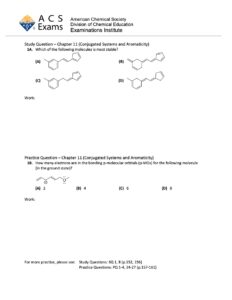
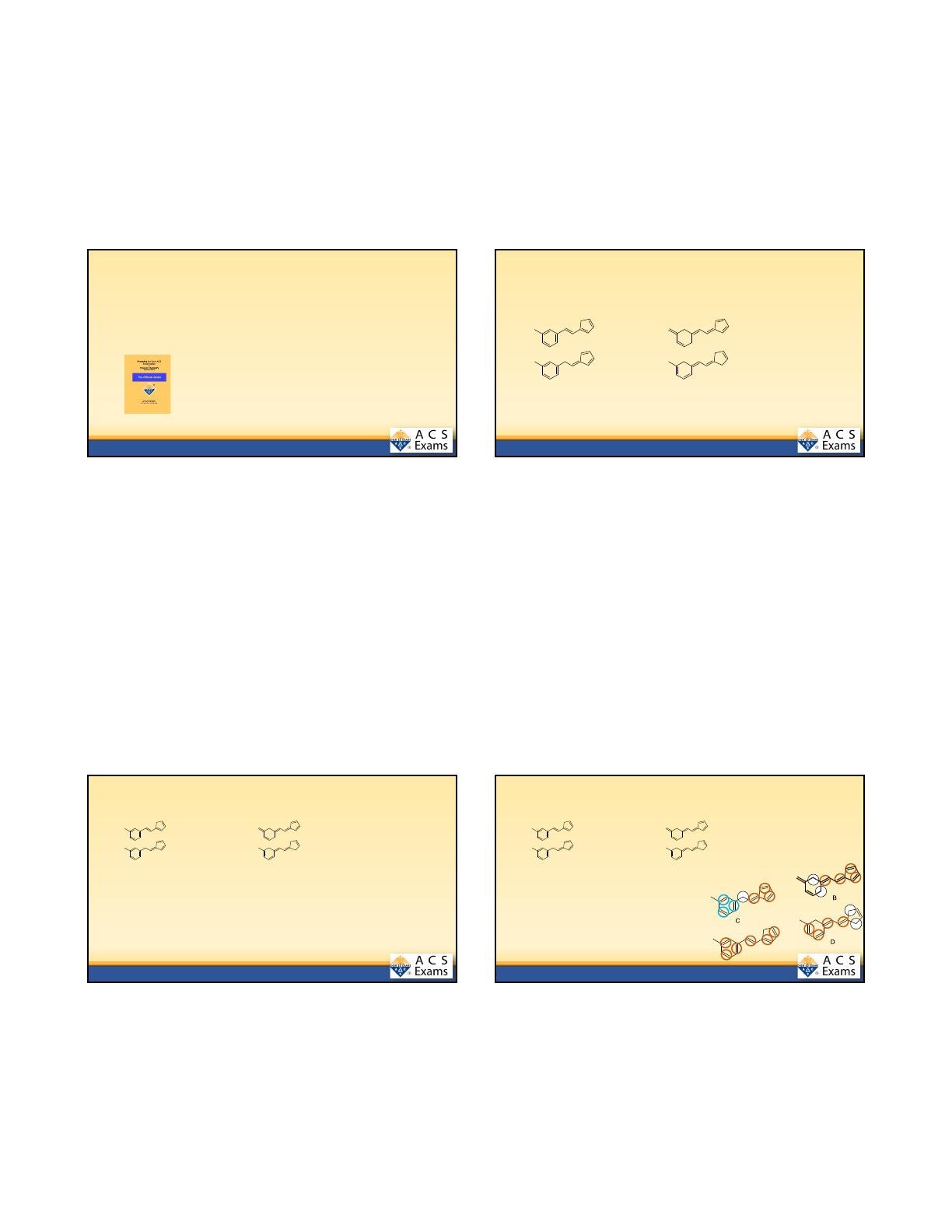
Conjugated Systems and Aromaticity: Question #1
ACS Exams, Organic Chemistry-Second Term Exam Practice
Which of the following molecules is most stable?
(A)
(B)
(C)
(D)
2
Conjugated Systems and Aromaticity: Question #1
The correct answer is (A)
Yo u no ti ce t ha t al l o f th es e co m po un ds c o nt ai n p bonds.
This question is really asking you which of these molecules is MOST CONJUGATED. The more extended the conjugated
p-system the more stable the molecule.
Recall that sp
3
-hybridized carbon atoms will disrupt the conjugated system.
We can now assess the quantity of conjugated p bonds in each response.
Which of the following molecules is most stable?
(A)
(B)
(C)
(D)
ACS Exams, Organic Chemistry-Second Term Exam Practice
3
Conjugated Systems and Aromaticity: Question #1
The correct answer is (A)
Response (B) has 4 conjugated p bonds.
Note that sp
3
-hybridized carbon atoms disrupt the conjugated system.
Response (C) has 2 sets of 3 conjugated p bonds.
Note that sp
3
-hybridized carbon atoms disrupt the conjugated system.
Response (D) has 4 conjugated p bonds.
Note that sp
3
-hybridized carbon atoms disrupt the conjugated system.
Response (A) has 6 conjugated p bonds and is therefore the correct answer.
Note that sp
3
-hybridized carbon atoms disrupt the conjugated system.
Which of the following molecules is most stable?
(A)
(B)
(C)
(D)
A
ACS Exams, Organic Chemistry-Second Term Exam Practice
4
5/7/26
2
Conjugated Systems and Aromaticity: Question #1
For more practice, see: Chapter 11, Study questions: SQ1, 8 (p. 152-156)
Chapter 11, Practice questions: PQ1-4, 24-27 (p. 157-161)
Practice Question:
How many electrons are in the bonding p
-
molecular orbitals
(p
-MOs) for the following molecule (in the ground state)?
(A)
2
(B)
4
(C)
6
(D)
8
The correct answer is (B) 4
ACS Exams, Organic Chemistry-Second Term Exam Practice
5
Conjugated Systems and Aromaticity: Question #2
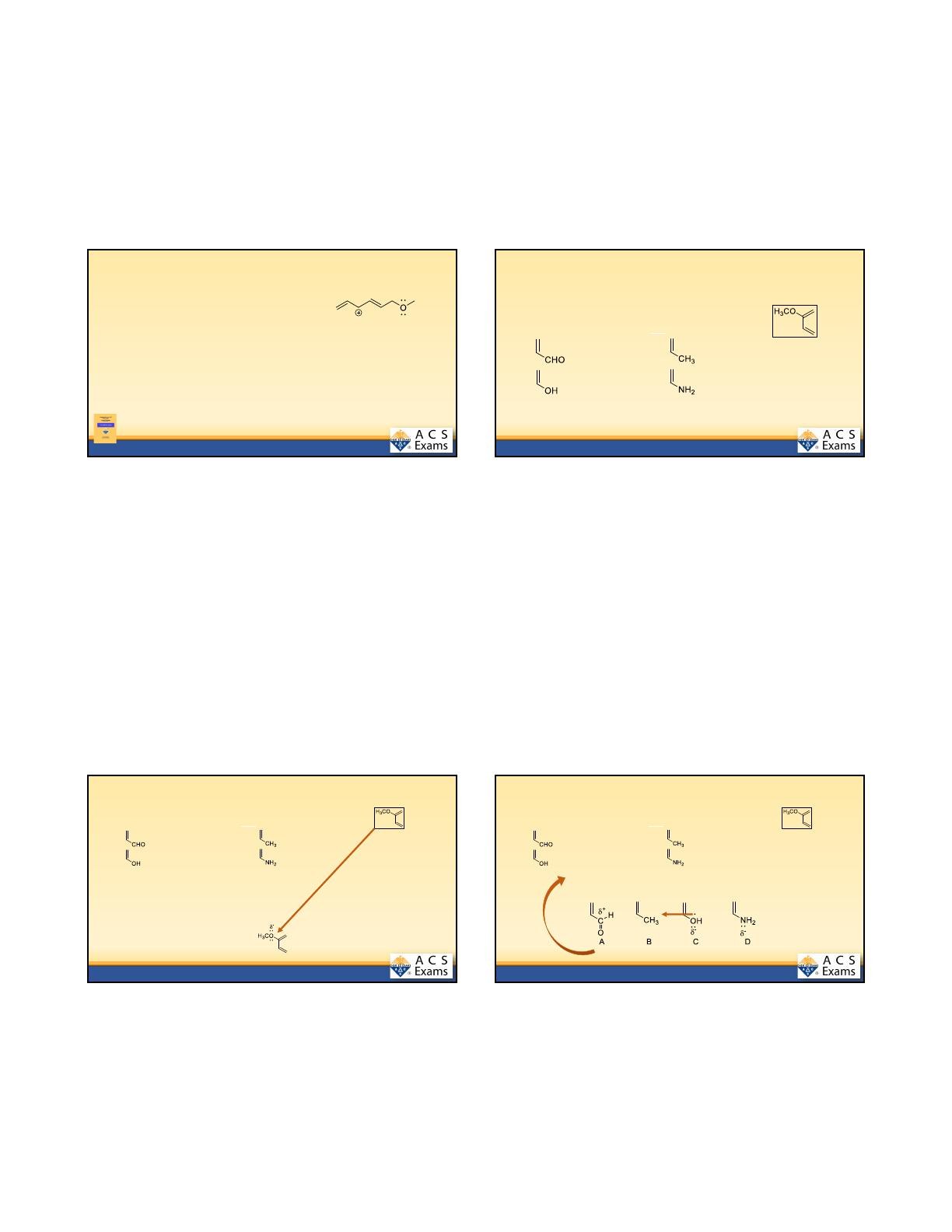
From the standpoint of reactivity, which is the best dienophile to react with
the following diene in a Diels
-Alder reaction?
(A)
(B)
(C)
(D)
ACS Exams, Organic Chemistry-Second Term Exam Practice
6
Conjugated Systems and Aromaticity: Question #2
The correct answer is (A)
For this question you recall that for a Diels-Alder reaction you want to match the electrostatics for the 2 reactants.
Yo u wa nt o n e to c on ta i n el ec tr on wi th dr aw in g g ro up s (E WG s ) wh il e t he o th er co nt ai ns e le ct ro n do n at in g gr ou p s (E DG s) .
The given diene has an EDG (the oxygen is d
-
) so we are looking for a response which has an EWG.
From the standpoint of reactivity, which is the best dienophile to react with the following
diene in a Diels
-Alder reaction?
(A)
(B)
(C)
(D)
ACS Exams, Organic Chemistry-Second Term Exam Practice
7
Conjugated Systems and Aromaticity: Question #2
The correct answer is (A)
From the last slide we know we are searching for a response which contains an Electron Withdrawing Group (EWG).
From the standpoint of reactivity, which is the best dienophile to react with the following
diene in a Diels
-Alder reaction?
(A)
(B)
(C)
(D)
“R” groups are
EDG by induction
EWG EDG EDG EDG
ACS Exams, Organic Chemistry-Second Term Exam Practice
8
5/7/26
3
Conjugated Systems and Aromaticity: Question #2
For more practice, see: Chapter 11, Study questions: SQ6, 8 (p. 155-156)
Chapter 11, Practice questions: PQ16-21, 24-27 (p. 159-161)
Practice Question:
How many electrons are in the conjugated π
-system of this molecule?
(A)
6
(B)
8
(C)
10
(D)
12
The correct answer is (B) 8
ACS Exams, Organic Chemistry-Second Term Exam Practice
9
Conjugated Systems and Aromaticity: Question #3
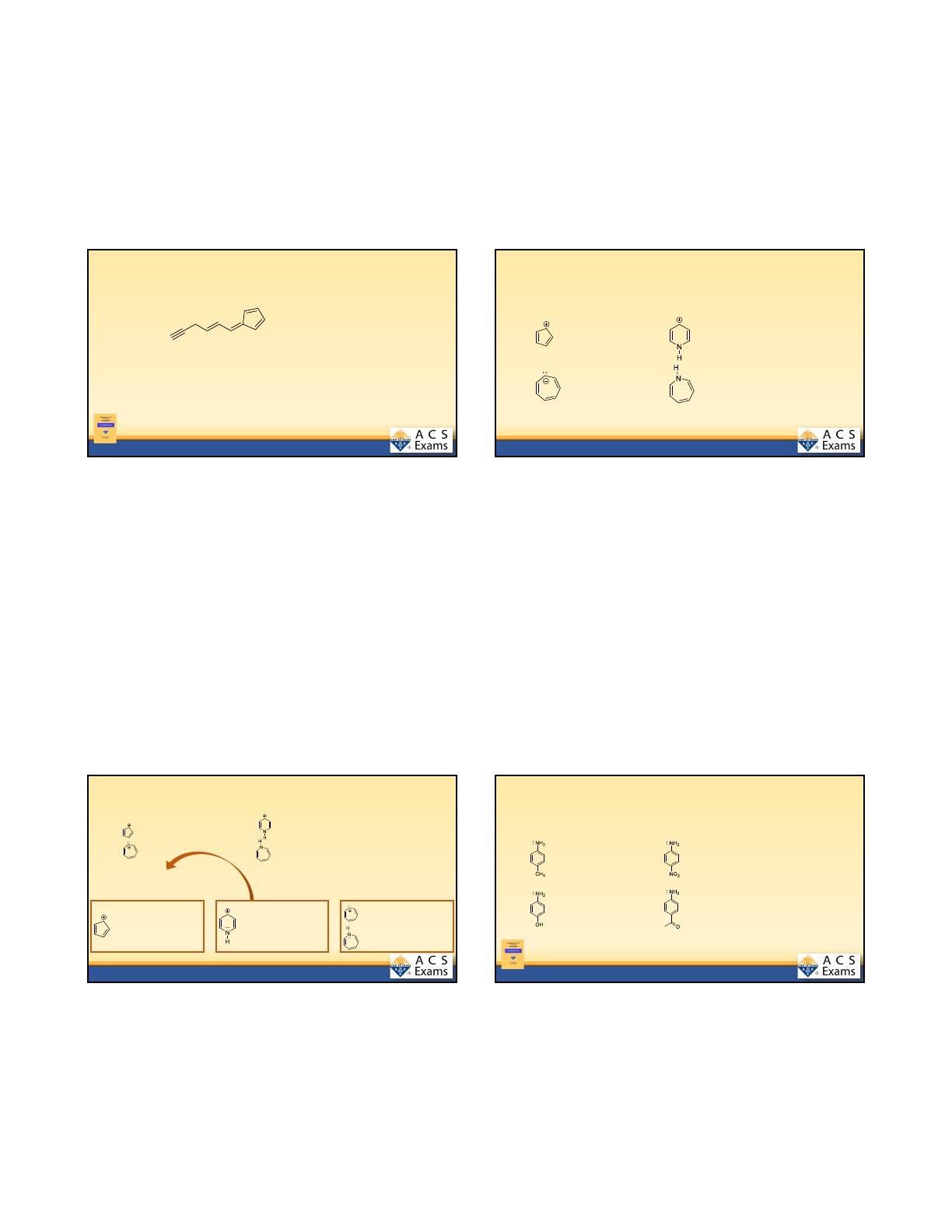
Which of the following is aromatic?
(A)
(B)
(C)
(D)
ACS Exams, Organic Chemistry-Second Term Exam Practice
10
(B) the carbocation contains an
empty P-orbital, and we count the
electrons on the nitrogen. 6 p
electrons is aromatic.
Conjugated Systems and Aromaticity: Question #3
The correct answer is (B)
For this question we must evaluate all the molecules and apply Huckel’s rule to decide which one satisfies the requirements.
Which of the following is aromatic?
(A)
(B)
(C)
(D)
(A) the carbon with the carbo-
cation contains an empty p-orbital.
This molecule has 4 p electrons
and is antiaromatic.
(C) and (D) are both 7-membered
rings containing 8 p-electrons.
Both break Huckel’s rule. Since 8 p
electrons would be antiaromatic,
these rings likely pucker and are
not flat, thus are non aromatic.
ACS Exams, Organic Chemistry-Second Term Exam Practice
11
Conjugated Systems and Aromaticity: Question #3
For more practice, see: Chapter 11, Study questions: SQ2, 4 (p. 152-154)
Chapter 11, Practice questions: PQ5-8, 12-13 (p. 158-159)
Practice Question:
The correct answer is (C)
Which of the following amines is most basic?
(B)
(D)
ACS Exams, Organic Chemistry-Second Term Exam Practice
12
/ 14
End of Document
55

FAQs

What is the most stable molecule in conjugated systems according to the ACS exam practice?
The most stable molecule in conjugated systems is identified as option (A). This conclusion is drawn from the assessment of the number of conjugated p-bonds in each response. Molecule (A) has six conjugated p-bonds, making it the most stable compared to the others, which have fewer conjugated p-bonds and include sp3-hybridized carbon atoms that disrupt the conjugated system.
How many electrons are in the bonding p-molecular orbitals for a specific molecule?
According to the practice question in the document, the correct answer is (B) 4 electrons. This question assesses the understanding of the bonding p-molecular orbitals in the ground state of the specified molecule, emphasizing the importance of recognizing the number of electrons involved in the bonding.
Which dienophile is best for a Diels-Alder reaction with a given diene?
The best dienophile to react with the given diene in a Diels-Alder reaction is option (A). This is because the diene contains an electron-donating group (EDG), and the ideal dienophile should have an electron-withdrawing group (EWG). Matching the electrostatics of the two reactants is crucial for the reaction's success.
Which of the following amines is most basic according to the practice questions?
The correct answer for the most basic amine is (C). This assessment involves evaluating the basicity of different amines based on their structural characteristics and the influence of substituents on their ability to accept protons.
What is the major product of a Friedel-Crafts alkylation reaction?
The major product of the Friedel-Crafts alkylation reaction is identified as option (C). In this context, the reaction occurs on an activated ring, which directs the addition of the methyl group to the ortho and para positions, leading to the correct product formation.
What role does the hydroxide ion play in a condensation reaction?
In the given condensation reaction, the hydroxide ion acts as a catalytic base. This role is significant as it facilitates the reaction without being consumed, aiding in the formation of the product through deprotonation steps.
How do you rank compounds in increasing reactivity with cyanide anion?
The correct ranking of compounds in increasing rate of reaction with cyanide anion is (C) II < IV < III < I. This ranking is based on the reactivity of aldehydes versus ketones, with aldehydes being more reactive due to steric and electronic factors influencing the carbonyl carbon's electrophilicity.