CHM203 Organic Chemistry II focuses on the principles of organic chemistry, including bonding, molecular structure, and physical properties of compounds. This study guide is designed for students preparing for exams in organic chemistry, covering essential topics such as intermolecular forces, hydrogen bonding, and acid-base theories. Key concepts include the melting and boiling points of various compounds, the effects of molecular weight on solubility, and the importance of resonance in aromatic compounds. Ideal for undergraduate chemistry students, this guide provides a comprehensive overview of organic chemistry principles and applications.

Key Points

  • Explains bonding and structural features of organic compounds
  • Covers physical properties including melting and boiling points
  • Details intermolecular forces such as hydrogen bonding and London forces
  • Discusses acid-base theories and their applications in organic chemistry
Yahaya Mary
28 pages
Language:English
Type:Study Guide
Yahaya Mary
28 pages
Language:English
Type:Study Guide
124
/ 28
PLEASE PATRONISE US FOR MORE SUMMARY, PAST QUESTION AND
TMA (30/30)
WHATSAPP 08024665051 Page 1
WINSMART ACADEMY
MOTTO: PERSONALISED TUTORING FOR LEADERS OF TOMORROW
WHATSAPP: 08024665051, 08169595996
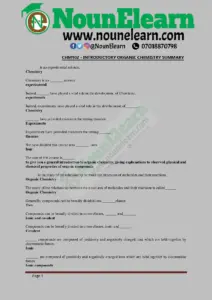
CHM203 ORGANIC CHEMISTRY II SUMMARY
The _______ and structural features of a compound are manifested in its
physical properties.
Bonding
The bonding and _______ features of a compound are manifested in its physical
properties.
Structural
The bonding and structural features of a _______ are manifested in its physical
properties.
Compound
The bonding and structural features of a compound are manifested in its
_______ properties.
Physical
The bonding and structural features of a compound are manifested in its
physical properties.
True
The physical properties of a compound include the following
melting point
boiling point
solubility
Conversely, if the _______ of a compound is known its physical properties can
be predicated.
Structure
PLEASE PATRONISE US FOR MORE SUMMARY, PAST QUESTION AND
TMA (30/30)
WHATSAPP 08024665051 Page 2
The physical properties of a compound depend upon the number and nature
of _______ constituting its structural units
Atoms
In _______compounds, the positive and negative ions are held together by
strong electrostatic forces.
Ionic
In ionic compounds, the positive and negative ions are held together by strong
_______ forces.
Electrostatic
In _______compounds, the molecules are held together by intermolecular
forces.
Covalent
In covalent compounds, the molecules are held together by _______forces.
Intermolecular
The three important intermolecular forces are:
(i) dipole-dipole interactions
(ii) London forces
(iii) Hydrogen bonding
_______ are defined as the interactions between the different molecules of a
compound having permanent dipoles.
Dipole-Dipole Interactions
The dipole-dipole interactions are weak interactions
True
The intermolecular interactions which exist between no polar molecules is
known as_______
London forces
When the molecules A and B approach each other, there is a distortion in the
distribution of the charge resulting in a small and momentary dipole in one
molecule. This small dipole can then create another dipole in the second
molecule which is called________.
Induced dipole
The induced dipole induced dipole interaction are also known as_______.

PLEASE PATRONISE US FOR MORE SUMMARY, PAST QUESTION AND
TMA (30/30)
WHATSAPP 08024665051 Page 3
London forces
______ occurs when a hydrogen atom is covalently bonded to a strongly
electronegative atom such as oxygen, nitrogen or fluorine.
Hydrogen Bonding
When a hydrogen atom has a large affinity for the non bonded electrons of
oxygen (or nitrogen or fluorine) atom of the other molecule. This type of
intermolecular interaction is known as_______
Hydrogen bonding
The strength of a hydrogen bond ranges from _______
10 to 40 kJ mol-1
The dipole-dipole, induced dipole-induced dipole interactions are collectively
known as _______ van der Waals forces
The ______ of a substance can be defined as the temperature at which it
undergoes the transition from the solid to the liquid state.
Melting point
Pure ______ solids have sharp melting points.
Crystalline
Pure crystalline solids have ______ melting points.
Sharp
________ solids have sharp melting points.
Pure crystalline
Pure crystalline solids have sharp _______ points.
Melting
Pure crystalline solids have sharp melting points.
True
Pure crystalline solids melt over a temperature range of_______
1
o
or less
_______ crystalline solids melt over wider ranges of temperatures.
Impure
/ 28
End of Document
124

FAQs

what are the key concepts in CHM203 Organic Chemistry II study guide

The CHM203 Organic Chemistry II study guide covers essential concepts in organic chemistry, including bonding, molecular structure, and physical properties of compounds.

  • Bonding: Understanding ionic and covalent bonds.
  • Physical Properties: Melting points, boiling points, and solubility.
  • Intermolecular Forces: Dipole-dipole interactions, London forces, and hydrogen bonding.
  • Acid-Base Theory: Arrhenius and Bronsted-Lowry definitions.

how to predict physical properties using CHM203 Organic Chemistry II study guide

The CHM203 Organic Chemistry II study guide explains how to predict physical properties based on the structure of a compound.

  • Knowing the structure allows for predictions about melting point, boiling point, and solubility.
  • For example, ionic compounds typically have high melting points due to strong electrostatic forces.
  • Covalent compounds have lower melting points, influenced by intermolecular forces.

what are the types of intermolecular forces in CHM203 Organic Chemistry II study guide

The CHM203 Organic Chemistry II study guide identifies three main types of intermolecular forces that influence the physical properties of compounds.

  • Dipole-Dipole Interactions: Occur between molecules with permanent dipoles.
  • London Forces: Weak interactions between nonpolar molecules.
  • Hydrogen Bonding: Strong interactions when hydrogen is bonded to electronegative atoms like oxygen or nitrogen.

what is the significance of resonance in CHM203 Organic Chemistry II study guide

Resonance is a crucial concept in the CHM203 Organic Chemistry II study guide, explaining the stability of certain molecules.

  • It allows for the representation of a molecule by multiple structures, known as resonance structures.
  • This concept is particularly important for understanding the stability of benzene and other aromatic compounds.
  • The energy difference between expected and actual heat values is termed resonance energy.

how does CHM203 Organic Chemistry II study guide explain acid-base theories

The CHM203 Organic Chemistry II study guide outlines key acid-base theories, including those proposed by Arrhenius and Bronsted-Lowry.

  • Arrhenius Theory: Defines acids as substances that produce hydrogen ions in solution.
  • Bronsted-Lowry Theory: Describes acids as proton donors and bases as proton acceptors.
  • This framework helps in understanding reactions and predicting the behavior of acids and bases in various contexts.

what are the melting points of common compounds in CHM203 Organic Chemistry II study guide

The CHM203 Organic Chemistry II study guide provides specific melting points for various compounds, which are essential for understanding their physical properties.

CompoundMelting Point (K)
Sodium Chloride1074
Methanol179
Propanone178

how is hydrogen bonding explained in CHM203 Organic Chemistry II study guide

Hydrogen bonding is a significant topic in the CHM203 Organic Chemistry II study guide, highlighting its role in molecular interactions.

  • It occurs when a hydrogen atom is covalently bonded to a highly electronegative atom like oxygen or nitrogen.
  • This type of bonding significantly influences the physical properties of compounds, such as boiling and melting points.
  • Hydrogen bonds are stronger than other intermolecular forces, making them crucial in biological systems.

what are the types of hydrocarbons discussed in CHM203 Organic Chemistry II study guide

The CHM203 Organic Chemistry II study guide discusses various types of hydrocarbons, which are foundational in organic chemistry.

  • Aliphatic Hydrocarbons: These include alkanes, alkenes, and alkynes.
  • Aromatic Hydrocarbons: Compounds like benzene and its derivatives.
  • Understanding these types helps in predicting reactivity and properties of organic compounds.

how does branching affect the solubility of compounds in CHM203 Organic Chemistry II study guide

The CHM203 Organic Chemistry II study guide explains that branching in carbon chains affects solubility.

  • Branched isomers tend to have higher solubility compared to their straight-chain counterparts.
  • This is due to reduced intermolecular forces in branched structures, allowing for easier interaction with solvents.
  • As molecular weight increases, solubility generally decreases, particularly in homologous series.

what is the role of the Henderson-Hasselbalch equation in CHM203 Organic Chemistry II study guide

The Henderson-Hasselbalch equation is an important tool discussed in the CHM203 Organic Chemistry II study guide for understanding acid-base equilibria.

  • This equation relates pH to the pKa and the concentrations of the acid and its conjugate base.
  • It is useful for predicting the behavior of weak acids and bases in biological systems.
  • By applying this equation, students can calculate the pH of buffer solutions effectively.