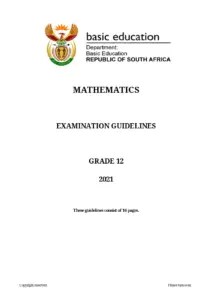
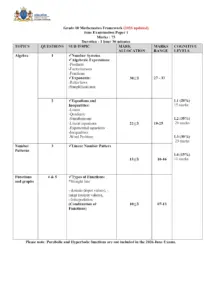
Grade 11 Mathematics Examination Guidelines 2015 provides a comprehensive framework for educators and students preparing for mathematics assessments. It outlines the assessment structure, cognitive levels, and acceptable reasoning for Euclidean geometry. This guide is essential for teachers and learners aiming to excel in their final examinations. Key topics include algebra, functions, and geometry, ensuring thorough preparation for the Grade 11 curriculum. Ideal for students seeking to understand the examination format and content expectations.

Key Points

  • Outlines assessment structure for Grade 11 Mathematics
  • Covers cognitive levels and marking guidelines
  • Includes acceptable reasoning for Euclidean geometry
  • Essential for final examination preparation
Celokuhle Ntloko
Edition:2015
12 pages
Language:English
Type:Study Guide
Celokuhle Ntloko
Edition:2015
12 pages
Language:English
Type:Study Guide
334
/ 12
,-ffi,
irepartment:
i,\|1
rlt
Basic
Education
}r.
.\l
.c ErEf)r rDr tA A?
\#7
REPUBLTC
oF
souTH
AfrRrcA
MATHElVIATICS
EXA
i\{
TNATIO]\
G
UID
E
tr,INES
GRADE
1
I
201
s
These
guidelines
consist
ol l2 pagcs.
i.'op)
riBht
rssicr!,ed
Pleast'lum
trrq
Malhematjcs/Crade
I
I
CO]\TENTS
CRAPTER
I:
C]{APTER
2:
CIIApTER
3r
C'IIAP'TER
4:
C[{;tPTER
5:
CHAPTER
6r
:
llxa-n
ination
Grridelines
lntroduction
.{ssessrneaa
in
Grade
Il
1;91nt3.of
Cuesric,n
papers
for
Crade
I
J
werghlin,g
of
cogniiive
levels
Elaborarion
of
Content
for
Grade
I
n (CAPS)
Acceptable
rea.sot.ts:
Euclitlean
Geonretry
Guidelines
for
nrarking
Conclusion
DlJIr./201.5
Pager
3
)1
))
9
i2
12
P;ezsg
lurD
ovcr
Ccpyrl6;ht
resen,erj
I.
IN,I'I{ODUCTION
l-he
cu'iculum
and
Asse'ssnrent
Policy
Statement
i'cApS)
for
Matfrenratics
outlines
Lrc
nature
and
ll'3:l;.,f.tlr'r,'loJ,..J,Yti;ff|'i:'rr,i'
!'ia.,'
tl,. pr,ii","p"i,",,na.,ryine
the
teaching
and
The
purposc
of
these
E,xamination
Guidelines
is
to:
n
Provide
cliiriry*
on
the-depth,and
scope
of the
oontent
to
be
assessr:d
in
the
Grade
lr
comnt.,n
natirinal
examination
in
Mathematic..
o
Arislst
teache
rs
to
adEquafeiy
prepare
learncrs
flrr
the
exarninatic,ns,
J,i
l$il'Hl.:i*.::':$i[i,1ru*o'
I I
final
examinations.
It croes
nor
dear
,n
any
deprh
rvirh
These
llxamination
Guidelines
sbould
bc
read
in
conjunction
wi*r:
'
il)ir}i''illffiIfiutun't
Statement
NCs)
()urricutun
and
As:;essmenr
poticy
Statement
"
Th,:
National
protocoi
of
Assessmen
t:
An
arltlendunr
to
the politryt
4esyaem,
rhe
l\utional
senic)r
certificate;
A
qualiJication
at
Levet
'l
on
the
l,{ational
eualifcariotts
Frcnrework
1Nl,)I;'),
regrtrding
the
lVarional
protocoljor
Assessmen!
(Grades
R_.1
2)
"
'fhe
national
policy
pertaininglo
the progruro,.
and promotior
rerlulrements.f
the
National
Culriculunr
Staternent,
Grades
R_l
2
lncluded
in
this
cocument
is
a list
of
Euclidean
Geometry
reasons
whrch
should
be
used
as
a
gurdeiine
when
teaching
learners
Euclidean
Geomerry
\lalherx3tl
;5iq]126g
1 1
Copyrighr
ret;erved
3
Flxaminati
on
Guidelines
DBE/2015
Plr:ase
1p;n
ou.t
/ 12
End of Document
334

FAQs

what is Grade 11 Mathematics Examination Guidelines 2015

The Grade 11 Mathematics Examination Guidelines 2015 outline the curriculum and assessment policy for mathematics at this level.

  • They provide clarity on the content to be assessed.
  • Guidelines assist teachers in preparing learners for final examinations.
  • They include cognitive levels and acceptable reasoning in geometry.

how to prepare for Grade 11 Mathematics Examination Guidelines 2015

Preparing for the Grade 11 Mathematics Examination Guidelines 2015 involves understanding the curriculum and focusing on key areas outlined in the guidelines.

  • Review the assessment structure, including two external papers.
  • Focus on cognitive levels: knowledge, routine procedures, complex procedures, and problem-solving.
  • Practice with past papers and sample questions that align with the guidelines.

what topics are covered in Grade 11 Mathematics Examination Guidelines 2015

The Grade 11 Mathematics Examination Guidelines 2015 cover a variety of essential topics in mathematics.

  • Functions and Graphs
  • Algebra, Equations, and Inequalities
  • Euclidean Geometry
  • Trigonometry
  • Statistics and Probability

what are the cognitive levels in Grade 11 Mathematics Examination Guidelines 2015

The cognitive levels in the Grade 11 Mathematics Examination Guidelines 2015 are crucial for understanding how questions are structured.

  • Knowledge: Recall of facts and basic concepts.
  • Routine Procedures: Application of known methods to solve problems.
  • Complex Procedures: Multi-step problems requiring deeper understanding.
  • Problem Solving: Non-routine problems that require innovative thinking.

what is the assessment format in Grade 11 Mathematics Examination Guidelines 2015

The assessment format in the Grade 11 Mathematics Examination Guidelines 2015 consists of two external papers.

  • Paper 1 focuses on Algebra, Functions, and Graphs.
  • Paper 2 covers Geometry, Trigonometry, and Statistics.
  • Each paper is designed to test different cognitive levels and skills.

what are acceptable reasons in Euclidean Geometry according to Grade 11 Mathematics Examination Guidelines 2015

Acceptable reasons in Euclidean Geometry are crucial for justifying answers in the Grade 11 Mathematics Examination Guidelines 2015.

  • Lines and angles: Properties of parallel lines and transversal angles.
  • Triangles: Congruence criteria such as SSS, SAS, and AAS.
  • Circles: Properties related to chords, tangents, and angles subtended by arcs.

how is problem-solving assessed in Grade 11 Mathematics Examination Guidelines 2015

Problem-solving is assessed in the Grade 11 Mathematics Examination Guidelines 2015 through various cognitive levels.

  • Students are expected to tackle non-routine problems.
  • Assessment includes applying knowledge to unfamiliar situations.
  • Higher-order reasoning is emphasized, requiring connections between different mathematical concepts.

what are the key tips for Grade 11 Mathematics Examination Guidelines 2015

Key tips for succeeding in the Grade 11 Mathematics Examination Guidelines 2015 include focused study and practice.

  • Understand the curriculum and key topics thoroughly.
  • Practice past examination papers to familiarize yourself with the format.
  • Work on time management during practice to improve efficiency.

how to interpret the cognitive levels in Grade 11 Mathematics Examination Guidelines 2015

Interpreting cognitive levels in the Grade 11 Mathematics Examination Guidelines 2015 helps in understanding the depth of knowledge required.

  • Knowledge: Basic recall of concepts.
  • Routine Procedures: Familiar methods applied to solve problems.
  • Complex Procedures: Multi-step calculations requiring deeper understanding.
  • Problem Solving: Innovative approaches to new problems.

what is the importance of the Grade 11 Mathematics Examination Guidelines 2015

The importance of the Grade 11 Mathematics Examination Guidelines 2015 lies in their role in standardizing assessment and teaching practices.

  • They ensure consistency across different schools and educators.
  • Help in preparing students effectively for examinations.
  • Provide a framework for evaluating student understanding and skills.