The ACS Organic Chemistry Second Term Exam Practice provides students with a comprehensive set of practice questions designed to mirror the style of actual ACS exams. This resource covers essential topics such as conjugated systems, aromaticity, and carbonyl chemistry, helping students prepare effectively for their second-semester organic chemistry exams. Each question is accompanied by detailed explanations and references to relevant chapters in the ACS Organic Chemistry Study Guide, making it an invaluable tool for exam preparation. Ideal for students looking to enhance their understanding and performance in organic chemistry, this practice exam includes a variety of question types to test knowledge and application skills.
Key Points
Includes practice questions on conjugated systems and aromaticity for ACS exam prep
Covers carbonyl chemistry with detailed explanations for each question
References specific chapters in the ACS Organic Chemistry Study Guide for further study
Designed for students preparing for their second-semester organic chemistry exams

This link leads to an external site. We do not know or endorse its content, and are not responsible for its safety. Click the link to proceed only if you trust this site.
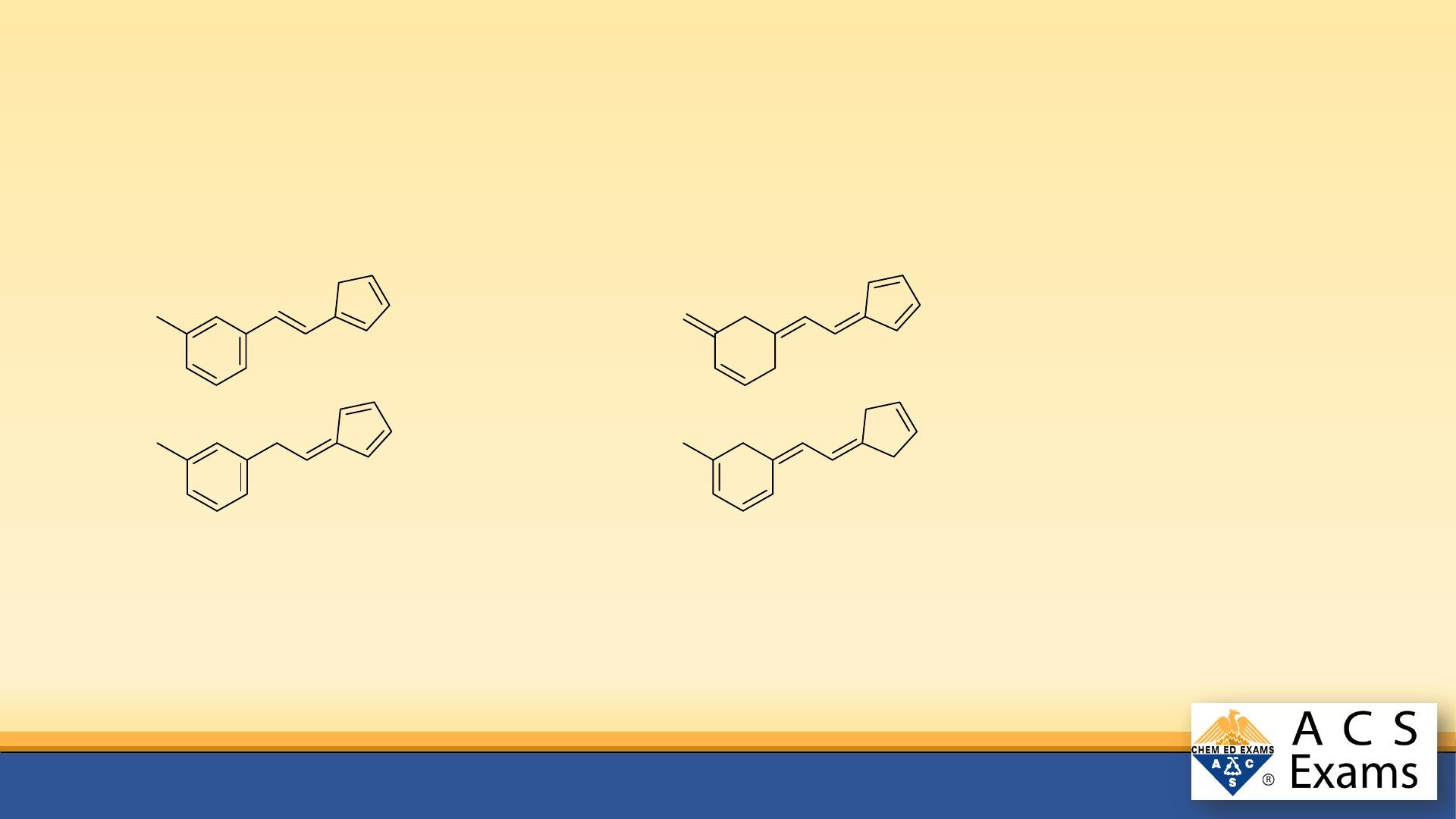
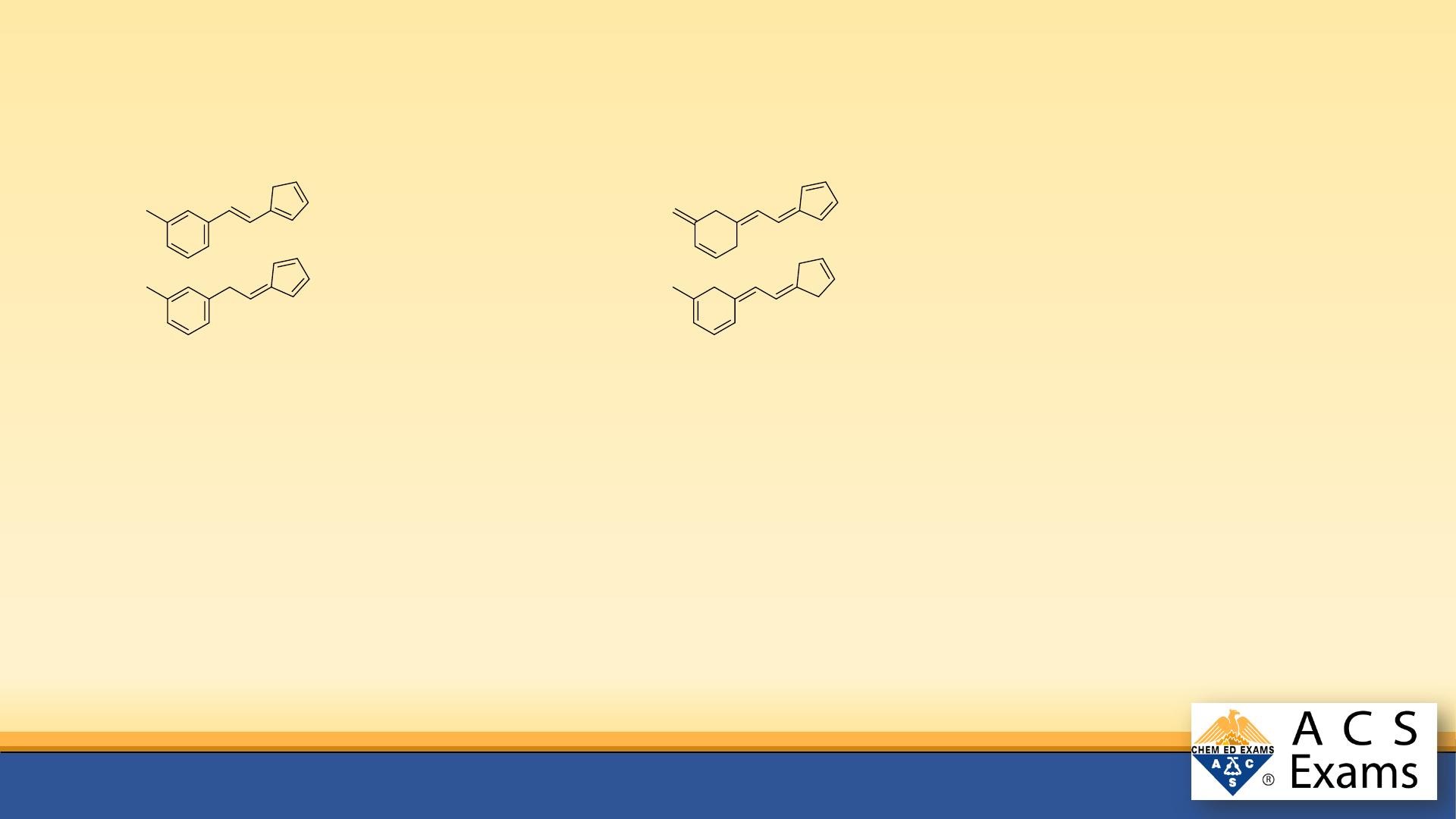
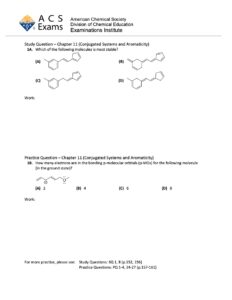
Which molecules are most stable in conjugated systems?
In the context of conjugated systems and aromaticity, the stability of molecules is determined by the extent of their conjugation. The document indicates that response (A) has the highest stability with 6 conjugated π-bonds, making it the most stable option. In contrast, responses (B) and (D) each contain 4 conjugated π-bonds, while response (C) has 2 sets of 3 conjugated π-bonds. The presence of sp3-hybridized carbon atoms disrupts the conjugated system, further emphasizing the stability of response (A).
What is the best dienophile for a Diels-Alder reaction?
According to the document, the best dienophile to react with a given diene in a Diels-Alder reaction is response (A), which contains a carbonyl group (CHO). This choice is based on the need to match the electrostatics of the reactants, where one must have electron-withdrawing groups (EWGs) and the other electron-donating groups (EDGs). The diene mentioned has an EDG due to the presence of oxygen, making the EWG in response (A) the most compatible for a successful reaction.
How many electrons are in the conjugated π-system of a molecule?
The document poses a question regarding the number of electrons in the conjugated π-system of a specific molecule, with the correct answer being 8. This highlights the importance of understanding the structure and electron distribution within conjugated systems. Recognizing the total number of electrons involved in the π-systems is crucial for predicting reactivity and stability in organic chemistry.
Which compounds are aromatic according to Huckel's rule?
In evaluating aromatic compounds, the document identifies response (B) as the only aromatic molecule. This conclusion is drawn from applying Huckel's rule, which states that a compound must have a planar structure with a specific number of π-electrons (4n + 2). The other responses either contain too few or too many π-electrons, thus failing to meet the criteria for aromaticity.
What is the major product of a Friedel-Crafts alkylation?
The document explains that in a Friedel-Crafts alkylation reaction, the major product is determined by the reactivity of the aromatic ring. Specifically, the reaction proceeds on the activated ring, which contains an electron-donating group (EDG). The product is formed by substituting the alkyl group onto the ring at the ortho or para positions, as activating groups direct the addition. This understanding is essential for predicting outcomes in electrophilic aromatic substitution reactions.
What factors affect the reactivity of carbonyl compounds with cyanide?
The document discusses the reactivity of carbonyl compounds with cyanide anion, emphasizing that aldehydes are generally more reactive than ketones. This increased reactivity is attributed to both electronic and steric factors, where the carbonyl carbon is the electrophile. The presence of electron-donating groups stabilizes the carbonyl, making aldehydes more susceptible to nucleophilic attack compared to ketones, which are less reactive due to steric hindrance.
What is the role of hydroxide ion in condensation reactions?
In the context of condensation reactions, the document states that hydroxide ion acts as a catalytic base. Its role is to facilitate the reaction by deprotonating the substrate, thereby promoting the formation of the enolate ion. This step is crucial for the subsequent nucleophilic attack on the carbonyl carbon, ultimately leading to the formation of the desired product in the condensation process.
Related
PDFStudy Guide
Practice EKG Strips with Answers for Medical StudentsStudy Guide
PDF
Secondary School Examination Class X Results 2026
PDF
2021 USNCO Local Section Chemistry Olympiad Exam
PDF
Organic Chemistry ACS Sample Questions
PDF
CH142 S26 Exam 1 Sample Solutions for Chemistry Students
PDF
CH142 Spring 2026 Exam 3 Learning Goals for Chemistry
PDF
Math 10C Practice Exam on Numbers, Radicals, and Exponents
PDF
Advanced Organic Chemistry Part B by Carey and Sundberg
PDF
Advanced Organic Chemistry Part B Reactions and Synthesis
PDF
AP Human Geography Exam 1 Practice Questions and Answers
PDF
AP World History CED Practice Exam 2024 Edition
PDF
AP Calculus AB 2018 International Practice Exam Scoring Guidelines