AP Physics 1 Unit 3 MCQ Scoring Guide provides a comprehensive overview of multiple-choice questions and answers for the AP Physics 1 exam. It includes detailed explanations of concepts related to energy, motion, and gravitational potential energy. This guide is essential for students preparing for the AP Physics 1 exam, helping them understand the scoring criteria and rationales behind each answer. It covers various topics, including kinetic energy changes, work done by forces, and gravitational interactions, making it a valuable resource for effective exam preparation.

Key Points

  • Includes multiple-choice questions and answers for AP Physics 1 Unit 3
  • Explains concepts of kinetic energy, work, and gravitational potential energy
  • Provides detailed rationales for each answer to aid understanding
  • Essential resource for AP Physics 1 exam preparation
newtopiccyclegrowin
13 pages
Language:English
Type:Study Guide
newtopiccyclegrowin
13 pages
Language:English
Type:Study Guide
247
/ 13
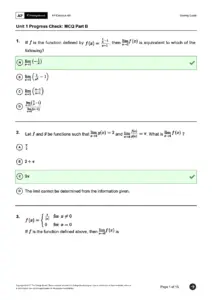
1.
A hawk with mass dives straight downward. At time , the hawk has a speed of . At time , the
hawk has a speed of
. The change in the kinetic energy of the hawk between and is most nearly
(A)
(B)
(C)
(D)
Answer C
Correct. The change in kinetic energy is equal to the difference between the final and initial kinetic
energy.
2.
A block is initially at rest on a rough, horizontal tabletop. A student then pulls the block across the tabletop
with a constant horizontal force of
. After being pulled a distance of , the speed of the block is .
The amount of energy dissipated by friction between the block and the tabletop is most nearly
(A)
(B)
(C)
(D)
Answer C
Correct. The student does positive work on the block. The magnitude of the work done is
. The increase in the kinetic energy of the block is
. Therefore, friction dissipated an
amount of energy equal
.
AP PHYSICS 1 Scoring Guide
Unit 3 Progress Check: MCQ
AP Physics 1
Page 1 of 13
3.
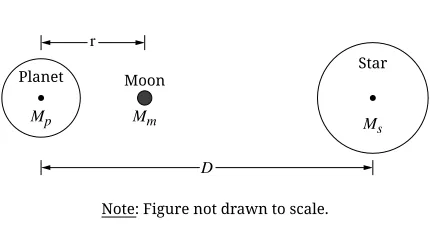
A planet, a moon, and a star are aligned as shown. The moon has mass and is a distance from the center of
the planet. The planet has mass and is a distance from the center of the star of mass . Which of the
following is a correct expression for the total gravitational potential energy of this three-body system?
(A)
(B)
(C)
(D)
Answer D
Correct. The total gravitational potential energy is the sum of the potential energy between each pair of
objects. The gravitational potential energy is proportional to the product of the masses of the two objects
and inversely proportional to the distance between the centers of the objects.
.
Scoring Guide
Unit 3 Progress Check: MCQ
Page 2 of 13
AP Physics 1
4.
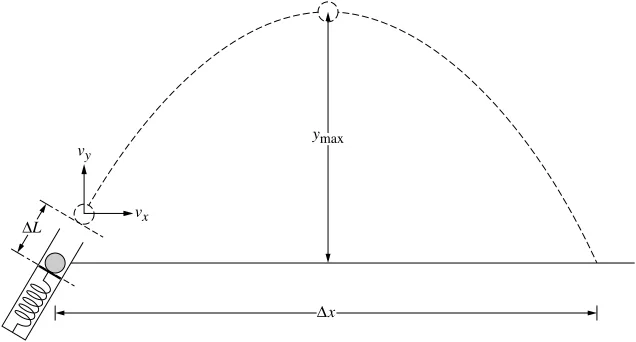
A ball of mass is loaded into a launcher with a spring of spring constant . The ball is pushed down until it is at a
vertical position , and the spring is compressed a distance , as shown. The ball is then released from rest.
Immediately after leaving the launcher, the
- and -components of the ball’s velocity are and , respectively.
The ball reaches a maximum height of
and lands a horizontal distance away from its initial position.
Energy losses due to friction are negligible. Which of the following is a correct conservation of energy equation that
compares the total mechanical energy of the ball-spring-Earth system immediately before the ball is launched to the
total mechanical energy of the ball-spring-Earth system the moment the ball reaches its maximum height?
(A)
(B)
(C)
(D)
Answer C
Correct. The left side of this equation represents the total mechanical energy of the ball-spring-Earth
system when the spring is compressed. The ball is at a vertical position of
, so the gravitational
potential energy is taken to be zero, and the ball is at rest so there is no kinetic energy. The right side of
the equation represents the mechanical energy of the ball-spring-Earth system when the ball at its highest
point, which includes the gravitational potential energy and the kinetic energy of the horizontal motion.
5.
At time
, a cart with mass being pushed on a straight, level track has speed . A short time later at , the cart
has speed . Which of the following expressions is equal to the average power delivered to the cart between time
and ?
Scoring Guide
Unit 3 Progress Check: MCQ
AP Physics 1
Page 3 of 13
/ 13
End of Document
247

FAQs

What is the relationship between kinetic energy and speed in AP Physics 1?
Kinetic energy is proportional to the mass of an object times the square of its speed. This relationship indicates that as the speed of an object increases, its kinetic energy increases exponentially. For example, if the speed doubles, the kinetic energy increases by a factor of four, given that mass remains constant. This principle is illustrated in the scoring guide, where it discusses the kinetic energy of cars moving at different speeds.
How does gravitational potential energy change in a three-body system?
In a three-body system, the total gravitational potential energy is expressed as the sum of the potential energy between each pair of objects. The potential energy is proportional to the product of the masses of the two objects and inversely proportional to the distance between their centers. This concept is crucial for understanding gravitational interactions in systems involving planets, moons, and stars, as detailed in the scoring guide.
What is the significance of work done by friction in energy calculations?
The work done by friction is significant because it represents energy dissipated in a system. In the context of the scoring guide, when a block is pulled across a surface, the work done by the student is countered by the energy lost to friction. This means that the energy dissipated due to friction can be calculated by comparing the work done on the block to its change in kinetic energy. Understanding this relationship is essential for solving problems related to energy conservation.
How does the acceleration of a spaceship affect its kinetic energy?
When a spaceship experiences acceleration that is directed opposite to its velocity, its kinetic energy must be decreasing. This is because the acceleration reduces the speed of the spaceship, and since kinetic energy is proportional to the square of the speed, any decrease in speed results in a decrease in kinetic energy. This principle is highlighted in the scoring guide, emphasizing the relationship between acceleration, speed, and kinetic energy.
What determines the power delivered to an object in motion?
Power delivered to an object is determined by the rate of energy transfer to that object. In the scoring guide, it is explained that power can be calculated as the product of force and velocity. For instance, if an object is moving at a constant speed while a force is applied, the power can be expressed as P = Fv. This relationship is crucial for understanding how energy is transferred in mechanical systems.
What factors affect the gravitational potential energy of a block on a ramp?
The gravitational potential energy of a block on a ramp depends on the height of the block above a reference point and its mass. As the block moves up the ramp, its height increases, leading to an increase in gravitational potential energy. The scoring guide illustrates that the change in gravitational potential energy is directly related to the weight of the block and the change in height, which is critical for energy conservation problems.
How do forces affect the energy of a spring in a system?
In a system where a spring is involved, the potential energy of the spring is only zero when it is at its equilibrium length. If a force is applied to stretch or compress the spring, it will exert a force on the connected objects, affecting their kinetic energy. The scoring guide explains that if a block is accelerating, the spring must be stretched beyond its equilibrium length, indicating that potential energy is present in the system.