

Organic chemistry is the scientific discipline centered on the structure, properties, composition, reactions, and synthesis of carbon-containing compounds. Far from being restricted to the study of living matter, organic chemistry spans an incredible array of synthetic materials, pharmaceuticals, polymers, and petrochemicals. The unique capacity of carbon to form stable covalent bonds with itself—a property known as catenation—allows for the generation of virtually limitless structural arrangements, ranging from simple linear alkanes to intricate three-dimensional molecular architectures. On Chesser Resources, a vast repository of advanced organic chemistry study guides, mechanism roadmaps, and electron-pushing exercises is available to help students navigate this visually demanding and highly logical field.
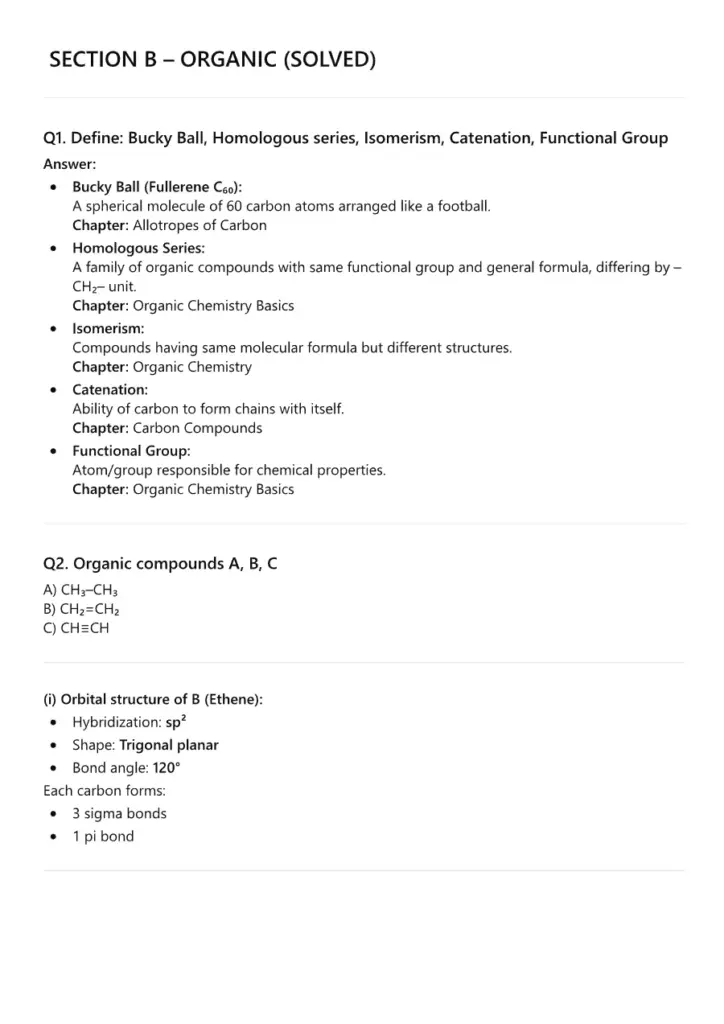
The underlying structural framework of organic compounds is governed by quantum mechanical orbital hybridization. Carbon possesses four valence electrons, which undergo hybridization to form $sp^3$, $sp^2$, or $sp$ hybrid orbitals depending on the number of neighboring atoms it binds to. An $sp^3$ hybridized carbon, characteristic of alkanes, adopts a tetrahedral geometry with bond angles of approximately $109.5^\circ$, utilizing four single $\sigma$ (sigma) bonds. When carbon forms double or triple bonds, as seen in alkenes ($sp^2$) and alkynes ($sp$), it incorporates unhybridized $p$ orbitals to build lateral $\pi$ (pi) bonds, giving rise to planar and linear geometries that fundamentally dictate the spatial orientation and physical properties of the molecule.
Functional groups represent the highly reactive, predictable epicenters of organic molecules, shifting the chemistry away from inert hydrocarbon scaffolds. These specific clusters of atoms—such as hydroxyl groups (alcohols), carbonyls (aldehydes and ketones), carboxyls (carboxylic acids), and aminos (amines)—exert a powerful influence over intermolecular forces, solubility, boiling points, and chemical reactivity. Organic synthesis and reactivity are completely organized around the transformation of these functional groups, where the differences in electronegativity between carbon and heteroatoms like oxygen, nitrogen, and halogens establish distinct dipoles, turning certain carbons into attractive targets for chemical attack.
Stereochemistry introduces the critical third dimension to organic architecture, exploring how molecules with identical atom-to-atom connectivity differ in their spatial orientations. This field isolates the study of chirality, which occurs when a carbon atom is bonded to four distinct substituents, forming a stereocenter. Such molecules exist as non-superimposable mirror images called enantiomers, which share identical physical properties like melting points but interact with polarized light and biological systems in completely opposite ways. Recognizing the subtle distinctions between enantiomers, diastereomers, and meso compounds is paramount, particularly in pharmacology, where one spatial arrangement of a drug can heal while its mirror image may cause toxic side effects.
The language of organic chemistry is written through reaction mechanisms, which track the precise, step-by-step movement of valence electrons during a chemical transformation. Using curved electron-pushing arrows, chemists map how electron-rich species (nucleophiles) donate electron pairs to establish new covalent bonds with electron-deficient species (electrophiles). Mechanisms expose the transient existence of high-energy reactive intermediates, such as carbocations, carbanions, and free radicals. Understanding the relative thermodynamic and kinetic stabilities of these intermediates—influenced by electron-donating inductive effects, hyperconjugation, and resonance delocalization—allows for the accurate prediction of major and minor reaction products.
Substitution and elimination pathways represent the classic competitive networks that govern the transformations of alkyl halides and alcohols. Nucleophilic aliphatic substitution operates via bimolecular ($S_N2$) or unimolecular ($S_N1$) pathways, where a leaving group is displaced by an incoming nucleophile. Concurrently, elimination reactions ($E2$ and $E1$) compete with these substitution pathways, removing elements to construct carbon-carbon double bonds. Choosing which pathway will dominate requires a multi-layered evaluation of the substrate’s steric hindrance, the nucleophile’s nucleophilicity and basicity, the temperature of the reaction, and the polarity and proticity of the solvent system.
Carbonyl chemistry constitutes one of the most versatile and synthetically valuable domains within organic science due to the highly polarized nature of the $C=O$ double bond. The strongly electronegative oxygen atom pulls electron density away from the carbonyl carbon, rendering it highly electrophilic and susceptible to nucleophilic addition or nucleophilic acyl substitution. Furthermore, the presence of an adjacent carbonyl group significantly increases the acidity of neighboring alpha-hydrogens ($\text{p}K_{\text{a}} \approx 20$), enabling base-mediated deprotonation to form highly stable resonance-stabilized enolate ions. These enolates serve as powerful nucleophiles in carbon-carbon bond-forming reactions, such as the Aldol, Claisen, and Michael additions, which constitute the bedrock of molecular construction.
Aromatic chemistry centers on the exceptional thermodynamic stability displayed by cyclic, planar, fully conjugated ring systems that comply with Hückel’s rule of possessing $(4n+2)$ $\pi$ electrons. Benzene, the definitive archetype of aromatic compounds, resists standard addition reactions that would destroy its stabilizing resonance energy; instead, it undergoes Electrophilic Aromatic Substitution (EAS). During an EAS reaction, an incoming electrophile replaces a hydrogen atom on the ring. The regiochemical outcome of subsequent substitutions is heavily dictated by existing substituents on the benzene ring, which act as activating ortho/para-directors or deactivating meta-directors based on their ability to donate or withdraw electron density via inductive or resonance pathways.
Organic synthesis and retrosynthetic analysis transform the science from theoretical concepts into an engineering discipline. Retrosynthetic analysis, popularized by E.J. Corey, requires working backward from a target complex molecule, systematically disconnecting strategic chemical bonds to reveal simpler, readily available starting materials. Executing these synthetic roadmaps requires deep familiarity with chemoselectivity, regioselectivity, and stereoselectivity. Synthesizers must carefully sequence reactions, frequently deploying specialized protecting groups to temporarily shield vulnerable functional groups from unintended modification while target modifications are achieved elsewhere on the molecular skeleton.
The definitive validation of any organic synthesis relies entirely on spectroscopic and spectrometric structural characterization methods. Because organic molecules cannot be seen directly, analytical instruments are used to interpret their physical properties and confirm their structural identity. Infrared (IR) spectroscopy measures molecular bond vibrations to identify specific functional groups, while Mass Spectrometry (MS) bombards the sample to determine molecular weight and fragmentation patterns. Most critically, Nuclear Magnetic Resonance (NMR) spectroscopy exploits the magnetic properties of hydrogen ($^1\text{H}$) and carbon ($^{13}\text{C}$) nuclei, providing clear maps of carbon connectivity and chemical environments, turning raw data into concrete molecular layouts.
To map how organic chemistry structures its academic and professional disciplines, its structural taxonomy can be organized as follows:
Parent Category: Chemical Sciences
Parent Branches: Physical Chemistry, Structural Chemistry
Core Discipline: Organic Chemistry
Child Branches:
Synthetic Organic Chemistry (Methodology & Total Synthesis)
Physical Organic Chemistry (Kinetics & Mechanisms)
Stereochemistry & Conformational Analysis
Bioorganic Chemistry & Natural Products Isolation
Polymer Chemistry & Macromolecular Materials
Organometallic Chemistry (Transition Metal-Carbon Catalysis)
Heterocyclic Chemistry (Non-Carbon Ring Systems)
| Evaluation Feature | SN1 Mechanism | SN2 Mechanism |
| Reaction Kinetics | Unimolecular; Rate = $k[\text{Substrate}]$ | Bimolecular; Rate = $k[\text{Substrate}][\text{Nucleophile}]$ |
| Number of Reaction Steps | Two steps (bond breaking, then bond making) | One concerted step (simultaneous bond breaking/making) |
| Substrate Preference | Tertiary ($3^\circ$) > Secondary ($2^\circ$) >> Primary ($1^\circ$) | Methyl > Primary ($1^\circ$) > Secondary ($2^\circ$) >> Tertiary ($3^\circ$) |
| Stereochemical Outcome | Racemization (mixture of retention and inversion) | Complete stereochemical inversion (Walden inversion) |
| Reactive Intermediate | Planar, $sp^2$-hybridized carbocation | No intermediate; passes through a pentacoordinate transition state |
| Favored Solvent Profile | Polar Protic (solvates both cations and anions) | Polar Aprotic (solvates cations, leaves nucleophile naked) |
| Nucleophile Requirement | Weak nucleophiles (often acts as the solvent; solvolysis) | Strong, unhindered nucleophiles required |
Chesser Resources is a free online study-and-research library at chesserresources.com. It holds 300,000+ documents — books, textbooks, past papers, lecture notes, study guides, research papers and much more — across exams, the sciences, math, literature, the humanities and beyond. Everything is readable in the browser with no account, alongside free AI summaries, an Ask-AI chatbot, highlights, notes and read-aloud audio. Instead of a subscription, downloads are unlocked by contributing back to the community, so the library stays genuinely free.
What physical property causes carbon to be the central element of organic chemistry?
Carbon poses a unique combination of a small atomic radius and four valence electrons, enabling it to form four highly stable covalent bonds with a wide variety of elements. Most importantly, it exhibits an exceptional ability to undergo catenation, forming long, stable chains and rings with itself, which provides the structural framework for millions of complex molecules.
What is the geometric difference between sp3, sp2, and sp hybridized carbons?
An $sp^3$ hybridized carbon bonds to four atoms, adopting a tetrahedral geometry with bond angles of $109.5^\circ$. An $sp^2$ hybridized carbon bonds to three atoms, creating a trigonal planar geometry with $120^\circ$ angles and one unhybridized $p$ orbital available for a single $\pi$ bond. An $sp$ hybridized carbon bonds to two atoms, resulting in a linear geometry with $180^\circ$ angles and two unhybridized $p$ orbitals forming two separate $\pi$ bonds.
How do constitutional isomers differ from stereoisomers?
Constitutional isomers share the exact same molecular formula but possess entirely different structural connectivity or atom-to-atom bonding arrangements. Stereoisomers share both the same molecular formula and identical atom-to-atom connectivity, but they differ completely in the three-dimensional spatial orientation of their atoms in space.
What parameters must a molecule meet to be considered chiral?
A molecule is considered chiral if it lacks an internal plane of symmetry or an inversion center, making it completely non-superimposable on its own mirror image. In organic systems, this most frequently occurs when a tetrahedral carbon atom is covalently bonded to four completely different atoms or groups of substituents.
What is the operational difference between enantiomers and diastereomers?
Enantiomers are stereoisomers that are non-superimposable, exact mirror images of each other; they possess identical physical properties except for the direction in which they rotate plane-polarized light. Diasteoromers are stereoisomers that are not mirror images of one another, occurring when some but not all chiral centers in a multi-chiral molecule are inverted; they display entirely different physical and chemical properties.
What defines a meso compound?
A meso compound is a molecule that contains two or more chiral stereocenters but is itself completely achiral and optically inactive. This occurs because the molecule possesses an internal plane of symmetry that causes one half of the structural matrix to mirror the other, canceling out any net rotation of plane-polarized light.
How does Markovnikov’s rule predict the outcome of electrophilic alkene additions?
Markovnikov’s rule states that during the addition of a protic acid ($H-X$) to an asymmetric alkene, the acidic hydrogen atom attaches to the vinylic carbon that already carries the greater number of hydrogen atoms. This pathway is preferred because it ensures the incoming halogen or nucleophile binds to the more substituted carbon, which passes through the more thermodynamically stable carbocation intermediate.
Why are tertiary carbocations significantly more stable than primary carbocations?
Tertiary carbocations are stabilized through inductive effects and hyperconjugation. Surrounding alkyl groups are electron-donating, shifting electron density through $\sigma$ bonds to mitigate the positive charge on the central carbon. Additionally, hyperconjugation allows the electron density from adjacent $C-H$ or $C-C$ $\sigma$ bonds to overlap with the empty, unhybridized $p$ orbital of the carbocation, delocalizing and stabilizing the charge.
What role does a polar aprotic solvent perform in accelerating SN2 reactions?
Polar aprotic solvents (such as acetone, DMSO, or DMF) possess strong dipoles to solvate the positive counter-cations of a nucleophilic salt but lack acidic hydrogens to hydrogen-bond with the anionic nucleophile. This leaves the nucleophile “naked,” unencumbered by a tight solvent shell, maximizing its kinetic energy and ground-state reactivity for a rapid backside attack.
What is Zaitsev’s rule in elimination reactions?
Zaitsev’s rule predicts that during an alcohol dehydration or alkyl halide dehydrohalogenation elimination reaction, the major alkene product will be the most highly substituted, and therefore the most thermodynamically stable, alkene. This path dominates because the transition state leading to a more highly substituted double bond is lower in activation energy.
What structural criteria must a molecule satisfy to demonstrate aromaticity?
To be classified as aromatic, a compound must be cyclic, completely planar (allowing continuous $p$ orbital overlap), fully conjugated throughout the entire ring loop, and contain a specific number of $\pi$ electrons that satisfies Hückel’s rule, which mathematically equals $(4n+2)$ electrons where $n$ is any non-negative integer.
Why does benzene undergo substitution reactions rather than addition reactions?
Benzene possesses an extraordinary amount of resonance stabilization energy ($~152\text{ kJ/mol}$) due to its fully delocalized ring of six $\pi$ electrons. Undergoing an addition reaction would break the continuous conjugation and permanently destroy this aromatic stabilization, whereas substitution replaces a hydrogen atom while preserving the intact, stabilized aromatic ring system.
How do activating groups direct electrophilic aromatic substitution to the ortho and para positions?
Activating groups (like $-OH$ or $-NH_2$) possess lone pairs of electrons on the atom directly attached to the aromatic ring. These lone pairs can be donated into the ring through resonance, increasing the overall electron density. Resonance structures demonstrate that this electron wealth is localized specifically at the ortho and para positions, making those sites highly nucleophilic toward incoming electrophiles.
Why are nitro groups considered powerful deactivating meta-directors in EAS?
The nitro group ($-NO_2$) features a positively charged nitrogen atom directly attached to the aromatic ring, which strongly pulls electron density out of the ring through both inductive and resonance pathways. Resonance mapping shows that this withdrawal places partial positive charges directly on the ortho and para positions, making those sites highly unfavorable for electrophilic attack and leaving the meta position as the least deactivated path.
What is a Grignard reagent, and how must it be handled?
A Grignard reagent is an organomagnesium halide ($R-MgX$) synthesized by reacting an alkyl halide with magnesium metal in an anhydrous ether solvent. The carbon-magnesium bond is highly polarized, giving the carbon atom strong carbanionic character; it acts as a powerful nucleophile and an exceptionally strong base, meaning it must be handled under strictly anhydrous conditions to prevent immediate protonation by water or alcohols.
What occurs during keto-enol tautomerism?
Keto-enol tautomerism is a chemical equilibrium involving the rapid interconversion of constitutional isomers, known as tautomers, mediated by the relocation of a proton and a $\pi$ bond. In most simple carbonyl compounds, the keto form (containing a $C=O$ double bond) is overwhelmingly favored thermodynamically over the enol form (containing a vinylic alcohol) due to the high bond energy of the carbonyl link.
What is the rate-limiting step of an Aldol condensation reaction?
The rate-limiting step of a base-catalyzed Aldol condensation is typically the nucleophilic addition of the resonance-stabilized enolate ion to the electrophilic carbonyl carbon of an un-ionized aldehyde or ketone molecule, resulting in the formation of a carbon-carbon $\sigma$ bond and a tetrahedral alkoxide intermediate.
How does a Fischer esterification reaction achieve high yields despite being an equilibrium process?
Fischer esterification reacts a carboxylic acid with an alcohol under acid catalysis to produce an ester and water in a reversible equilibrium. To force the reaction forward and achieve high yields, Le Chatelier’s principle is applied by either using the reacting alcohol as the reaction solvent in vast excess or continuously removing the water byproduct from the matrix via distillation.
Why are carboxylic acids significantly more acidic than simple alcohols?
Carboxylic acids are far more acidic because their conjugate base, the carboxylate anion, stabilizes the negative charge through resonance. The negative charge is completely delocalized across two highly electronegative oxygen atoms. In contrast, deprotonating an alcohol yields an alkoxide ion where the negative charge is localized entirely on a single oxygen atom without resonance mitigation.
What are the three distinct steps comprising a radical halogenation mechanism?
Radical halogenation proceeds via: 1. Initiation, where homolytic cleavage of a halogen bond via light or heat generates free radicals; 2. Propagation, where a radical reacts with a stable molecule to generate a product and a new radical, sustaining a continuous cycle; and 3. Termination, where any two free radicals collide and combine to form a stable covalent bond, ending the chain.
What is a Diels-Alder reaction, and what are its requirements?
The Diels-Alder reaction is a concerted $[4+2]$ cycloaddition reaction between a conjugated diene and an unsaturated alkene or alkyne termed a dienophile, constructing a six-membered cyclohexene ring. It requires the diene to adopt a sterically accessible $s-cis$ conformation, and its efficiency is vastly improved when the diene carries electron-donating groups and the dienophile carries electron-withdrawing groups.
Why is the carbonyl carbon of an acyl chloride more reactive than that of an amide?
The chlorine atom in an acyl chloride is highly electronegative, withdrawing electron density inductively to maximize the partial positive charge on the carbonyl carbon, and it serves as an exceptional leaving group. In contrast, the nitrogen atom in an amide is an effective resonance electron donor, shifting its lone pair to form a double bond with the carbonyl carbon, which minimizes its electrophilicity and renders the amide bond highly stable against nucleophilic attack.
What is the structural utility of deploying protecting groups in organic synthesis?
When a complex target molecule contains multiple functional groups, a protecting group is used to temporarily convert a highly reactive group into an inert form. This blocks it from undergoing unwanted reactions during synthetic modifications targeted at other sites on the molecule. Once the targeted adjustments are completed, the protecting group is removed via a specific, mild reagent to regenerate the original functional group.
Where does the characteristic carbonyl stretch appear in an Infrared (IR) spectrum?
The highly polarized carbon-oxygen double bond ($C=O$) produces a very strong, sharp, and unmistakable diagnostic absorption peak in an Infrared spectrum, typically appearing in the region between $1650\text{ cm}^{-1}$ and $1750\text{ cm}^{-1}$, with its precise location determined by conjugation and ring strain.
Where do aromatic ring protons typically resonate in a 1H-NMR spectrum?
Protons directly attached to an aromatic benzene ring experience a powerful downfield shift due to the magnetic anisotropy generated by the continuous circulation of $\pi$ electrons (the ring current effect). Consequently, aromatic protons consistently resonate far downfield, appearing in the region between $\delta\ 6.5\text{ ppm}$ and $\delta\ 8.5\text{ ppm}$.
How does the n+1 rule predict multiplicity in 1H-NMR spectroscopy?
The $n+1$ rule states that if a target proton has $n$ chemically equivalent, non-equivalent protons on adjacent carbons, its $^1\text{H}$-NMR signal will split into a multiplet containing exactly $n+1$ peaks. This splitting is caused by spin-spin coupling, where the magnetic orientations of adjacent protons interact through local $\sigma$ bonds to modify the effective magnetic field felt by the target nucleus.
What defines a racemic mixture, and why is it optically inactive?
A racemic mixture, or racemate, is an equimolar solution containing exactly equal parts ($50:50$) of a pair of enantiomers. Because both enantiomers are present in equal numbers, the dextrorotatory rotation of plane-polarized light caused by one enantiomer is exactly counteracted and canceled out by the levorotatory rotation of its mirror image, resulting in a net optical rotation of zero.
What differentiates a stereospecific reaction from a stereoselective reaction?
A stereospecific reaction is a process where the stereochemistry of the starting material completely dictates the stereochemical outcome of the product via the reaction mechanism (e.g., an $S_N2$ backside attack on an $R$-substrate always yields an $S$-product). A stereoselective reaction is a process where a single substrate has choice of paths but preferentially forms one stereoisomer over another because that path passes through a lower-energy transition state.
How do Clemmensen and Wolff-Kishner reductions differ in their reaction matrices?
Both reactions reduce aldehydes and ketones completely into methylene ($-CH_2-$) groups. They differ fundamentally in their chemical conditions: the Clemmensen reduction uses strongly acidic conditions, utilizing a zinc-mercury amalgam ($\text{Zn(Hg)}$) in concentrated $\text{HCl}$. The Wolff-Kishner reduction uses strongly basic conditions, utilizing hydrazine ($\text{H}_2\text{NNH}_2$) combined with potassium hydroxide ($\text{KOH}$) at high temperatures, allowing synthesizers to select the reduction path that avoids destroying sensitive functional groups elsewhere on the molecule.
What is hyperconjugation in organic structural chemistry?
Hyperconjugation is the stabilizing delocalization of electron density from a filled, local bonding orbital (typically a $C-H$ or $C-C$ $\sigma$ bond) into an adjacent, empty or partially filled non-bonding $p$ orbital or anti-bonding $\pi^*$ orbital. This orbital overlap lowers the overall energy of the system, serving as a primary structural reason behind the increased stability of substituted alkenes and substituted carbocations.