Flow in soils focuses on the principles of permeability and seepage, essential concepts in geotechnical engineering. It explores Darcy's law, which describes the flow of fluids through porous media, emphasizing the relationship between discharge velocity and hydraulic gradient. The document also discusses laboratory methods for determining soil permeability, including constant head and falling head tests. This content is valuable for civil engineering students and professionals seeking to understand soil behavior under fluid flow conditions.

Key Points

  • Explains Darcy's law and its application in soil permeability
  • Covers laboratory methods for measuring soil permeability
  • Discusses the significance of seepage in geotechnical engineering
  • Illustrates flow through soils with practical examples

Truth0414
Author:Abdullahi Yusuf Sada
45 pages
Language:English
Type:Presentation
Truth0414
Author:Abdullahi Yusuf Sada
45 pages
Language:English
Type:Presentation
202
/ 45
By Abdullahi Yusuf Sada
Baze University Abuja
Faculty of Engineering
Civil Engineering Department
SOIL MECHANICS
CVE 306
2017
Baze University, Abuja
By Abdullahi Yusuf Sada
Baze University Abuja
Faculty of Engineering
Civil Engineering Department
FLOW IN SOIL
PEERMEABILITY AND SEEPAGE
CVE 306 2
By Abdullahi Yusuf Sada
Baze University Abuja
Faculty of Engineering
Civil Engineering Department
Introduction
Permeability, as the name implies (ability to permeate), is a measure
of how easily a fluid can flow through a porous medium.
In geotechnical engineering, the porous medium is soils and the fluid
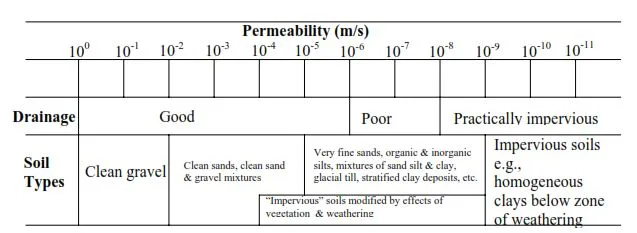
is water at ambient temperature. Generally, coarser the soil grains,
larger the voids and larger the permeability. Therefore, gravels are
more permeable than silts.
Hydraulic conductivity is another term used for permeability, often in
environmental engineering literature.
CVE 306 3
/ 45
End of Document
202

FAQs

What is permeability in soil mechanics?
Permeability, in the context of soil mechanics, refers to the ability of a fluid to flow through a porous medium, which in geotechnical engineering is typically soil. It is a measure of how easily water can move through the soil's voids. The general principle is that coarser soil grains, such as gravels, have larger voids and thus higher permeability compared to finer soils like silts. Hydraulic conductivity is another term often used interchangeably with permeability, particularly in environmental engineering literature.
How does seepage occur in soils?
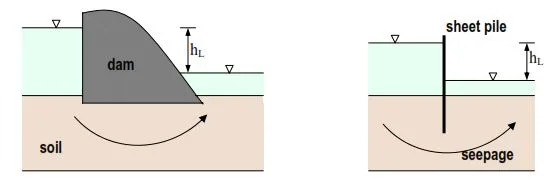
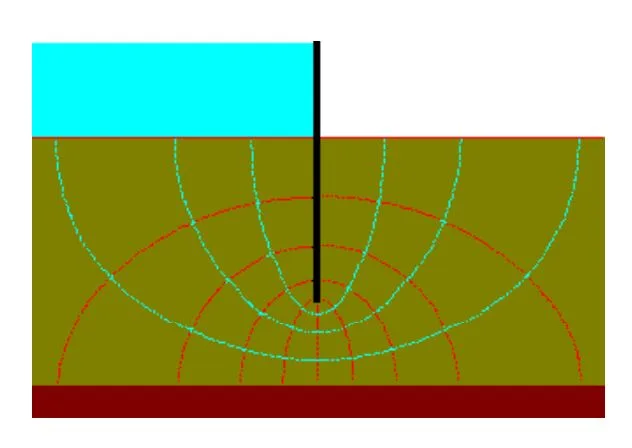
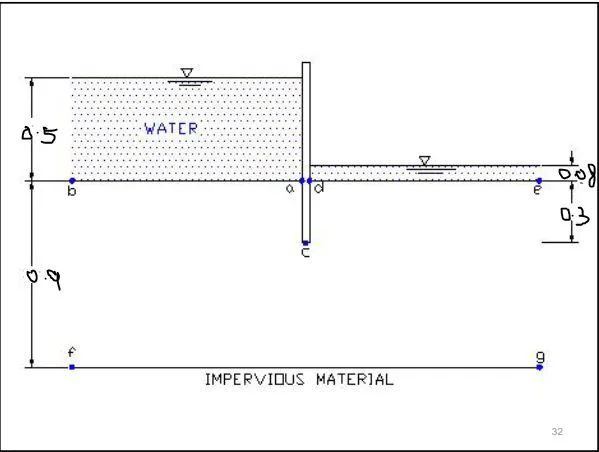
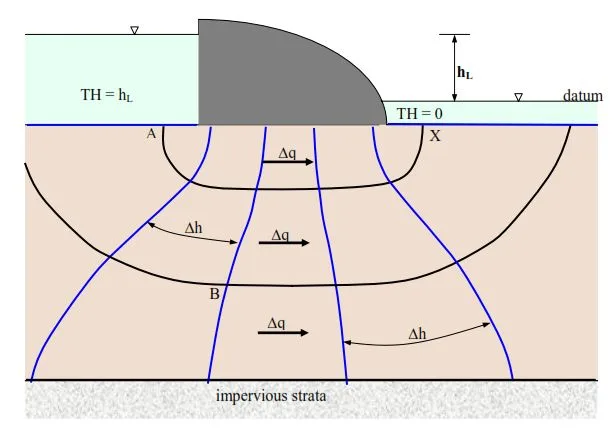
Seepage in soils occurs when there is a difference in water levels on either side of a structure, such as a dam or sheet pile. This flow of water through the soil is driven by the hydraulic gradient created by the difference in water levels. When seepage occurs, it is crucial to estimate the quantity of water flowing through the soil, which directly relates to the soil's permeability. Understanding seepage is essential for the design and safety of structures that interact with groundwater.
What is Darcy's Law in relation to soil flow?
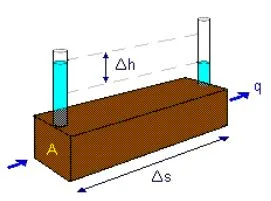
Darcy's Law, proposed by engineer Henry Darcy in 1856, states that the discharge velocity of water through soils is proportional to the hydraulic gradient. Mathematically, it is expressed as v = k.i, where v is the discharge velocity, k is the coefficient of permeability, and i is the hydraulic gradient. This law applies primarily to laminar flow conditions in soils, and the coefficient of permeability is typically expressed in units of cm/s or m/s in geotechnical engineering.
What are the laboratory methods to determine soil permeability?
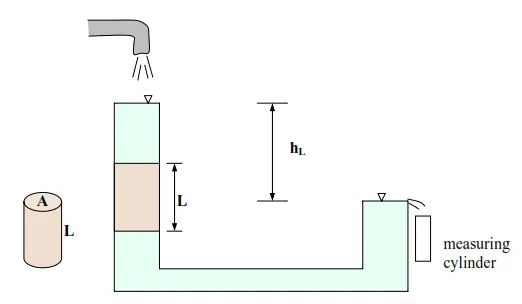
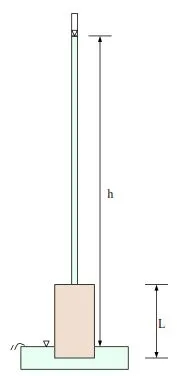
Soil permeability can be determined in laboratory settings using two primary tests: the constant head permeability test and the falling head permeability test. The constant head test is recommended for coarse-grained soils, where the total head loss is maintained constant throughout the test. In contrast, the falling head test is suitable for fine-grained soils, where the water level in a standpipe is allowed to drop, and the time taken for this drop is measured to calculate permeability.
What is the significance of hydraulic gradient in soil flow?
The hydraulic gradient is defined as the total head loss per unit length of flow in soil. It is a dimensionless quantity and serves as a crucial factor in determining the flow of water through soils. In homogeneous soils, the hydraulic gradient remains constant, while in heterogeneous soils, it can vary from point to point. A higher hydraulic gradient indicates a greater difference in water levels, leading to increased flow rates and potential changes in pore water pressures.
What are the limitations of laboratory permeability tests?
Laboratory permeability tests face several limitations, including the non-homogeneity of soil, which can lead to inaccurate results. Anisotropy in soil properties can also affect permeability measurements, as different directions may yield different values. Additionally, sampling disturbances during the collection of soil samples can alter the natural structure and properties of the soil, further complicating the accuracy of test results.
How does flow direction affect pore water pressure in soils?
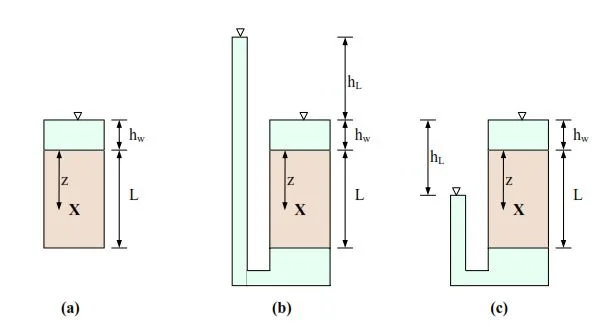
The direction of flow significantly influences pore water pressure in soils. When water flows upwards through a soil specimen, the pore water pressure increases, leading to a decrease in effective stress. Conversely, when flow occurs downwards, the pore water pressure decreases, resulting in an increase in effective stress. The hydraulic gradient directly affects these changes, with higher gradients causing more pronounced variations in pore pressure and effective stress.