Universal Gravitation explores the fundamental principles of gravitational forces as described by Isaac Newton. This physics text delves into planetary motion, Kepler’s laws, and the derivation of gravitational potential energy. It serves as an essential resource for university students studying physics, particularly in courses focused on mechanics and astronomy. The content includes detailed explanations of Newton’s law of universal gravitation and its applications in real-world scenarios. Ideal for those preparing for exams or seeking a deeper understanding of gravitational concepts.

Key Points

  • Explains Newton’s law of universal gravitation and its significance in physics.
  • Covers Kepler’s laws of planetary motion and their implications.
  • Includes derivations of gravitational potential energy for various systems.
  • Discusses the historical context of gravitational theories and their evolution.
Sihle Usisa mpongwana
14 pages
Language:English
Type:Presentation
Sihle Usisa mpongwana
14 pages
Language:English
Type:Presentation
274
/ 14
Universal Gravitation
PH15M1A General Physics I
Planetary Motion
Introduction
A large amount of data had been collected by 1687.
There was no clear understanding of the forces related to these motions.
Isaac Newton provided the answer.
Newtons First Law
A net force had to be acting on the Moon because the Moon does not move
in a straight line.
Newton reasoned the force was the gravitational attraction between the
Earth and the Moon.
Newton recognized this attraction was a special case of a general and universal
attraction between objects.
Universal Gravitation
Introduction
This chapter emphasizes a description of planetary motion.
This motion is an important test of the laws validity.
Keplers Laws of Planetary Motion (LEAVE-OUT)
These laws follow from the law of universal gravitation and the principle of
conservation of angular momentum.
Also derive a general expression for the gravitational potential energy of a
system
Look at the energy of planetary and satellite motion.
/ 14
End of Document
274

FAQs

what is universal gravitation

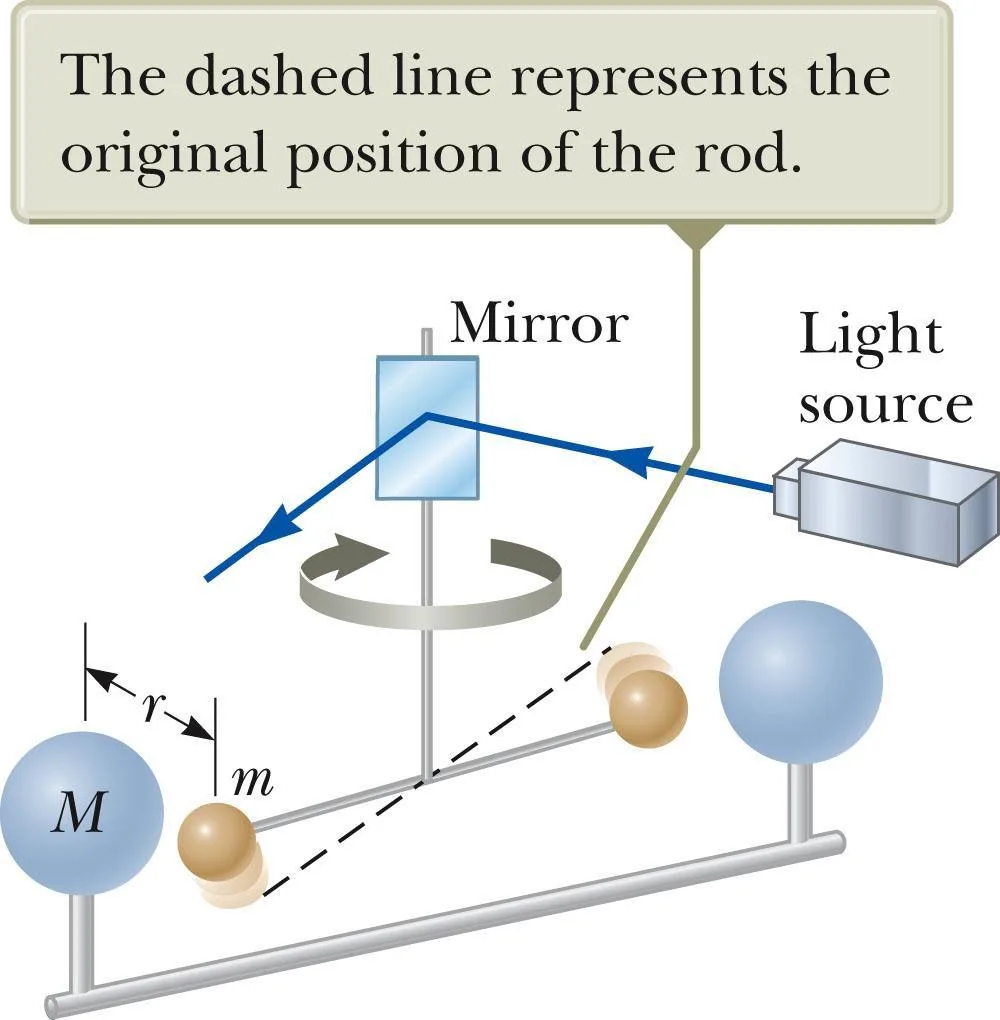
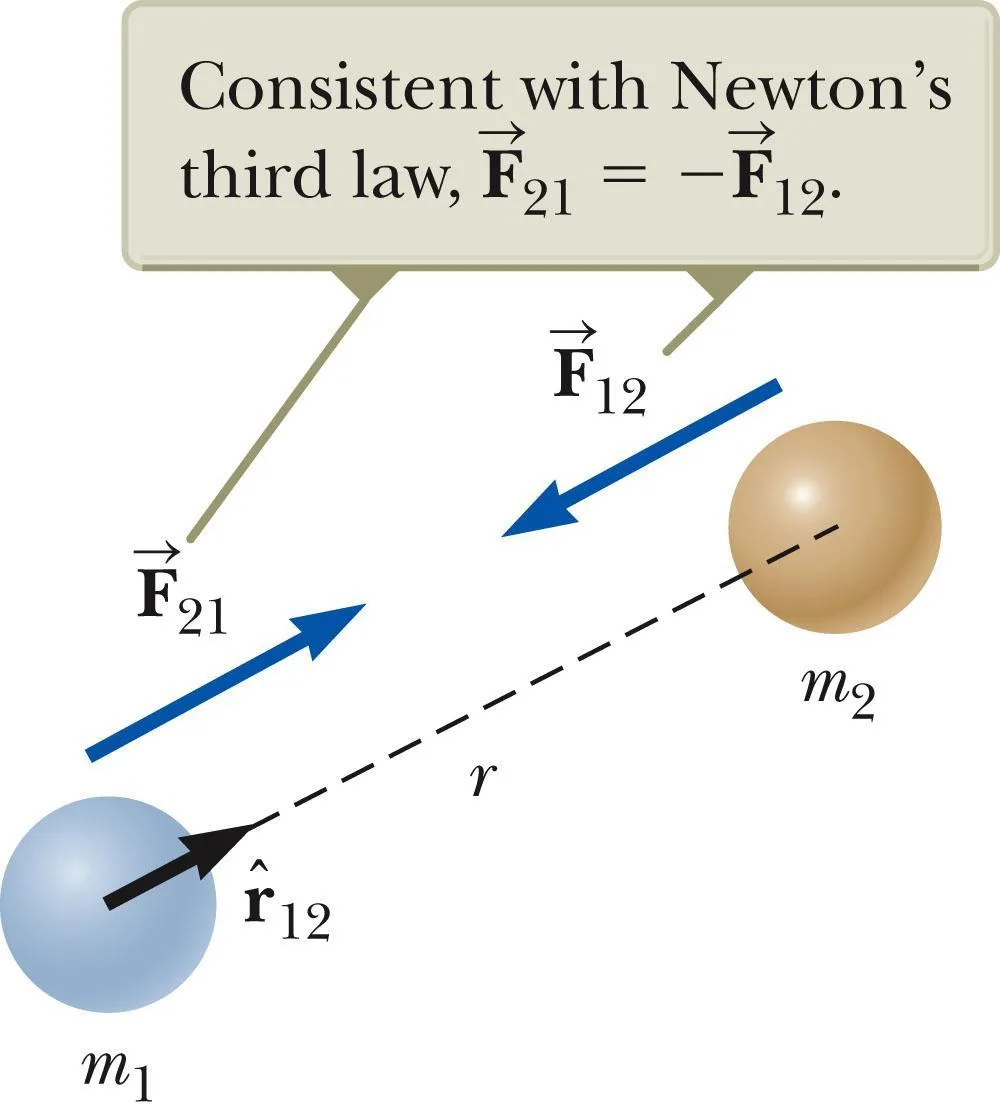
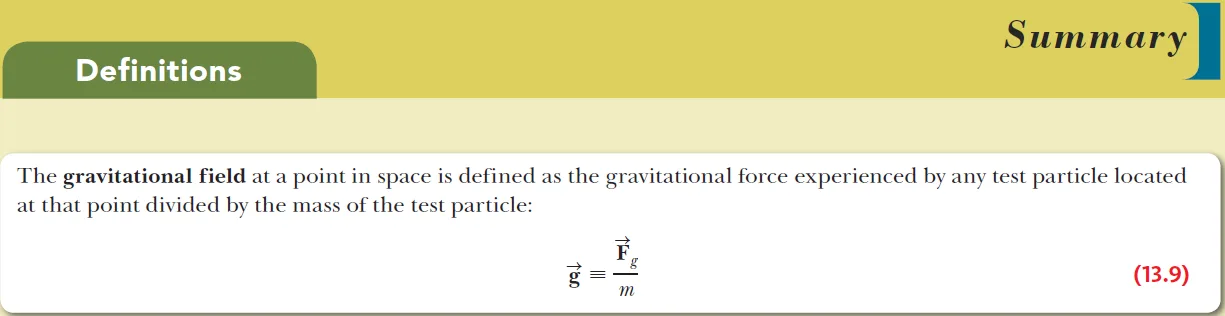
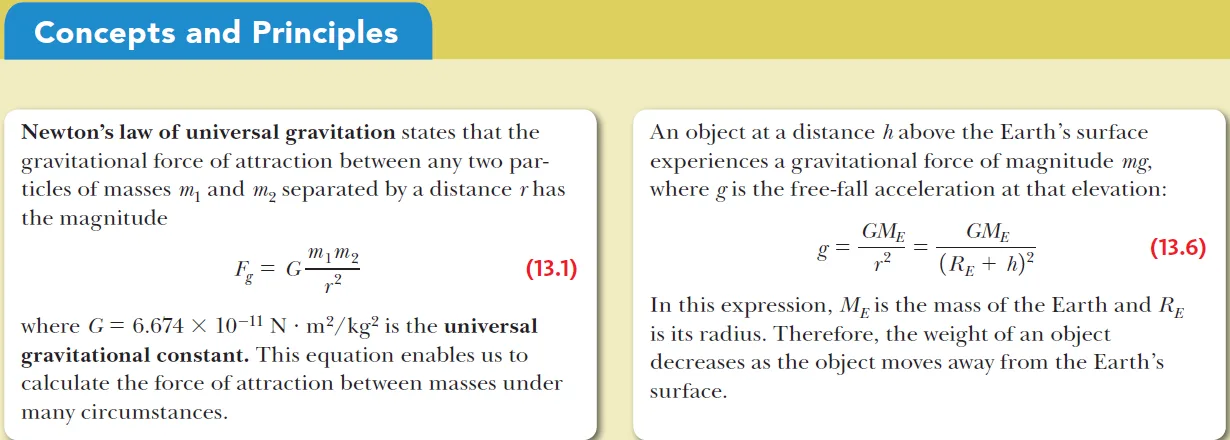
Universal gravitation is a fundamental principle stating that every particle in the universe attracts every other particle with a force that is directly proportional to the product of their masses and inversely proportional to the square of the distance between them.

  • Formula: Fg = G(m1m2/r2)
  • G: Universal gravitational constant, approximately 6.673 x 10⁻¹¹ N·m2/kg2.
  • This law helps explain the motion of celestial bodies and the behavior of objects under gravitational influence.

how does universal gravitation work

Universal gravitation works by describing how masses attract each other through gravitational force, which decreases with distance.

  • The force is stronger when masses are closer together.
  • It applies universally, affecting everything from falling apples to planetary orbits.
  • This principle is foundational in understanding planetary motion and the behavior of satellites.

what are the applications of universal gravitation

Universal gravitation has numerous applications in both theoretical and practical physics.

  • Astronomy: It explains the orbits of planets and moons.
  • Engineering: It is used in satellite design and space missions.
  • Physics: Helps in calculating gravitational potential energy in various systems.

who discovered universal gravitation

Universal gravitation was formulated by Sir Isaac Newton in the 17th century.

  • His work laid the foundation for classical mechanics.
  • Newton's law of universal gravitation was published in his book, 'Philosophiæ Naturalis Principia Mathematica' in 1687.
  • This law revolutionized the understanding of forces and motion.

what is the formula for universal gravitation

The formula for universal gravitation is expressed as Fg = G(m1m2/r2).

  • Fg: Gravitational force between two masses.
  • G: Universal gravitational constant (6.673 x 10⁻¹¹ N·m2/kg2).
  • m1 and m2: The masses of the two objects.
  • r: The distance between the centers of the two masses.

how does gravity change with distance in universal gravitation

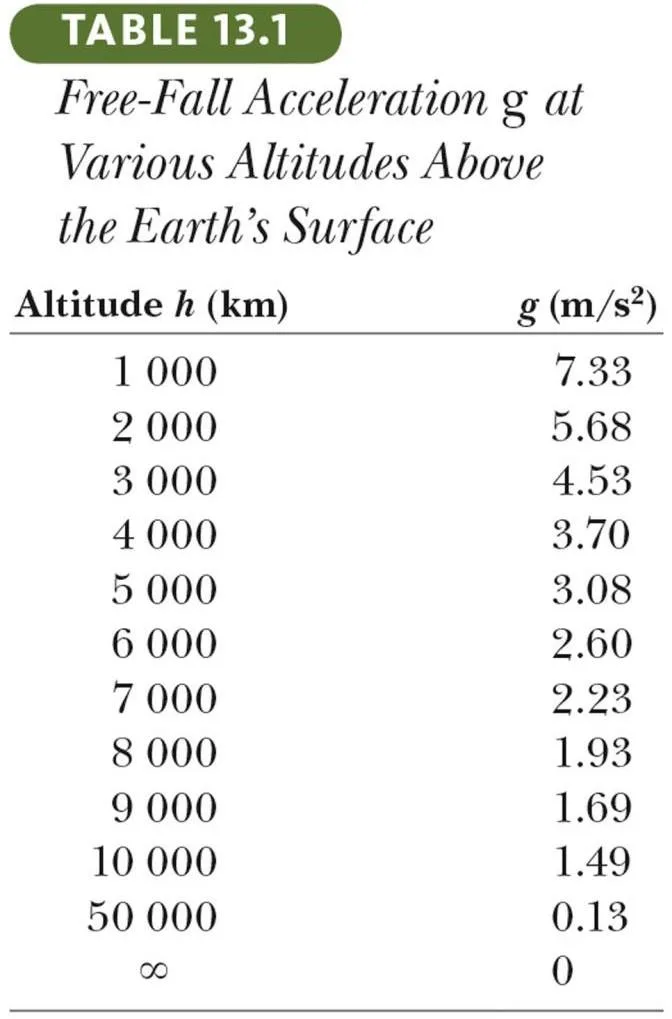
In universal gravitation, the force of gravity decreases with the square of the distance between two masses.

  • This relationship is known as the inverse square law.
  • If the distance doubles, the gravitational force becomes one-fourth as strong.
  • This principle is crucial for understanding how gravitational forces operate in space.

what is the significance of universal gravitation in physics

The significance of universal gravitation in physics lies in its ability to explain a wide range of natural phenomena.

  • It governs the motion of celestial bodies, including planets, moons, and stars.
  • It provides the framework for understanding tides, orbits, and the behavior of objects under gravitational influence.
  • This law is essential for fields like astrophysics and cosmology.

how did Newton prove universal gravitation

Newton proved universal gravitation through mathematical reasoning and observational data.

  • He used the motion of celestial bodies, such as the Moon's orbit around the Earth, to demonstrate gravitational attraction.
  • His laws of motion and gravity explained the elliptical orbits described by Kepler.
  • Newton's work laid the groundwork for modern physics and astronomy.

what are Kepler's laws and their relation to universal gravitation

Kepler's laws describe the motion of planets and are directly related to universal gravitation.

  • First Law: Planets move in elliptical orbits with the Sun at one focus.
  • Second Law: A line segment joining a planet and the Sun sweeps out equal areas during equal intervals of time.
  • Third Law: The square of the orbital period of a planet is proportional to the cube of the semi-major axis of its orbit.

what is gravitational potential energy in universal gravitation

Gravitational potential energy in universal gravitation is the energy an object possesses due to its position in a gravitational field.

  • The formula is given by U = -G(m1m2/r).
  • This energy is negative, indicating that work must be done to separate two masses.
  • It plays a critical role in understanding the energy dynamics of planetary and satellite motion.