Organic Chemistry Study Guide – Isomerism, Functional Groups, and Reactions
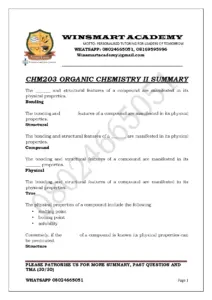
Organic Chemistry Study Guide focuses on key concepts such as isomerism, catenation, and functional groups. It provides detailed explanations of organic compounds, including their structures and reactions. This guide is ideal for students preparing for exams in organic chemistry, covering essential topics like ozonolysis and the Baeyer test. It also includes practical applications and reaction equations to enhance understanding. Perfect for high school and college-level chemistry courses.
Key Points
Explains isomerism and its significance in organic chemistry.
Covers functional groups and their roles in chemical reactions.
Details the ozonolysis reaction and its products.
Includes the Baeyer test for determining saturation in organic compounds.
This link leads to an external site. We do not know or endorse its content, and are not responsible for its safety. Click the link to proceed only if you trust this site.
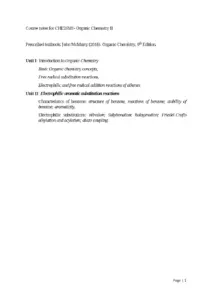
CHE26M1 Organic Chemistry II Handbook 2026Lecture Notes
PDFOther
Comprehensive Study Guide for AP Biology – Unit 7Other
FAQs
What are the types of isomerism in organic chemistry?
Isomerism in organic chemistry can be classified into two main types: structural isomerism and stereoisomerism. Structural isomerism involves compounds that have the same molecular formula but different structural formulas, such as chain isomerism and position isomerism. Stereoisomerism, on the other hand, includes compounds that have the same molecular formula and structural formula but differ in the arrangement of atoms in space, which can be further divided into geometric isomerism and optical isomerism.
What is a homologous series in organic chemistry?
A homologous series is a group of organic compounds that share the same functional group and general formula, differing by a CH₂ unit. For example, alkanes form a homologous series where each successive compound differs by a single carbon atom and two hydrogen atoms. This series allows chemists to predict the properties and reactions of the compounds based on the trends observed within the series.
How do you prepare ethyl amine from ethyl iodide?
Ethyl amine can be prepared from ethyl iodide through a reaction with ammonia. The process involves treating ethyl iodide with ammonia, which results in the substitution of the iodine atom by the amino group, yielding ethyl amine. The overall reaction can be summarized as follows: C₂H₅I + NH₃ → C₂H₅NH₂ + HI. This method highlights the importance of nucleophilic substitution reactions in organic synthesis.
What are the derivatives of carboxylic acids mentioned in the study guide?
The document outlines four derivatives of carboxylic acids: acid chlorides, acid anhydrides, esters, and amides. Each derivative retains the functional characteristics of carboxylic acids but varies in reactivity and the nature of the substituents. For instance, acid chlorides are known for their high reactivity, while esters are often used in flavorings and fragrances due to their pleasant aromas.
What is the Baeyer Test for ethane?
The Baeyer Test is a qualitative test used to determine the saturation of hydrocarbons. In the case of ethane, the test shows that it does not decolorize potassium permanganate (KMnO₄), indicating that ethane is a saturated hydrocarbon. This reaction is significant as it helps differentiate between saturated and unsaturated compounds in organic chemistry.
Why are amines considered basic?
Amines are considered basic due to the presence of a lone pair of electrons on the nitrogen atom, which can accept protons (H⁺ ions). This property allows amines to act as Lewis bases in chemical reactions. The basicity of amines is also influenced by the alkyl groups attached to the nitrogen, which can donate electron density and enhance the nitrogen's ability to accept protons.