Sindh Board Chemistry 12th Solved Questions provides comprehensive answers to key topics in the chemistry curriculum. This resource covers essential concepts such as d-block elements, flame tests, and mass spectrometry, making it ideal for students preparing for exams. Detailed explanations of chemical reactions, properties of compounds, and various organic and inorganic chemistry topics are included. Perfect for Sindh Board students, this guide aids in understanding complex chemistry principles and enhances exam readiness.
Key Points
Includes solved questions on d-block elements and their properties.
Covers flame test results for alkali and alkaline earth metals.
Explains the preparation and properties of nylon and PVC.
Details the manufacture of caustic soda by the Castner-Kellner process.
This link leads to an external site. We do not know or endorse its content, and are not responsible for its safety. Click the link to proceed only if you trust this site.
2024 WAEC Chemistry Practical Questions Alternative B
PDF
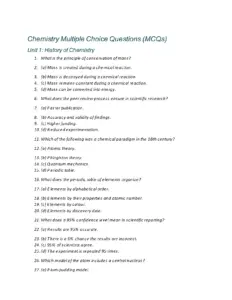
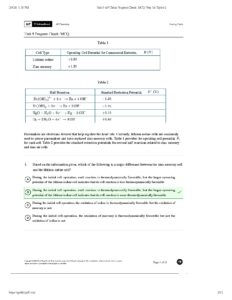
AP Chemistry Unit 9 Progress Check Multiple Choice Questions
FAQs
What is bleaching powder and how is it prepared?
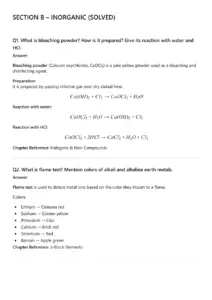
Bleaching powder, known chemically as calcium oxychloride with the formula CaOCl₂, is prepared by passing chlorine gas over dry slaked lime (Ca(OH)₂). The reaction can be represented as Ca(OH)₂ + Cl₂ → CaOCl₂ + H₂O. When bleaching powder reacts with water, it produces calcium hydroxide and chlorine gas, as shown in the equation CaOCl₂ + H₂O → Ca(OH)₂ + Cl₂. Additionally, when it reacts with hydrochloric acid (HCl), it forms calcium chloride, water, and chlorine gas: CaOCl₂ + 2HCl → CaCl₂ + H₂O + Cl₂.
What are the flame colors of alkali and alkaline earth metals?
The flame test is a method used to identify metals based on the color they produce in a flame. For alkali metals, lithium produces a crimson red flame, sodium gives a golden yellow flame, and potassium shows a violet flame. In contrast, alkaline earth metals exhibit different colors: calcium produces a brick red flame, strontium shows a crimson flame, and barium gives an apple green flame. These distinct colors help in the identification of these metals in various chemical analyses.
What is crystal field theory and its significance?
Crystal field theory explains the behavior of transition metal complexes, particularly regarding their color. According to this theory, ligands surrounding a metal ion cause the d-orbitals to split into different energy levels. This splitting allows electrons to absorb energy and transition between d-orbitals, which results in the absorption of visible light and the appearance of color in the compounds. The presence of partially filled d-orbitals in transition metals is crucial for this phenomenon, as it leads to the formation of colored compounds.
What is the preparation method for nylon?
Nylon is synthesized through the process of condensation polymerization, specifically from adipic acid and hexamethylene diamine. This reaction results in the formation of long-chain polyamide molecules, which exhibit strong and elastic properties. Nylon is known for its resistance to chemicals, making it a valuable material in various applications, including textiles and engineering.
How does the boiling point of halogens change down the group?
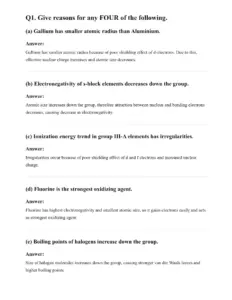
The boiling point of halogens increases as you move down the group in the periodic table. This trend is attributed to the increase in molecular size and the corresponding rise in van der Waals forces between the molecules. As the size of the halogen atoms increases, the strength of these intermolecular forces also increases, leading to higher boiling points for the heavier halogens.
What defines d-block elements and their unique properties?
D-block elements are defined as those elements in which the last electron enters a d-orbital. These transition metals exhibit unique properties, such as the ability to form colored compounds due to their partially filled d-orbitals. The presence of these d-orbitals allows for d-d transitions, where electrons absorb visible light, contributing to the characteristic colors of these compounds. Additionally, d-block elements often have variable oxidation states, making them versatile in chemical reactions.
What is the significance of the Baeyer test for ethane?
The Baeyer test is used to detect the presence of unsaturation in organic compounds. In the case of ethane, it does not decolorize potassium permanganate (KMnO₄), indicating that ethane is a saturated hydrocarbon with no double or triple bonds. This test is significant as it helps differentiate between saturated and unsaturated compounds, providing insights into the chemical structure and reactivity of the substance being tested.