Computer science is the foundational discipline that explores the theoretical, algorithmic, and practical boundaries of information processing, software architecture, and hardware-software integration. Rather than treating computers as simple consumer utilities, computer science unpacks them into sophisticated ecosystems of logical layers—spanning from raw physical voltages to abstract high-level human-readable code. Mastering this field requires a comprehensive grasp of structural data handling, systemic resource management, mathematical complexity analysis, and modern engineering design principles. On Chesser Resources, students and professionals can leverage an expansive repository of technical papers, structural roadmaps, and exam prep modules to navigate this rapidly evolving field.
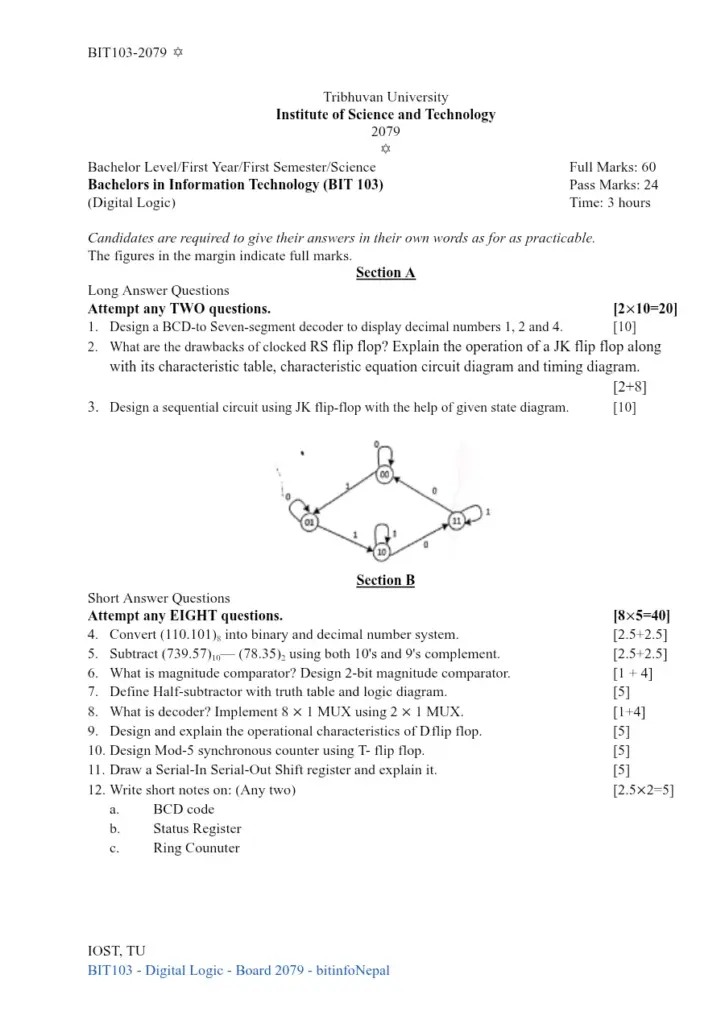
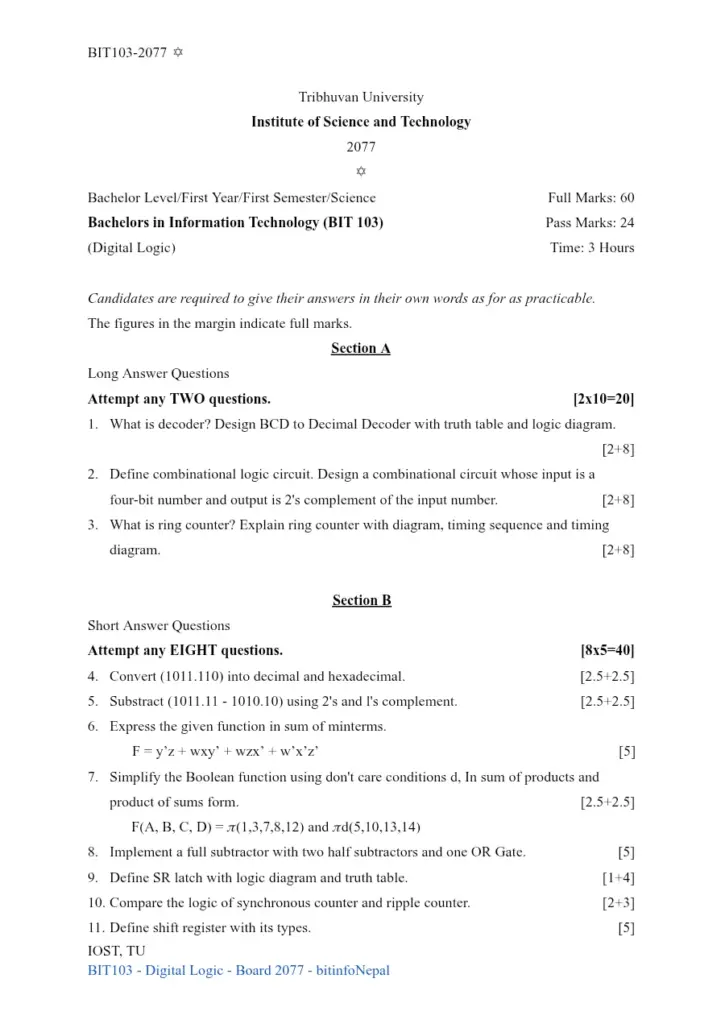
The baseline of all modern computation begins at the hardware and foundational systems layer, where physical silicon gates process discrete binary expressions. To fully appreciate this transformation, students can explore early milestones in Introductory Computer Science – Chapter One: Introduction and History of Computers and break down internal hardware components with Computer Parts – Chapter 2b Updated. This engineering architecture relies heavily on digital systems design, as detailed in BIT103 Digital Logic – Tribhuvan University 2079 and BIT103 Digital Logic – Tribhuvan University 2077. These basic logic gates are subsequently scaled to orchestrate central processing operations, a topic explored extensively in Introduction to Computer Architecture and optimized via execution techniques found in Pipelining in Computer Organization and Architecture. Bridging this low-level hardware domain to executable logic requires translation mechanics, such as those outlined in Two-Pass Assembler: Understanding Assembly Language Translation and visualized in CPE 321 Presentation on Computer Systems and Hardware. For a comprehensive high-level baseline across all initial computing models, the Computer Science Summary: Key Concepts and Data Representation serves as an indispensable primary overview.
The structural soul of computer science resides within our core sub-category for Algorithms & Data Structures. This subfield dictates the ultimate memory footprint and execution runtime efficiency of any software solution, heavily relying on Big-O asymptotic notation to evaluate algorithm performance. Students looking to master linear structures like linked lists, queues, stacks, and complex non-linear trees can work through the Data Structures and Algorithms Handwritten Notes. Practical deployment and conceptual evaluations are further reinforced by reviewing the Data Structure and Algorithm Assignment – CS201 alongside structured assessment platforms like the CS201P Quiz 7 – Computer Science Assessment.
To implement these conceptual data frameworks into functional software, developers operate within the dedicated sub-category for Programming. This domain covers varied paradigms—from structured imperative workflows to elegant object-oriented tracking and script-based automations. Beginners often start with highly readable languages via resources like the Introduction to Python Programming and Python Programming – Chapters 1 to 5. For deeper intermediate engineering, developers look to advanced material like the Python Notes for Professionals and validate their skills with the Fundamentals of Python Programming Practice Set. Concurrently, lower-level system-oriented memory control is best mastered through structural resources such as C Programming Unit 1 Notes: Language Elements and Control Structures and C Language Unit 1 Exam Ready Notes. Academic tracks also offer procedural blueprints via the Programming for Problem Solving Lab Manual BCS-151. For large-scale application development, object-oriented concepts become paramount, as taught in Java Object Oriented Programming Notes – Clean & Structured and defined within the Object Oriented Programming Syllabus BIT153.
When moving beyond individual code scripts to large-scale collaborative ecosystems, software must pass through our sub-categories for Software Engineering and Web Development. Professional software construction demands absolute maintainability and adherence to rigid clean architectural blueprints, a classic paradigm explored inside Clean Code: A Handbook of Agile Software Craftsmanship. Aspiring professionals can structure their long-term learning goals using the Software Development Curriculum – Become Job-Ready in 6 Months and benchmark their growth against industry standards via a Senior Frontend Engineer Resume. On the user-facing side of web applications, styling layouts and interaction rules are defined via structural guides like CPE 314 Lesson 3: CSS and CPE 314 Lesson 4: Introduction to JavaScript. These modular layers are ultimately brought together in complex enterprise projects, such as the Medical Shop E-commerce Project – C# and .NET Development.
The cognitive evolution of modern computing is led by our sub-category for Artificial Intelligence. This domain studies how machines can emulate complex cognitive functions through statistical estimation models and connectionist networks. Researchers looking to demystify complex neural architectures can dive into Deep Learning Fundamentals and explore human tracking systems through specialized documentation like An Ensemble Model Using Face and Body Tracking for Engagement Detection. In commercial spheres, automated agents are driving immense corporate shifts, a trend thoroughly assessed in KI Agenten im Mittelstand: Digitale Kollegen die wirklich entlasten. However, these technological milestones require strong governance and safety evaluation, as discussed in macro-defense papers like Autonomous Weapons and Artificial Intelligence in Warfare – Working Paper Of Block B and societal threat briefs like Safeguarding Alert: AI Undress Apps and Websites.
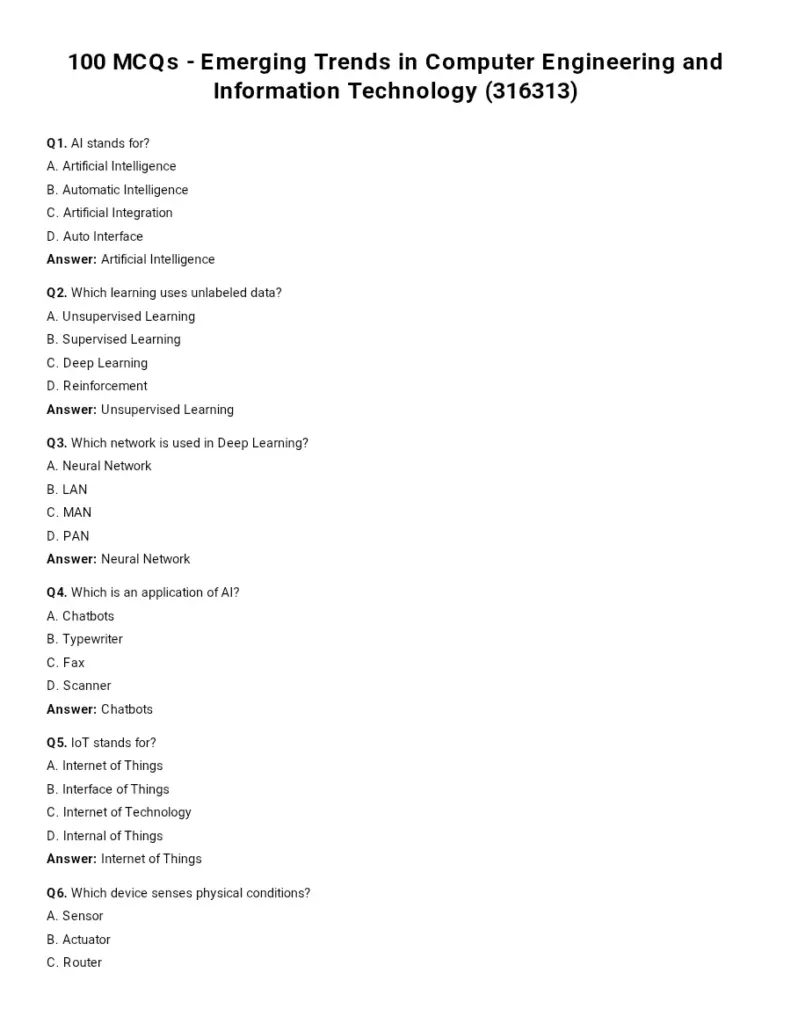
Finally, distributed computation and information storage are sustained by our interconnected sub-categories for Computer Networks, Operating Systems, and Databases. System topology and reliable message delivery routing across deep web nodes are analyzed using Data Transmission and Packet Switching and Data Communication and Computer Networks – Unit 5.1. For low-level non-synchronized information routing, engineers study mechanisms such as Asynchronous Transfer: Data Communication Without a Shared Clock. Closer to the localized CPU layer, resource orchestration, thread mapping, and basic file system operations are managed via the software modules reviewed in Operating Systems and Utility Programs – Week 6. Meanwhile, persistent storage architecture relies on structural database engines, which can be fully mastered using the Database Management System Full Notes and optimized for major scale-out deployments via advanced machine-learning predictions like the Distributed Database Load Balancing Prediction Based on Convolutional Neural Network. To contextualize these systems among emerging technological shifts, engineers reference 100 Multiple Choice Questions on Emerging Trends in Computer Engineering and Information Technology, maintaining full awareness of how these fields continue to converge.
To understand how the vast domain of computer science structures its child categories and professional engineering specialties, review the following academic taxonomy:
Parent Category: Applied Technological Sciences
Parent Branches: Discrete Mathematics, Electrical Engineering, Systems Science
Core Discipline: Computer Science
Child Branches:
Algorithms & Data Structures (Complexity Analysis & Data Organization)
Programming (Functional, Imperative, & Object-Oriented Development)
Software Engineering (System Architecture & Agile Craftsmanship)
Web Development (Frontend, Backend, & Cloud Integrations)
Artificial Intelligence (Machine Learning, Neural Networks, & Robotics)
Computer Networks (Data Routing, Protocols, & Network Infrastructures)
Operating Systems (Kernel Routing, Process Scheduling, & Concurrency)
Databases (DBMS Architecture, Schema Design, & Distributed Ledgers)
| Technical Feature | Low-Level Systems Programming | Enterprise Object-Oriented Software | Agile Web Development |
| Primary Structural Scope | Direct hardware control, manual memory allocation, Kernel extensions | Highly decoupled classes, component frameworks, desktop/mobile backends | Highly dynamic UI rendering, state management, REST/GraphQL cloud endpoints |
| Core Governing Metrics | Execution speed, precise byte overhead, predictable memory bounds | Scalability metrics, pattern decoupling, long-term codebase maintainability | Time to first paint, API response latency, cross-device cross-browser parity |
| Typical Languages | Assembly, C, C++, Rust | Java, C#, Python | JavaScript, TypeScript, HTML, CSS |
| Fundamental Objective | Maximizes raw physical execution velocity and manages hardware devices | Architects highly modular, reusable, fault-tolerant business software applications | Builds interactive, global web applications and real-time network platforms |
| Primary Toolset | Machine assemblers, hardware linkers, debuggers like GDB | Enterprise IDEs, dependency injection containers, build management engines | Frontend frameworks, package managers, continuous integration pipelines |
Chesser Resources is a free online study-and-research library at chesserresources.com. It holds 300,000+ documents — books, textbooks, past papers, lecture notes, study guides, research papers and much more — across exams, the sciences, math, literature, the humanities and beyond. Everything is readable in the browser with no account, alongside free AI summaries, an Ask-AI chatbot, highlights, notes and read-aloud audio. Instead of a subscription, downloads are unlocked by contributing back to the community, so the library stays genuinely free.
A stack is an ordered collection that operates strictly on a Last-In, First-Out (LIFO) scheduling protocol, where all element insertions and removals occur at a single terminus called the top. A queue is a linear collection that functions via a First-In, First-Out (FIFO) pipeline, where new elements are added exclusively at the rear (enqueued) and existing elements are removed solely from the front (dequeued).
Big-O notation is a mathematical framework used to describe the asymptotic upper bound of an algorithm’s execution runtime or memory workspace consumption as the input dataset size ($n$) scales toward infinity. Rather than measuring literal seconds (which shift based on hardware differences), it groups code into worst-case execution curves like $O(1)$ constant, $O(n)$ linear, or $O(n \log n)$ linearithmic time complexity.
A compiler translates an entire source code document in a single execution phase, converting high-level human logic directly into a standalone binary file of machine instructions tailored for specific hardware. An interpreter executes the source code dynamically on the fly, translating and running the program line-by-line in real time through an active runtime container, which typically yields slower operational runtimes but offers superior debugging workflows.
Encapsulation is the engineering principle of bundling an object’s internal data variables and its executable functional methods into a single unified class capsule. By restricting direct structural manipulation of internal states via private access modifiers and exposing safe, public getter and setter interfaces instead, encapsulation prevents external code modules from corrupting state boundaries, ensuring long-term code stability.
The operating system kernel is the central core program that loads first during boot and maintains absolute control over the physical hardware. It functions as the ultimate intermediary layer between running user software applications and physical components, orchestrating critical system operations like CPU process scheduling, primary memory virtualization, and direct input/output peripheral communications.
A relational database engine enforces transaction safety through four strict ACID criteria: Atomicity ensures an all-or-nothing execution where transactions either complete fully or roll back completely; Consistency guarantees the data always satisfies defined validation constraints; Isolation prevents concurrent transactions from reading incomplete, overlapping changes; and Durability guarantees that committed updates survive any unexpected system crashes or power failures.
Symmetric encryption utilizes a single, identical cryptographic secret key to handle both data encryption and decryption, requiring all participating nodes to securely share that single secret key. Asymmetric encryption implements a mathematically linked dual-key pair composed of a universally public key to encrypt information and a completely private key held exclusively by the recipient to perform decryption.
Semantic HTML implements meaningful layout elements (like <main>, <article>, or <nav>) that explicitly describe the nature and role of their internal content to browsers and assistive tools. This layout architecture allows screen readers to accurately map and traverse the site for visually impaired users while providing search engine crawlers with an indexed structural outline that dramatically boosts technical SEO.
Deep neural networks optimize internal weights by feeding input datasets forward through successive layers of mathematical processing nodes, calculating the resulting variance against known targets via a specialized loss function. The network then routes this error measurement backward through the system using backpropagation, applying gradient descent calculus to dynamically tune individual weights across hidden layers, incrementally improving predictive accuracy.
During a packet-switched routing sequence, oversized files are divided into small, independent data blocks termed packets, each carrying a header file packed with destination and source IP addresses. These packets traverse the digital network independently across varied physical routes dictated by real-time node traffic, before being reassembled in their original sequence once they land at the target destination device.