Introductory Computer Science explores the fundamentals of computing, focusing on the history and evolution of computers. This chapter provides a comprehensive overview of what constitutes a computer, detailing its functions, data processing, and the significance of programming. Key concepts include the definitions of data, programs, and information, along with examples of procedures and functions in programming. Ideal for students beginning their journey in computer science, this chapter lays the groundwork for understanding more complex topics in subsequent chapters.

Key Points

  • Explains the definition and functions of computers in everyday use
  • Covers the history and evolution of computer technology
  • Discusses the importance of data, programs, and information in computing
  • Introduces programming concepts, including procedures and functions
Joseph Akujieze
118 pages
Language:English
Type:Textbook
Joseph Akujieze
118 pages
Language:English
Type:Textbook
314
/ 118
INTRODUCTORY COMPUTER SCIENCE
CHAPTER ONE: INTRODUCTION AND HISTORY OF COMPUTERS.
1.0 INTRODUCTION
Computers are indeed some of the most interesting and complex items of technology in everyday
use, but they are only around in such numbers because they are useful tools. A computer is a
device which accepts data in one form and processes it to produce data in another form . This
definition can be put in a more explicit form as, computer is an electronic device that can receive
a set of instructions, or program, and then carry out this program by performing calculations on
numerical data or by compiling and correlating other forms of information. Note the three words
used in the definition of computer, data, program, and information. “Data” is the name given to
basic facts, e.g. the number of items sold by a business, the name of a customer, or the numerical
values used in mathematical formulae. A program is a set of instructions which is written in the
language of the computer. It is used to make the computer perform specific task such as
calculating interest to be paid to savings account holders or producing a payroll. Information
refers to a result when data is converted into a more useful or intelligible form. In this situation
data is said to be processed into information.
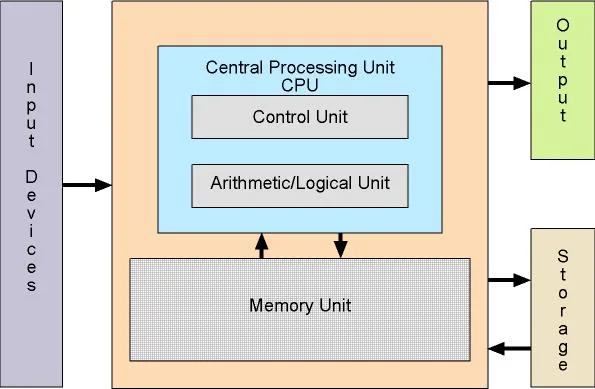
From the foregoing definition of a computer, it has a simplified representation as in Fig.1.1.
INPUT PROCESS OUTPUT
e.g. 5,4 Add 5 and 4 9
Fig. 1.1. An INPUT- PROCESS- OUTPUT diagram
A computer can be formally defined as a device which works under the control of a stored
program, automatically accepting and processing data to produce information which is the result
of that processing. In this line, computer science is concerned with the application of scientific
principles to the design, construction and maintenance of systems based upon the use of
computers. It therefore includes a study of what computers are, how they work and how they are
used.
1
1.2 THE EVOLUTION OF COMPUTER SYSTEMS
Most modern Computers are based upon general design principles which were established during
the 1940s and which have not changed greatly since then. In striking contrast, changes in
technology have revolutionized the ways in which Computers are made. The origins of
Computers can be stressed to the ancient times when different methods were used to represent and
store data. For example, the herdsmen used pebbles, sticks, or scratches on stones to count and
represent the number of animals in their care. The use of pebbles was latter on replaced with
stylized pictures or symbols to represent objects, numbers and ultimately languages. Such
representations provided a means of storing information for subsequent retrieval and use.
1.2.1 The Development of Calculating Devices
For over two thousand years ago, some simple calculating devices, notable among them abacus
were already in used. Abacus is still used today in parts of Asia. This device is a mechanized
pebble counter in which beads are strung on wires or strings held in a frame. The beads are slid
along the wires when counting, adding, etc. Subsequent significant developments of calculating
devices took place especially in the seventeenth century. Prominent among them include the
invention of logarithms by John Napier, a Scottish mathematician in 1614. Logarithms aid
manual multiplication and division. Later in 1617, Napier’s bones were devised for use as
multiplication aids. Napier’s bones were a set of rods carved from bone. Three years later, that
was in 1620 to be precise, William Oughted, an English Parson, invented an analog calculating
device otherwise called the slide rule. The rule has scales divided in fixed and sliding scales
respectively. Francis Bacon in 1623 made the first known use of binary codes for number
representation.
The first true calculating (adding) machine, a precursor of the digital computer, was devised in
1642 by the French philosopher and mathematician Blaise Pascal.. This device employed a series
of ten-toothed wheels, each tooth representing a digit from 0 to 9. The wheels were connected so
that numbers could be added to each other by advancing the wheels by a correct number of teeth.
It consisted of a series of six numbered dials and a ratchet ‘carry” mechanism. Multiplication and
division using this device were quite slow and laborious. On the other hand addition and
2

subtraction were straight forward. In the 1960s Pascal’s contribution to computing was
recognized when a renowned mathematician professor Niklaus Wirth of Zurich named his new
programming language “ Pascal” after Blaise Pascal. The laborious processes in multiplication
and division experienced using Pascal’s device was simplified when a German mathematician,
Gottfried Von Leibniz invented a calculating machine capable of true multiplication and
division in 1671. The machine was a development of Pascal’s idea. The new feature was a shift
mechanism. Pascal had already devised a method of number complements for use in subtraction.
Early in the nineteenth century, a French textile manufacturer made a brilliant imaginative efforts.
Between 1802 and 1804 the French inventor Joseph Marie Jacquard perfected a mechanical
means of automatically controlling weaving looms to facilitate the production of woven cloth
with complex patterns. The machine, called “ the Jacquard loom”, was programmed by means of
special punched cards which stored information about the required patterns in the cloth. These
punched cards were strung tightly together side by side in a long continuous strip. They were
automatically fed through a loom mechanism in sequence with the purpose of controlling the
loom’s weaving action. It is generally accepted that Jacquard’s loom was the start of a chain of
developments which led to the robot operated factory production lines of today. Jacquard’s work
had led also to the automation of calculations. Within a few years of Jacquard’s invention, a
professor of mathematics at Cambridge University, Charles Babbage in 1822 demonstrated a
small working model of his “Difference Engine” to the Royal Society. Babbage’s demonstration
won him government backing who wished to produce a larger machine able to generate reliable
astronomical and mathematical tables containing values accurate to 20 decimal places. The
machine was never completed because of mechanical difficulties. In 1884 Babbage designed and
developed the concept of an “Analytic Engine”. It was essentially a general purpose automatic
calculator. Its design owed much to Jacquard’s invention and incorporated many features present
in modern computers inter alia
1) Data and program instructions fed in via a device using a suitable medium (punched cards)
2) Storage facilities for data and instructions
3) A mechanized unit for calculation- a ”mill”
4) A suitable output device.
3
/ 118
End of Document
314

FAQs

What are the main components of a computer according to Chapter One?
Chapter One defines a computer as a device that processes data to produce information. The main components include input, processing, and output units. Input refers to the data entered into the computer, processing involves the manipulation of that data according to a set of instructions or programs, and output is the final information produced, which can be displayed or printed.
How did early calculating devices evolve into modern computers?
The evolution of calculating devices began with simple tools like the abacus and progressed through significant inventions such as Blaise Pascal's adding machine and Charles Babbage's Analytical Engine. Babbage's design included essential features of modern computers, such as input methods, storage, and processing units. This historical context illustrates the gradual transition from mechanical devices to electronic computers, highlighting the foundational principles established in the 1940s.
What role did Lady Ada Lovelace play in the history of computing?
Lady Ada Lovelace is recognized as one of the first programmers due to her work on Charles Babbage's Analytical Engine. She created algorithms intended for the machine, demonstrating early insights into programming. Her contributions are significant as they laid the groundwork for future developments in computer science, and the programming language 'Ada' is named in her honor.
What was the impact of the invention of the transistor on computers?
The invention of the transistor in 1948 marked a pivotal change in computer technology, leading to the development of smaller, faster, and more reliable computers. Transistors replaced vacuum tubes, resulting in reduced power consumption and increased longevity of computing devices. This advancement facilitated the transition from first-generation to second-generation computers, enhancing the overall efficiency and performance of computing systems.
What is the significance of Boolean Algebra in computer science?
Boolean Algebra, developed by George Boole, is crucial in computer science as it provides a framework for representing and manipulating logical expressions. This algebraic system underpins the design of digital circuits and programming languages, enabling computers to perform logical operations. Its theoretical foundations have influenced various aspects of computing, including circuit design and algorithm development.
How did Herman Hollerith contribute to the evolution of computers?
Herman Hollerith's invention of a mechanical tabulator using punched cards revolutionized data processing, particularly for the 1890 U.S. Census. His system significantly reduced the time required to process census data, demonstrating the potential for automation in data handling. This innovation laid the groundwork for future developments in computing technology, leading to the establishment of the company that became IBM.
What defines the first generation of computers?
The first generation of computers, spanning from 1945 to 1956, was characterized by the use of vacuum tubes for circuitry and magnetic drums for memory. These computers were large, expensive, and primarily used for specific tasks, with programming done in machine language. Notable examples include the ENIAC and UNIVAC, which laid the foundation for subsequent generations of computing technology.