

Algorithms and data structures notes, Big-O notation guide, linear vs non-linear data structures, binary search trees tutorial, sorting algorithms runtime, graph traversal algorithms PDF, dynamic programming roadmaps, CS201 assignments, chesser resources algorithms
Algorithms & Data Structures Study Guides: Analysis & Implementation | Chesser Resources
Download free algorithms and data structures lecture notes, handwritten sheets, and CS201 assignments on Chesser Resources. Master Big-O complexity analysis today!
Algorithms and data structures constitute the foundational bedrock of all computer science and software engineering disciplines. While programming languages serve as the syntactic tools used to communicate instructions to a machine, algorithms and data structures represent the pure logic, architectural organization, and mathematical strategies that dictate how efficiently those instructions are executed. At scale, an unoptimized choice in data layout or execution logic can result in systemic bottlenecks, server timeouts, and runaway infrastructure costs. Consequently, mastering the design, analysis, and implementation of these core structures is essential for transitioning from basic coding to building high-performance, enterprise-grade software systems. On Chesser Resources, a specialized hub for Algorithms & Data Structures provides comprehensive access to academic lecture notes, assignments, and exam review guides.
The primary framework used to evaluate algorithmic performance is asymptotic analysis, which measures how an algorithm’s execution time and memory footprint scale relative to an increasing input size, denoted as $n$. Expressed via Big-O notation, this mathematical abstraction discards hardware-specific variables to isolate the worst-case execution curve of a code block. Programmers classify routines into distinct complexity classes, ranging from highly efficient $O(1)$ constant and $O(\log n)$ logarithmic behaviors to $O(n)$ linear, $O(n \log n)$ linearithmic, and highly restrictive quadratic $O(n^2)$ or exponential $O(2^n)$ runtimes. Students can build a strong foundational baseline in these concepts by referencing comprehensive study tools like the Data Structures and Algorithms Handwritten Notes.
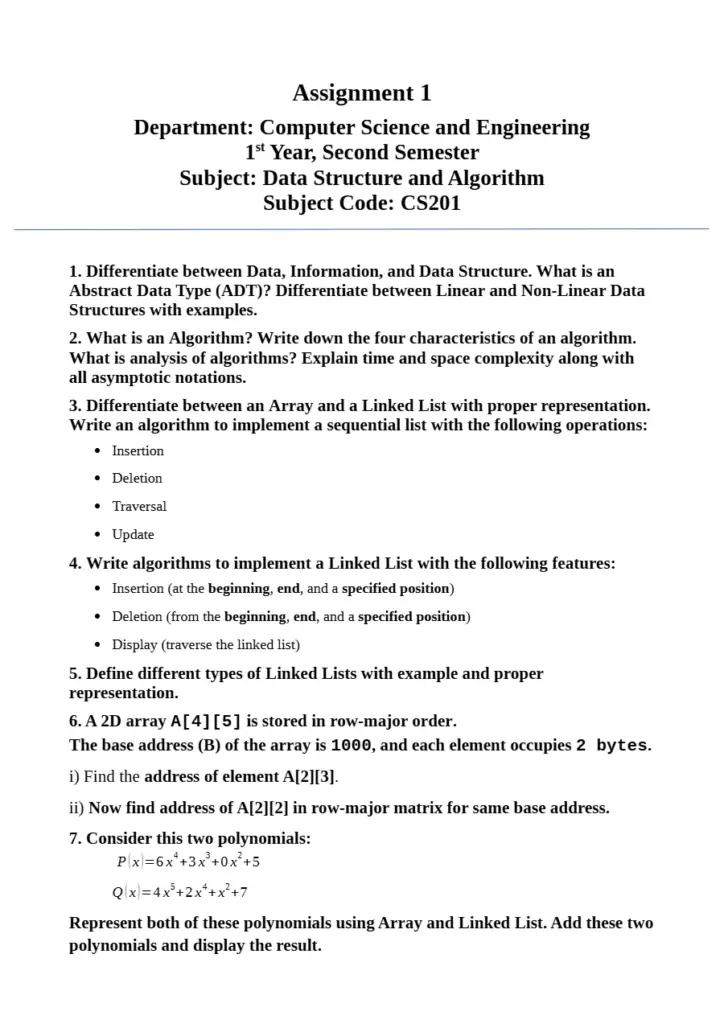
Data structures are broadly split into two principal categories: linear and non-linear. Linear data structures organize records sequentially in memory, meaning elements are connected adjacent to one another. The simplest configuration is the array, which allocates contiguous memory blocks to support instantaneous $O(1)$ index-based access but suffers from expensive $O(n)$ resizing operations. Linked lists mitigate these constraints by utilizing node-based wrappers containing data pointers to chain elements dynamically, facilitating fast insertions at the cost of linear search traversals. Advanced variants include stacks, which implement a restricted Last-In, First-Out (LIFO) execution stack, and queues, which enforce a First-In, First-Out (FIFO) pipeline. Reviewing academic benchmarks such as the Data Structure and Algorithm Assignment – CS201 provides an excellent vehicle for mastering these linear storage mechanics.
As data relationships grow in structural complexity, software solutions rely on non-linear data structures like trees and graphs to model hierarchical or networked real-world systems. A tree represents an acyclic, hierarchical network of nodes branching from a singular root. Within this domain, Binary Search Trees (BSTs) enforce a strict ordering rule where left-child elements remain smaller than the parent node and right-child elements remain larger, dropping average lookup, insertion, and deletion runtimes down to $O(\log n)$. However, if a BST becomes un-balanced, its performance can degrade to a linear $O(n)$ bottleneck, necessitating self-balancing algorithms like AVL or Red-Black trees to systematically preserve logarithmic depth constraints. Academic knowledge in these advanced behavioral layers can be verified using targeted evaluation materials, including the CS201P Quiz 7 – Computer Science Assessment.
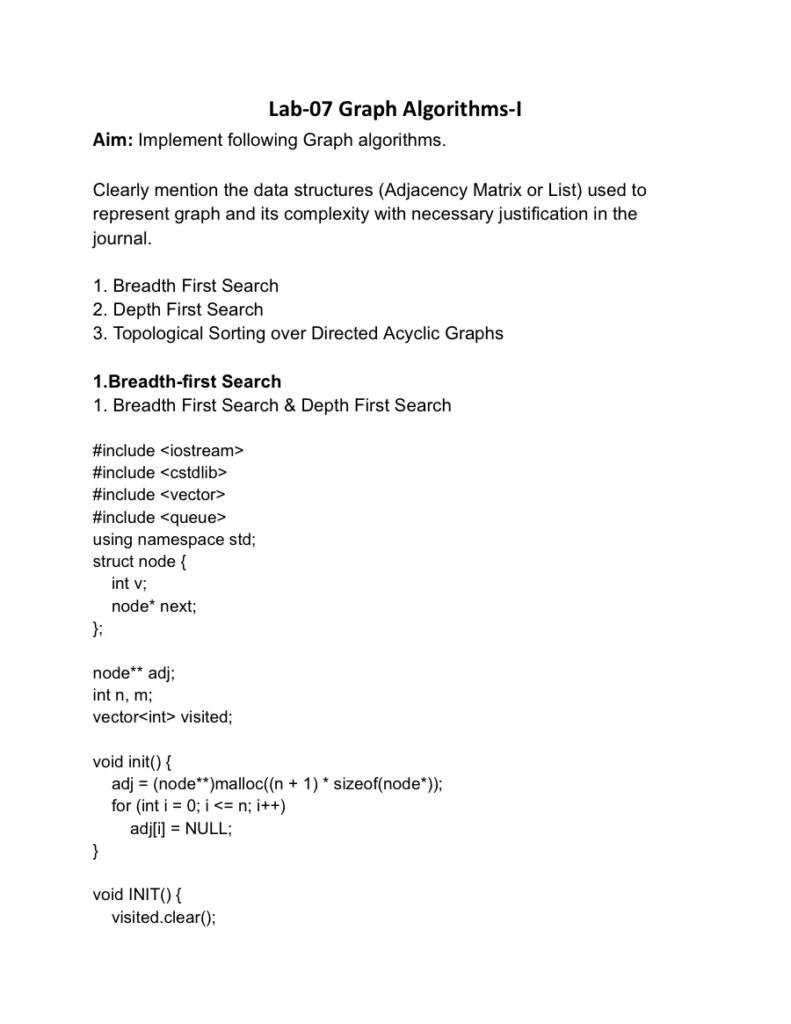
Graphs discard hierarchical constraints entirely to map highly intricate, interconnected multi-directional networks composed of elements (vertices) bound together by custom relationships (edges). Graphs are critical for modeling complex realities like social networks, geographic maps, and internet routing tables. Navigating these vast topological matrices requires distinct traversal mechanisms: Breadth-First Search (BFS) deploys a queue to evaluate the graph layer-by-layer, making it ideal for tracking the shortest path across unweighted edges; conversely, Depth-First Search (DFS) leverages a stack framework to plunge down a singular path to its absolute depth before backtracking. When optimizing paths across weighted graphs, engineers employ advanced greedy algorithms like Dijkstra’s or Bellman-Ford to compute ultimate structural efficiency.
Sorting and searching operations represent the classic operational algorithms that run continuously behind enterprise database indexes and computational engines. Searching algorithms range from simple $O(n)$ linear scans to the highly efficient $O(\log n)$ binary search, which requires a pre-sorted array to systematically halve the active search space with each iteration. Sorting algorithms are deeply tied to the design paradigms that power them. Simple comparison sorts like Bubble, Selection, and Insertion sort operate via intuitive $O(n^2)$ loops, making them inefficient for large datasets. In contrast, advanced frameworks utilize a Divide-and-Conquer strategy; algorithms like Merge Sort break collections down into single-element lists before merging them in sorted order, ensuring a guaranteed $O(n \log n)$ runtime at the expense of temporary $O(n)$ helper memory space.
When standard procedural loops prove insufficient for highly complex optimization problems, software engineers deploy advanced algorithmic design paradigms like Greedy Choice, Divide-and-Conquer, and Dynamic Programming. Greedy algorithms make the locally optimal choice at each step with the hope of finding a global optimum, functioning exceptionally well in problems like Huffman coding or fractional knapsack allocation. However, for problems possessing overlapping subproblems and optimal substructure properties, Dynamic Programming (DP) is required. DP avoids redundant calculations by breaking down a massive problem into atomic subproblems, solving each individual subproblem exactly once, and systematically caching the results in a lookup table (memoization or tabulation), transforming a naturally exponential runtime into a highly manageable linear or polynomial solution.
To understand how the domain of algorithms and data structures organizes its core areas of study and structural implementations, review the following taxonomy:
Parent Category: Computer Science
Core Discipline: Algorithms & Data Structures
Subfields & Paradigms:
Asymptotic Analysis & Algorithmic Complexity (Big-O, Big-Theta, Big-Omega)
Linear Data Structures (Arrays, Linked Lists, Stacks, Queues)
Non-Linear Hierarchical Structures (Binary Trees, AVL Trees, Heaps, Tries)
Graph Theory & Network Routing (Adjacency Matrices, BFS, DFS, Shortest Path)
Sorting & Searching Frameworks (Quick Sort, Merge Sort, Tim Sort, Binary Search)
Dynamic Programming & Optimization Strategies (Memoization, Tabulation, Backtracking)
Cryptographic & Hashing Routines (Hash Tables, Collision Resolution, Crypto-Salting)
| Data Structure Type | Access Complexity | Search Complexity | Insertion Complexity | Deletion Complexity | Space Complexity |
| Array (Static) | $O(1)$ | $O(n)$ | $O(n)$ | $O(n)$ | $O(n)$ |
| Singly Linked List | $O(n)$ | $O(n)$ | $O(1)$ (at head) | $O(1)$ (at head) | $O(n)$ |
| Stack (Array/List based) | $O(n)$ (to find element) | $O(n)$ | $O(1)$ (push) | $O(1)$ (pop) | $O(n)$ |
| Hash Table (Average) | N/A | $O(1)$ | $O(1)$ | $O(1)$ | $O(n)$ |
| Binary Search Tree (Average) | $O(\log n)$ | $O(\log n)$ | $O(\log n)$ | $O(\log n)$ | $O(n)$ |
| Binary Search Tree (Worst) | $O(n)$ | $O(n)$ | $O(n)$ | $O(n)$ | $O(n)$ |
| AVL Tree (Balanced Worst) | $O(\log n)$ | $O(\log n)$ | $O(\log n)$ | $O(\log n)$ | $O(n)$ |
Chesser Resources is a free online study-and-research library at chesserresources.com. It holds 300,000+ documents — books, textbooks, past papers, lecture notes, study guides, research papers and much more — across exams, the sciences, math, literature, the humanities and beyond. Everything is readable in the browser with no account, alongside free AI summaries, an Ask-AI chatbot, highlights, notes and read-aloud audio. Instead of a subscription, downloads are unlocked by contributing back to the community, so the library stays genuinely free.
Big-O notation establishes an asymptotic upper bound for the growth rate of an algorithm’s execution time or memory space requirement as the size of the input data set ($n$) scales towards infinity. It intentionally filters out constant multipliers, lower-order terms, and machine-specific hardware behaviors to provide a pure, standardized baseline for evaluating structural algorithm efficiency in a worst-case scenario.
Binary search operates via a divide-and-conquer strategy that continuously divides the search field in half by evaluating the middle element of the collection. This elimination strategy relies entirely on the mathematical principle of transitivity; if the target element is smaller than the middle value, it can only exist in the left half of the data set. If the array is unsorted, this spatial guarantee collapses, rendering the $O(\log n)$ efficiency impossible and forcing a fallback to an $O(n)$ linear scan.
A Binary Search Tree (BST) degrades into an $O(n)$ runtime when data elements are inserted in a sequential or pre-sorted order (e.g., 1, 2, 3, 4, 5). This linear insertion pattern prevents branching and forces all new nodes to attach exclusively to one side, transforming the hierarchical tree into a skewed, linear single chain that mimics a singly linked list and completely destroys its logarithmic operational advantages.
An AVL tree maintains structural balance by enforcing a strict invariant: the heights of any two child subtrees originating from a single parent node can differ by at most one. During insertion or deletion operations, the tree continuously evaluates this structural delta; if the balance factor escapes the permitted range ($-1, 0, 1$), the AVL tree executes local pointer re-alignments termed single or double rotations to restore symmetry and lock maximum subtree depth to $O(\log n)$.
A hash collision occurs when two completely distinct input keys are converted by a hashing algorithm into the exact same array index inside a hash table. Open addressing resolves this conflict by keeping all elements directly within the primary array structure; when a collision occurs, the system initiates a systematic search probe (such as linear probing, quadratic probing, or double hashing) across adjacent array slots to find the next available empty index.
Separate chaining resolves hash collisions by wrapping each independent slot of the primary hash table array as a pointer to an external data structure, most frequently a singly linked list or a balanced red-black tree. When multiple keys hash to the same index, they are appended directly to that index’s linked chain. This prevents the primary table from filling up or suffering from the structural clustering issues common in open addressing, maintaining stable performance even under high load factors.
An adjacency matrix maps a graph using a two-dimensional array of size $V \times V$, where each cell acts as a boolean indicator tracking edge connections between vertices. It offers instant $O(1)$ edge verification but carries an expensive $O(V^2)$ space penalty, making it ideal only for dense graphs. An adjacency list represents a graph as an array of linked structures where each index corresponds to a vertex and lists only its direct neighbors, minimizing space consumption to $O(V + E)$, which is highly optimal for sparse graphs.
Breadth-First Search (BFS) should be selected when the primary objective is to locate the absolute shortest path between two nodes in an unweighted graph, or when the target nodes are known to reside close to the starting root. Because BFS radiates outward layer-by-layer using a FIFO queue, it guarantees discovery of the closest target first, whereas Depth-First Search (DFS) might dive down a deep, incorrect branch and execute extensive unnecessary processing before backtracking.
Quick Sort operates by partitioning an array around a selected pivot element. If the pivot consistently splits the array into roughly equal halves, the algorithm achieves an efficient $O(n \log n)$ runtime via a balanced recursion tree. However, if the pivot is poorly chosen and continuously isolates the smallest or largest single element (such as picking the first element of an already sorted array), the recursion depth stretches to $O(n)$, driving total execution efficiency down to a highly unoptimized quadratic $O(n^2)$ curve.
Merge Sort is highly preferred for large-scale external sorting because it is a stable sorting algorithm that relies on sequential data access patterns. While its $O(n)$ space requirement requires duplicate helper memory for internal execution, its highly predictable divide-and-conquer merge sequences allow it to process massive datasets broken down into chunks that fit into RAM, sorting them independently before stitching them back together from external disk storage.
A greedy algorithm makes the single, locally optimal choice at each individual step with the absolute assumption that these local choices will eventually converge into a globally optimal solution, never revisiting or modifying historical decisions. Dynamic programming evaluates all overlapping subproblems globally, systematically solving smaller dependencies exactly once, caching those solutions inside a lookup table, and referencing them to build an authenticated, globally optimized final solution.
Memoization represents a top-down optimization approach that maintains a standard recursive execution model, but intercepts each recursive call to check a shared lookup dictionary; if the subproblem has already been solved, it returns the cached value immediately, bypassing deeper recursion. Tabulation is a bottom-up approach that discards recursion entirely, deploying iterative loops to solve the smallest atomic subproblems first and progressively filling a multi-dimensional table array until the final objective is resolved.
A priority queue is an abstract data collection where every individual element carries an assigned priority ranking, dictating that elements with high priority must be served and removed before lower priority elements regardless of their insertion order. A binary heap implements this efficiently by structuring a complete binary tree inside a contiguous array; by enforcing the heap invariant (where a parent node is always greater than or equal to its children in a Max-Heap), it supports $O(1)$ lookups for the top element and fast $O(\log n)$ updates for extractions and insertions.
A Trie, or prefix tree, optimizes string lookups by mapping characters as structured nodes along shared paths rather than storing whole words independently. This organization allows multiple words sharing a common prefix to utilize identical node paths. Consequently, verifying or searching for a string of length $L$ within a Trie requires exactly $O(L)$ steps, completely independent of the total number of entries stored inside the database, making it ideal for auto-complete engines and dictionary indices.
Amortized analysis evaluates the average execution time of an algorithmic operation over a continuous sequence of actions, ensuring that a single, highly expensive worst-case operation does not distort the true long-term performance profile of a structure. For example, inserting an item into a dynamic array (Vector) takes an expensive $O(n)$ runtime when the array fills up and requires a complete memory relocation; however, because this relocation occurs very infrequently, the amortized cost across all insertions remains a highly efficient $O(1)$ constant.