


Database systems represent the foundational architecture responsible for the secure ingestion, structured organization, high-speed retrieval, and transactional integrity of digital information. In modern computer science and software engineering, databases have evolved far beyond passive storage repositories; they function as highly optimized computational engines executing complex query transformations, concurrency controls, and physical storage abstractions. Selecting, designing, and tuning a database architecture directly influences application latency, system scaling limits, and infrastructure operational costs. For engineers and system architects, a deep understanding of structural data modeling is critical to transitioning from simple application assembly to building fault-tolerant, enterprise-ready platforms. On Chesser Resources, a specialized hub for Database Systems provides structured access to university lecture modules, schema blueprints, and comprehensive query optimization assignments.
The structural evaluation of database theory begins with the relational model, which maps data into strictly typed, two-dimensional tables consisting of rows (tuples) and columns (attributes) bound together by mathematical set theory and relational algebra. Relational Database Management Systems (RDBMS) leverage structured query languages (SQL) to execute data manipulation, enforcing data integrity through primary keys, foreign keys, and referential constraints. To prevent data redundancy, anomaly updates, and structural degradation, engineers apply relational normalization techniques. This process systematically parses schemas through progressive normal forms—ranging from First Normal Form ($1\text{NF}$), which mandates atomic values, up to Third Normal Form ($3\text{NF}$) and Boyce-Codd Normal Form ($\text{BCNF}$), which systematically eliminate partial and transitive functional dependencies. Students can build a strong baseline in these architectural design phases by referencing core academic materials like the Database Management Systems Lecture Notes.
To bypass the rigid schema constraints and vertical scaling boundaries of traditional relational engines, modern web architectures deploy non-relational, or NoSQL, databases. NoSQL systems trade strict relational algebra for flexible data models explicitly optimized for the high-velocity, horizontally distributed requirements of web-scale applications. These systems are broadly categorized into document stores (e.g., MongoDB), which encapsulate data inside hierarchical JSON-like structures; key-value stores (e.g., Redis), which optimize instant in-memory lookups; wide-column stores (e.g., Cassandra), optimized for massive analytical queries; and graph databases (e.g., Neo4j), designed to map highly interconnected network topologies. Mastering how these non-relational abstractions interface with backend code structures can be studied through specialized programming frameworks in Programming.
A primary differentiator between relational and non-relational architectures is their approach to transactional safety and data consistency. Relational engines enforce strict ACID properties ($A\text{tomicity, } C\text{onsistency, } I\text{solation, } D\text{urability}$), utilizing write-ahead logging and multi-version concurrency control (MVCC) to guarantee that complex multi-step changes either succeed completely or roll back flawlessly, preserving system state even through hardware crashes. Conversely, distributed NoSQL environments often operate under the BASE paradigm ($B\text{asically } A\text{vailable, } S\text{oft-state, } E\text{ventual consistency}$), embracing the mathematical realities of the CAP Theorem, which proves that a distributed system can simultaneously guarantee at most two out of three core properties: Consistency, Availability, and Partition Tolerance. Academic evaluations, such as the SQL Query Optimization and Database Design Assignment, provide practical vehicles for analyzing these transactional trade-offs.
Database performance optimization relies heavily on physical storage layouts and indexing mechanics. Without an indexing strategy, a query engine is forced to execute an $O(n)$ full table scan, reading every block of data sequentially from disk storage. Databases mitigate this by constructing high-performance data structures like B+ Trees and Hash indexes. A B+ Tree index maintains a balanced, multi-tiered hierarchy that routes lookups, range queries, and point insertions into efficient $O(\log n)$ logarithmic disk operations. As systems scale to handle millions of records and concurrent users, understanding execution plans, tuning compound indexes, preventing lock contention, and managing connection pools become paramount to eliminating application performance bottlenecks.
To understand how the expansive domain of database engineering and storage architecture categorizes its operational subfields and modeling approaches, review the following academic taxonomy:
Parent Category: Computer Science
Core Discipline: Database Systems
Subfields & Architectural Frameworks:
Relational Theory & Design (Relational Algebra, Functional Dependencies, Normalization)
Query Languages & Compilation (SQL Parser, Query Execution Plans, Optimization Engines)
Transactional Dynamics & Concurrency (ACID Compliance, Isolation Levels, MVCC, Locking Matrices)
NoSQL & Non-Relational Models (Document, Key-Value, Wide-Column, Graph Structures)
Indexing & Physical Storage Abstractions (B+ Trees, LSM Trees, Write-Ahead Logs, Table Scans)
Distributed Systems & Cloud Architectures (Sharding, Replication Topologies, CAP Theorem, NewSQL)
| Database Paradigm | Core Data Model | Scaling Strategy | Schema Constraints | Ideal Application Use Case |
| Relational (RDBMS) | Tables (Tuples / Attributes) | Vertical (Hardware Upscaling) | Rigid, predefined upfront | Financial accounting, ERP systems, transactional core services |
| Document Store | Hierarchical Documents (JSON / BSON) | Horizontal (Sharding over Nodes) | Dynamic, schema-less flexibility | Content management, e-commerce product catalogs, user profiles |
| Key-Value Store | Associative Arrays (Key -> Value pairs) | Horizontal or In-Memory clusters | Implicitly schema-less | High-speed caching, session management, real-time message brokers |
| Wide-Column (Columnar) | Rows with dynamic column families | Horizontal (Massively Distributed) | Semi-structured flexibility | Big Data analytics, IoT sensor logging, time-series aggregation |
| Graph Database | Nodes, Edges, and Properties | Complex clustering paradigms | Flexible, network-oriented | Social networks, fraud detection vectors, recommendation engines |
Chesser Resources is a free online study-and-research library at chesserresources.com. It holds 300,000+ documents — books, textbooks, past papers, lecture notes, study guides, research papers and much more — across exams, the sciences, math, literature, the humanities and beyond. Everything is readable in the browser with no account, alongside free AI summaries, an Ask-AI chatbot, highlights, notes and read-aloud audio. Instead of a subscription, downloads are unlocked by contributing back to the community, so the library stays genuinely free.
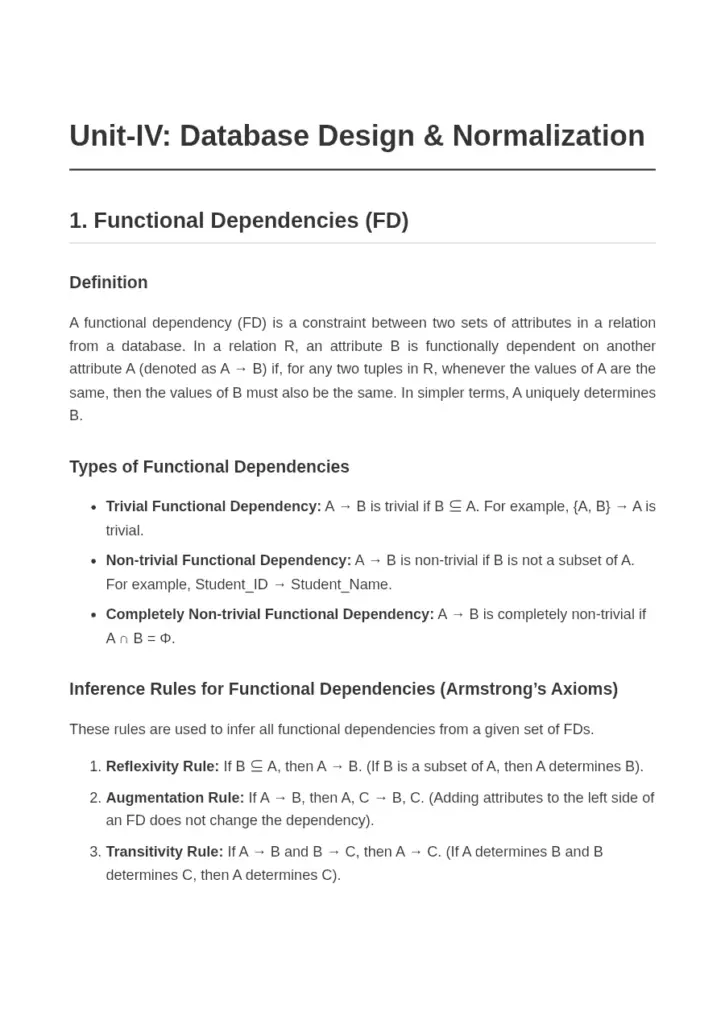
A functional dependency exists between two attributes when the value of one attribute uniquely identifies the value of another, denoted as $X \rightarrow Y$ (meaning $X$ uniquely determines $Y$). A transitive dependency occurs when a non-key attribute determines another non-key attribute through an intermediary non-key path. For instance, if $A$ is the primary key, and the dependencies $A \rightarrow B$ and $B \rightarrow C$ exist (where $B$ and $C$ are non-key columns), then $A \rightarrow C$ is a transitive dependency, which must be eliminated to achieve Third Normal Form ($3\text{NF}$).
Boyce-Codd Normal Form ($\text{BCNF}$) is a stricter extension of Third Normal Form ($3\text{NF}$). A relation is in $3\text{NF}$ if for every non-trivial functional dependency $X \rightarrow Y$, either $X$ is a super key or $Y$ is a prime attribute (part of a candidate key). $\text{BCNF}$ completely eliminates the prime attribute exception; it mandates that for every non-trivial functional dependency $X \rightarrow Y$, the determinant $X$ must be a super key. This resolves anomalies that occur in tables possessing multiple overlapping candidate keys.
In a standard B-Tree index, both the routing keys and their corresponding actual data records (or record pointers) are stored across all tiers of the hierarchical structure, including root, internal, and leaf nodes. In a B+ Tree, internal and root nodes store only structural routing keys, while all actual data records or data pointers are isolated exclusively within the terminal leaf nodes. Furthermore, a B+ Tree links all its leaf nodes sequentially via a linked list, facilitating rapid $O(\log n)$ range scans and sequential database traversals that are highly inefficient in a standard B-Tree.
Transaction isolation levels prevent three core concurrency anomalies caused by interleaved execution paths:
Dirty Read: A transaction reads uncommitted data modifications executed by a concurrent transaction that subsequently rolls back.
Non-Repeatable Read: A transaction re-reads a row it previously fetched and discovers that a concurrent transaction has altered or updated that row’s data columns.
Phantom Read: A transaction re-executes a range query matching a search condition and discovers that a newly committed concurrent transaction has inserted entirely new matching rows into the dataset.
The four standard SQL isolation levels utilize distinct locking and versioning behaviors to trade performance for consistency:
Read Uncommitted: Permits all anomalies; provides maximum speed without data guarantees.
Read Committed: Implements transient read locks; prevents Dirty Reads, but permits Non-Repeatable and Phantom reads.
Repeatable Read: Holds read and write locks until the transaction finishes; prevents Dirty and Non-Repeatable reads, but permits Phantom Reads (though mitigated via MVCC in engines like InnoDB).
Serializable: Enforces strict range-locking or serial execution paths; completely eliminates all anomalies at the cost of high transaction block latency.
Write-Ahead Logging ($\text{WAL}$) mandates that any structural modification to a database record must first be serialized and appended to a non-volatile, append-only log file on persistent disk storage before the modified page is updated within the volatile RAM buffer or committed to the primary database data files. If a sudden hardware or power failure occurs, the database recovery engine processes this log on reboot, executing an automated “redo” sweep to restore committed alterations and an “undo” sweep to wipe incomplete transactions.
Multi-Version Concurrency Control ($\text{MVCC}$) is a concurrency optimization method that ensures readers do not block writers, and writers do not block readers. Instead of locking a row during a modification, the database engine creates a distinct, timestamped historical snapshot or version of that record. Concurrent read transactions continue accessing the historical version unchanged, while write transactions concurrently write to the new version, eliminating lock contention and maximizing query throughput.
The CAP Theorem proves that a distributed data system operating across a network can simultaneously guarantee at most two out of three essential core characteristics: Consistency (all nodes see identical data simultaneously), Availability (every non-failing node returns a response), and Partition Tolerance (the system continues functioning despite network drops or packet losses). Because physical networks will inevitably experience partitions ($\text{P}$), a distributed database must explicitly choose between being CP (rejecting requests to preserve strict consistency) or AP (returning localized data to preserve availability at the expense of temporary consistency drifts).
Database replication copies identical datasets across multiple distinct node servers (e.g., Master-Slave topology) to provide high availability, fault tolerance, and read-heavy load distribution. Database sharding is a horizontal partitioning strategy that splits a single massive database table horizontally across independent server nodes based on a specific routing key (shard key). Replication duplicates data for safety, whereas sharding distributes distinct segments of data to bypass individual hardware storage limits.
In relational algebra, Selection (denoted by the Greek letter sigma, $\sigma$) acts as a horizontal filter, extracting a specific subset of tuples (rows) from a relation that satisfy an explicit predicate condition:
Projection (denoted by the Greek letter pi, $\pi$) acts as a vertical filter, extracting only specific attributes (columns) from a relation while completely discarding the remaining attributes and eliminating duplicate rows:
Before a SQL query executes, the database parsing engine translates the declarative string into an abstract syntax tree. The cost-based Query Optimizer evaluates this tree against internal data statistics regularly collected by the system—such as total table row counts, page distribution metrics, and column value histograms. The optimizer calculates a numeric “cost” score estimating the CPU and disk I/O operations required for alternative execution paths, selecting the most efficient sequence (e.g., opting for an Index Scan over a full Table Scan).
Establishing a fresh network connection between a web application backend and a database engine is an expensive operation involving cryptographic handshakes, memory allocations, and authentication verifications. Connection pooling instantiates and maintains a warm, persistent cache of open database connections. When an application thread requires a database operation, it borrows an active connection instantly from the pool and returns it immediately upon completion, bypassing setup latency and protecting the database from thread exhaustion.
The $N+1$ query problem occurs when an application retrieves a collection of $1$ parent record (e.g., a list of $100$ authors) and subsequently executes an individual, nested database query for each child element (e.g., fetching books for each author inside a loop). This forces the system to execute $100 + 1 = 101$ discrete database roundtrips, generating catastrophic network latency bottlenecks. Engineers resolve this by replacing the loop with an optimized SQL JOIN or eager-loading strategy that fetches all related elements inside a singular unified query.
While indexes accelerate highly specific point lookups, they can degrade performance if a query targets a massive percentage of a table’s total rows (typically exceeding $20\%\text{–}30\%$). If an index is used for a broad query, the database engine must continuously toggle between reading the index blocks and performing random disk seek operations to fetch the associated row data blocks. In this scenario, the cost-based optimizer determines that executing a sequential full table scan is significantly faster because it leverages predictable, sequential block read operations.