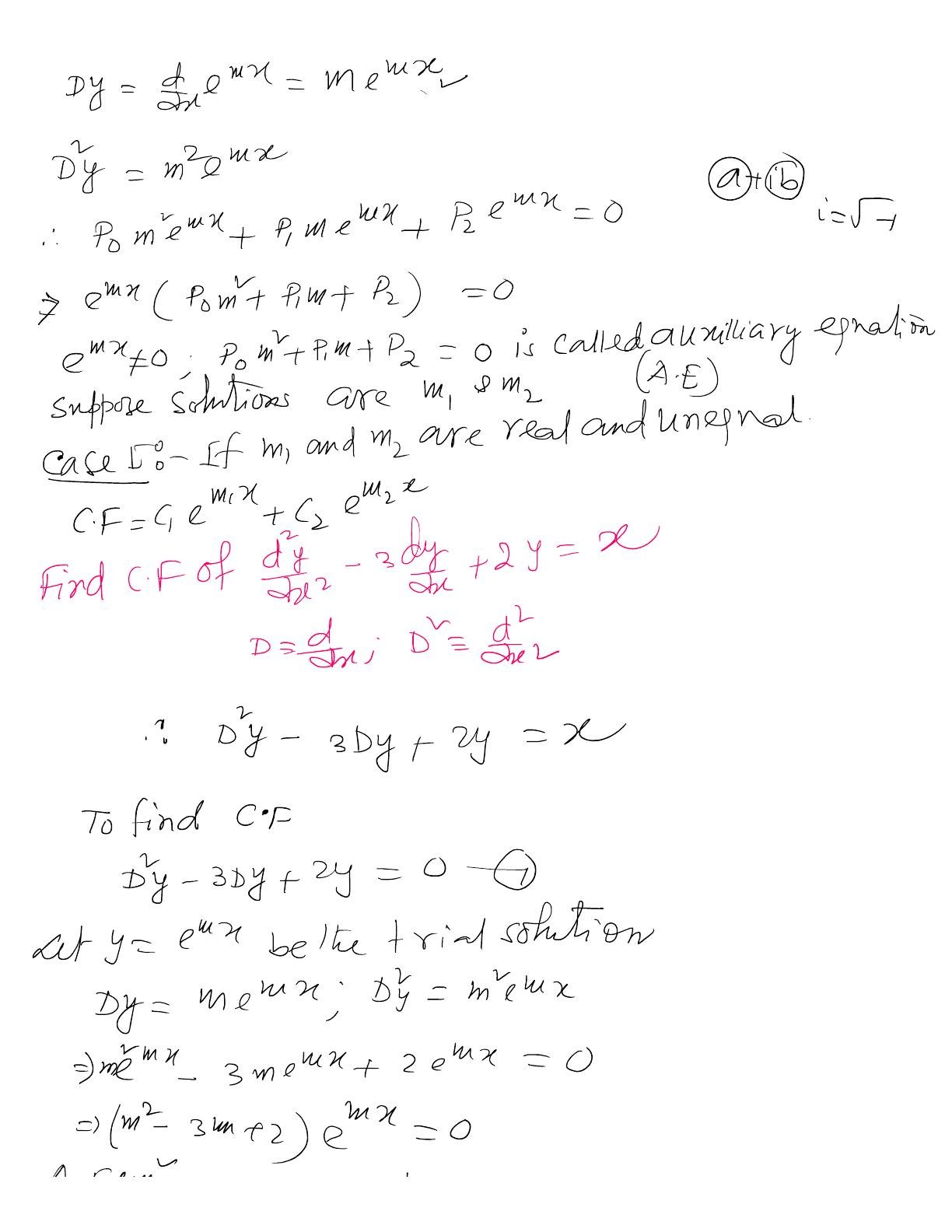
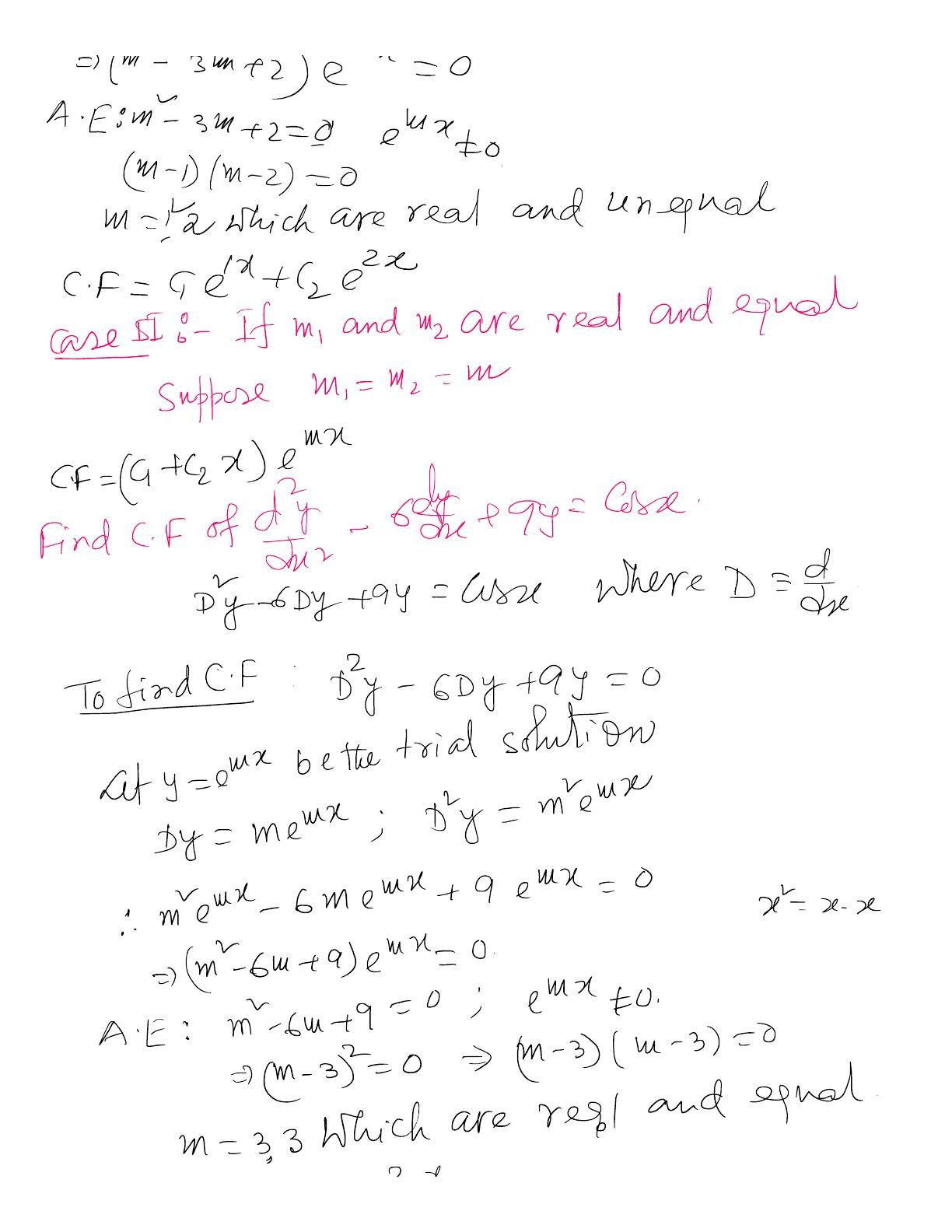
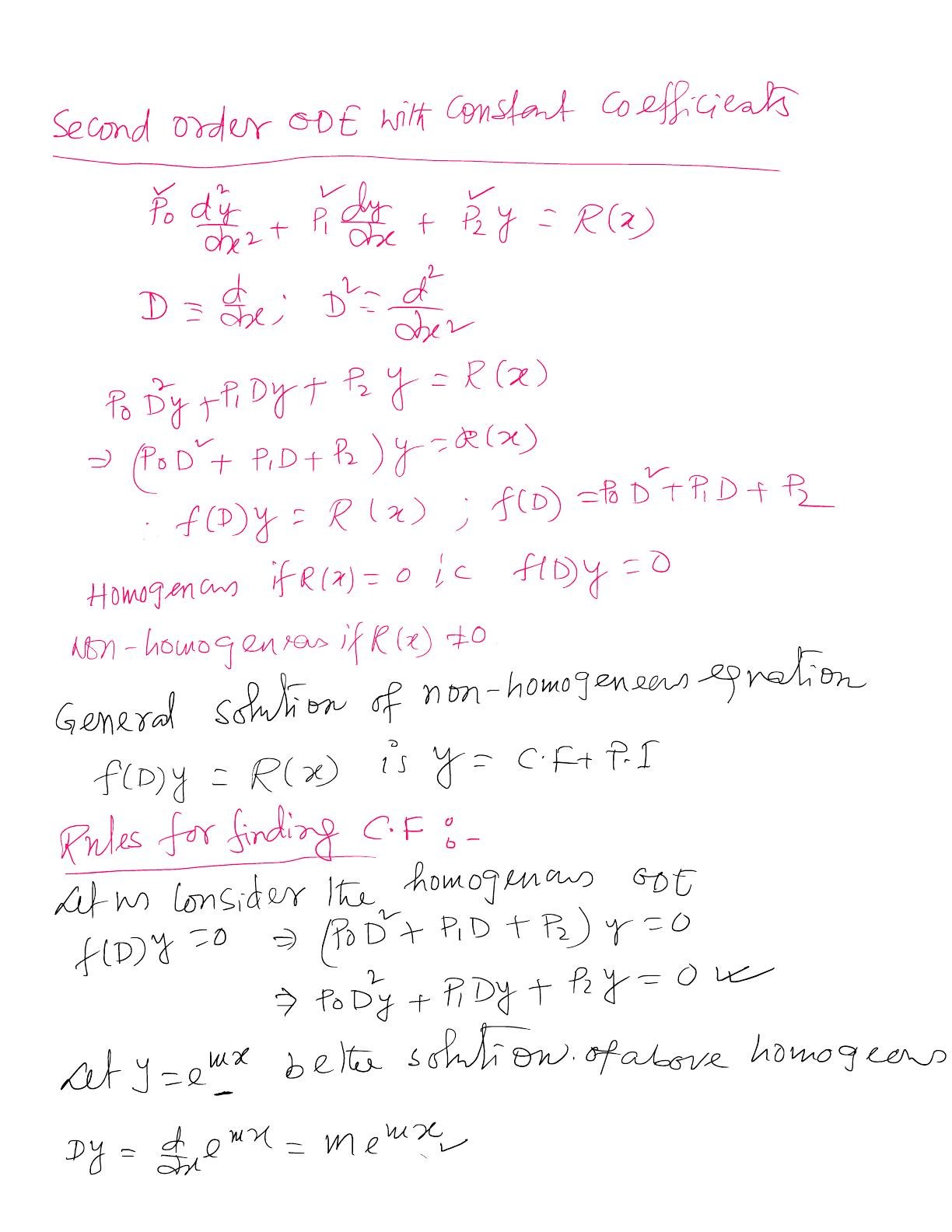
Second order differential equations with constant coefficients are essential in solving various mathematical problems. This document provides detailed explanations and examples of homogeneous and non-homogeneous equations, including methods for finding complementary functions and particular solutions. It covers various cases based on the nature of roots, such as real and equal roots, complex conjugate roots, and distinct real roots. Ideal for students studying advanced mathematics or preparing for exams, this resource includes step-by-step solutions and key concepts necessary for mastering the topic.

Key Points

  • Explains second order differential equations with constant coefficients
  • Covers methods for solving homogeneous and non-homogeneous equations
  • Includes examples for real, equal, and complex roots
  • Provides step-by-step solutions for various cases
112_KOUSHIK BADYAKAR_CSE
5 pages
Language:English
Type:Lecture Notes
112_KOUSHIK BADYAKAR_CSE
5 pages
Language:English
Type:Lecture Notes
397
/ 5
M201/CSE/I
20 April 2026 02:34 PM
New Section 4 Page 1
New Section 4 Page 2
New Section 4 Page 3
/ 5
End of Document
397

FAQs

what are second order differential equations

Second order differential equations are equations involving the second derivative of a function. They are commonly used in physics and engineering to model dynamic systems.

  • These equations can be classified into homogeneous and non-homogeneous types.
  • Homogeneous equations have solutions that can be expressed as linear combinations of their complementary functions.
  • Non-homogeneous equations include additional terms that require particular solutions.

how to solve second order differential equations

To solve second order differential equations, one typically finds the complementary function and a particular solution. The complementary function is derived from the associated homogeneous equation.

  • For real and distinct roots, the solution is a linear combination of exponential functions.
  • For complex roots, the solution involves sine and cosine functions.
  • Particular solutions can be found using methods such as undetermined coefficients or variation of parameters.

what is a homogeneous differential equation

A homogeneous differential equation is one where all terms involve the dependent variable or its derivatives. It can be expressed in the form of a differential equation set to zero.

  • Solutions to homogeneous equations are typically linear combinations of functions derived from the characteristic equation.
  • These solutions are crucial for understanding the behavior of dynamic systems in physics and engineering.

what are the applications of second order differential equations

Second order differential equations have numerous applications across various fields, including physics, engineering, and economics. They are used to model systems such as mechanical vibrations, electrical circuits, and population dynamics.

  • In physics, they describe motion under constant acceleration and oscillatory systems.
  • In engineering, they are essential for analyzing structural stability and control systems.

how to find particular solutions for non-homogeneous equations

Finding particular solutions for non-homogeneous differential equations often involves methods such as undetermined coefficients or variation of parameters. These methods allow for the determination of specific solutions that satisfy the non-homogeneous part of the equation.

  • Undetermined coefficients work well when the non-homogeneous term is a polynomial, exponential, or sinusoidal function.
  • Variation of parameters is a more general method applicable to a wider range of functions.