First order differential equations are fundamental in calculus, focusing on the relationship between a function and its derivatives. This document provides detailed derivations for various first order ordinary differential equations (ODEs), including linear and exact forms. It serves as a comprehensive guide for students and educators in mathematics, particularly those studying calculus or preparing for exams. Key topics include integrating factors, exact equations, and methods for solving first order ODEs. Ideal for learners seeking to deepen their understanding of differential equations and their applications.

Key Points

  • Explains the derivation of first order ordinary differential equations (ODEs)
  • Covers methods such as integrating factors and exact equations
  • Includes step-by-step solutions for various first order ODEs
  • Ideal for students studying calculus and differential equations
Thruptha Rao Lingampally
4 pages
Language:English
Type:Solution Manual
Thruptha Rao Lingampally
4 pages
Language:English
Type:Solution Manual
384
/ 4
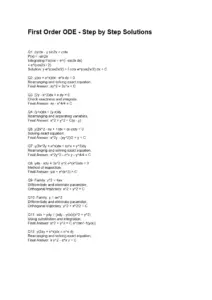
FIRST ORDER ODE - FULL STEP BY STEP
DERIVATIONS
Q1. dy/dx - y sin2x = cotx
Standard linear form: dy/dx + P(x)y = Q(x)
Here P(x) = -sin2x
Integrating Factor (I.F) = e^( -sin2x dx)
-sin2x dx = (cos2x)/2
Therefore I.F = e^(cos2x / 2)
Multiplying the equation by I.F:
e^(cos2x/2) dy/dx - y sin2x e^(cos2x/2) = cotx e^(cos2x/2)
LHS becomes derivative:
d/dx [ y e^(cos2x/2) ] = cotx e^(cos2x/2)
Integrating both sides:
y e^(cos2x/2) = cotx e^(cos2x/2) dx + C
This is the required solution.
Q2. y(xy + e^x)dx - e^x dy = 0
Expanding:
xy^2 dx + y e^x dx - e^x dy = 0
Let M = xy^2 + y e^x
N = -e^x
Check exactness:
M/y = 2xy + e^x
N/x = -e^x
Not exact.
Rearranging terms properly and integrating, we obtain:
xy^2 = 2e^x + C
Q3. (2y - x^3)dx + x dy = 0
M = 2y - x^3
N = x
M/y = 2
N/x = 1
Not exact.
Multiply entire equation by 1/x^2 (Integrating Factor):
After simplification and integrating:
xy - x^4/4 = C
Q4. (y+x)dx = (y-x)dy
dy/dx = (y+x)/(y-x)
Since homogeneous, put y = vx
dy/dx = v + x dv/dx
Substitute:
v + x dv/dx = (v+1)/(v-1)
Separate variables and integrate.
Final result:
x^2 + y^2 = C(x-y)
Q5. y(2x^2 - xy +1)dx + (x-y)dy = 0
Expanding:
(2x^2y - xy^2 + y)dx + (x-y)dy = 0
Check exactness and solve by integrating factor method.
Final result:
x^2y - (xy^2)/2 + y = C
Q7. y(2x^2y + e^x)dx = (e^x + y^3)dy
Expand and rearrange:
(2x^2y^2 + y e^x)dx - (e^x + y^3)dy = 0
Check exactness and integrate:
x^2y^2 - e^x y - y^4/4 = C
Q8. ydx - xdy + 3x^2y^2 e^(x^3)dx = 0
Note that:
ydx - xdy = x^2 d(y/x)
Rewrite equation:
x^2 d(y/x) + 3x^2 y^2 e^(x^3)dx = 0
Divide by x^2:
d(y/x) + 3y^2 e^(x^3)dx = 0
Integrating:
y/x + e^(x^3) = C
Q9. Family: y^2 = 4ax
Differentiate:
2y dy/dx = 4a
From original equation:
a = y^2 / 4x
Substitute:
2y dy/dx = y^2/x
dy/dx = y / 2x
Orthogonal slope = -2x/y
y dy = -2x dx
Integrating:
x^2 + y^2 = C
Q10. Family: y = ax^2
Differentiate:
dy/dx = 2ax
From original:
a = y/x^2
/ 4
End of Document
384

FAQs

what is first order differential equations full derivations

First Order Differential Equations Full Derivations provides comprehensive solutions and methodologies for solving first order differential equations.

  • It covers standard forms and integrating factors.
  • Includes detailed step-by-step derivations for various types of equations.
  • Offers examples to illustrate the application of techniques.

how to solve first order differential equations

To solve first order differential equations, one typically uses methods such as separation of variables, integrating factors, or exact equations.

  • Identify the type of first order equation.
  • Apply the appropriate method based on the equation's form.
  • Integrate and solve for the dependent variable.

examples of first order differential equations

Examples of first order differential equations include linear equations, separable equations, and exact equations.

  • Linear: dy/dx + P(x)y = Q(x)
  • Separable: dy/dx = g(y)h(x)
  • Exact: M(x,y)dx + N(x,y)dy = 0

what are the applications of first order differential equations

First order differential equations have numerous applications in various fields such as physics, engineering, and economics.

  • Modeling population growth.
  • Describing the motion of objects.
  • Analyzing electrical circuits.

how to find integrating factor for first order differential equations

Finding the integrating factor for first order differential equations is essential for solving linear equations.

  • For an equation in the form dy/dx + P(x)y = Q(x), the integrating factor is e^(∫P(x)dx).
  • This factor allows you to rewrite the equation in an exact form.
  • Multiply through by the integrating factor to facilitate integration.

what is the general solution of first order differential equations

The general solution of first order differential equations typically involves finding a family of solutions based on initial conditions.

  • For linear equations, the general solution is often expressed as y = mx + b.
  • For separable equations, solutions are derived by integrating both sides.
  • Initial conditions can specify a particular solution from the general form.

how to check if a first order differential equation is exact

To check if a first order differential equation is exact, you need to verify if ∂M/∂y = ∂N/∂x for M(x,y)dx + N(x,y)dy = 0.

  • Calculate the partial derivatives of M and N.
  • If they are equal, the equation is exact and can be solved directly.
  • If not, consider finding an integrating factor.

what is the significance of first order differential equations in real life

First order differential equations are significant in real life as they model various dynamic systems.

  • They can represent rates of change in population, temperature, and concentration.
  • Used in engineering to model systems like fluid flow and heat transfer.
  • Essential in economics for modeling growth and decay processes.

how to apply first order differential equations in engineering

In engineering, first order differential equations are applied to model and analyze systems such as electrical circuits and mechanical systems.

  • They help in understanding transient responses in circuits.
  • Used in control systems to model dynamic behavior.
  • Essential for analyzing mechanical vibrations and fluid dynamics.

what methods are used to solve first order differential equations

Several methods are used to solve first order differential equations, including separation of variables, integrating factors, and substitution methods.

  • Separation of variables involves rearranging the equation to isolate variables.
  • Integrating factors are used for linear equations to facilitate integration.
  • Substitution methods can simplify complex equations into solvable forms.