1
SERIES SOLUTION OF SECOND ORDER LINEAR DIFFERENTIAL EQUATIONS
WITH VARIABLE COEFFICIENTS
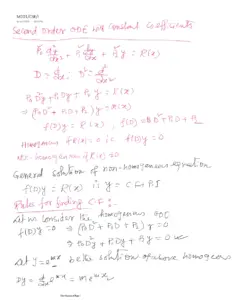
The second-order linear differential equations with variable coefficients are differential
equations whose coefficients are a function of a certain variable. A second-order linear
differential equation has a general form
where P, Q, R and G are functions of the independent variable x. If P, Q and R are some constant
quantities, then the above equation is known as a second-order linear differential equation with
constant coefficients. If G = 0 then the equation is called a homogeneous linear differential
equation of second order, otherwise it is non-homogenous.
A second-order ODE is called linear if it can be written in the form in Eqn. (1) above and
nonlinear if it cannot be written in this form.
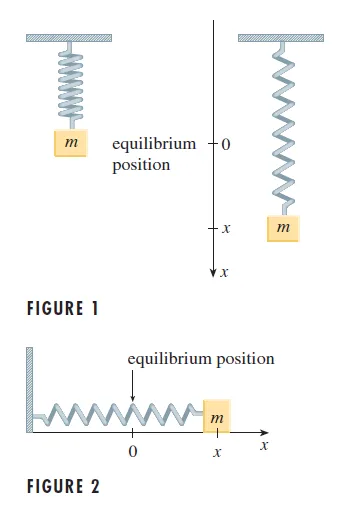
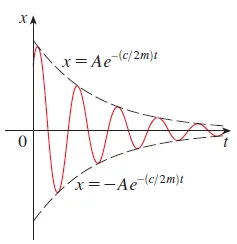
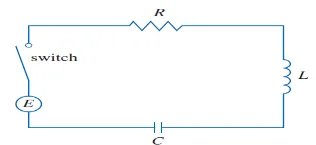
These equations have important engineering applications, especially in connection with
mechanical and electrical vibrations, as well as in wave motion, heat conduction, and other
parts of physics
Solutions to Homogeneous 2
nd
Order DE
Solution of a second order differential equation consisting of two parts; a complementary
function which is the solution of the differential equation whose R.H.S. is zero and a particular
integral which relates the RHS to the LHS of the equation
Thus, Complete Solution = Complementary Function + Particular Integral
To solve a second order homogeneous ODE when G(x) = 0, we look at the characteristic
equation, obtained by replacing the differentials in the form
The solution to the quadratic equation above gives a three-case solution: the case when the
roots of the characteristic equation are distinct and real, complex or equal.
CASE I: When
The Roots are Real and Different
CASE II: When
The Roots are Real and Equal
CASE III: When
The Roots are complex
Examples
1. Solve the equation
Solution
2. Solve the equation
Solution
3. Solve the equation
Solution