Digital electronics focuses on binary arithmetic and complements, essential for understanding digital systems. This resource covers binary addition, subtraction, multiplication, and division, providing examples and exercises for practice. It also delves into 1’s and 2’s complements, crucial for representing negative numbers in computing. Ideal for students and professionals seeking to enhance their knowledge in digital electronics and binary operations, this guide offers clear explanations and practical applications. Topics include signed numbers, binary operations, and their significance in computer architecture.

Key Points

  • Explains binary arithmetic operations including addition, subtraction, multiplication, and division.
  • Covers the concepts of 1’s and 2’s complements for representing negative numbers.
  • Includes practical examples and exercises for binary operations.
  • Discusses the significance of signed numbers in digital systems.

Devy dacker nickson
26 pages
Language:English
Type:Lecture Notes
Devy dacker nickson
26 pages
Language:English
Type:Lecture Notes
74
/ 26
Binary Arithmetic
Recap
Binary arithmetic is essential in all digital computers and in
many other types of digital systems.
To understand digital systems, you must know the basics of
binary addition, subtraction, multiplication, and division.
Binary Addition
Note: In binary 1 + 1 + 10, not 2.
Example:
Add the following binary numbers:
(a) 11 + 11 (b) 100 + 10
(c) 111 + 11 (d) 110 + 100
Binary Subtraction
Note: In binary 10 - 1 = 1, not 9.
Example:
Perform the following binary subtractions:
(a) 11 - 01 (b) 11 – 10 ( c ) 111 - 100
/ 26
End of Document
74

FAQs

what is binary arithmetic in digital electronics

Binary arithmetic is fundamental in digital electronics, as it forms the basis for all computations in digital systems.

  • It includes operations such as addition, subtraction, multiplication, and division.
  • Understanding binary arithmetic is essential for grasping how digital circuits and processors function.
  • Binary numbers are represented using only two digits: 0 and 1.

how to perform binary addition in digital electronics

Binary addition in digital electronics follows specific rules that differ from decimal addition.

  • For example, 1 + 1 in binary equals 10, not 2.
  • To add binary numbers, align them by their least significant bit (LSB) and add each column, carrying over when necessary.
  • Common examples include adding 11 + 11 and 100 + 10.

what is 1's complement in digital electronics

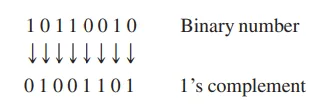
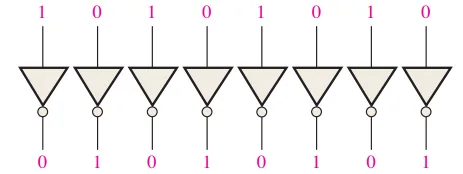
The 1's complement of a binary number is obtained by flipping all bits: changing 0s to 1s and 1s to 0s.

  • This method is crucial for representing negative numbers in binary.
  • For instance, the 1's complement of 1010 is 0101.
  • It is often used in conjunction with 2's complement for arithmetic operations.

how to find 2's complement in digital electronics

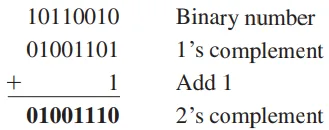
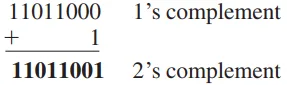
The 2's complement of a binary number is found by adding 1 to the 1's complement of that number.

  • To illustrate, if the 1's complement of 1010 is 0101, adding 1 gives 0110.
  • This method allows for easier arithmetic operations with negative numbers.
  • Alternatively, one can invert the bits and add 1 to the least significant bit (LSB).

what are signed numbers in digital electronics

Signed numbers in digital electronics represent both positive and negative values using binary systems.

  • They can be expressed in various forms, including sign-magnitude, 1's complement, and 2's complement.
  • The left-most bit (sign bit) indicates whether the number is positive (0) or negative (1).
  • Among these forms, 2's complement is the most commonly used for arithmetic operations.

how to convert binary to decimal in signed numbers

To convert signed binary numbers to decimal, the method varies based on the representation used.

  • In sign-magnitude, sum the weights of the magnitude bits and apply the sign based on the sign bit.
  • For 1's complement, sum the weights of the bits and adjust for the sign bit accordingly.
  • In 2's complement, the sign bit has a negative weight, affecting the final decimal value.

what is the significance of the sign bit in digital electronics

The sign bit is the left-most bit in a signed binary number, indicating whether the number is positive or negative.

  • A sign bit of 0 denotes a positive number, while 1 indicates a negative number.
  • This bit is crucial for interpreting the value of signed numbers in binary arithmetic.
  • Understanding the sign bit is essential for accurate computations in digital systems.

how to express negative numbers in binary

Negative numbers can be expressed in binary using methods like sign-magnitude, 1's complement, and 2's complement.

  • In sign-magnitude, the sign bit is set to 1 while the magnitude is represented as usual.
  • 1's complement involves flipping the bits of the positive equivalent.
  • 2's complement is obtained by taking the 1's complement and adding 1.

what are the operations in binary arithmetic

Binary arithmetic includes several fundamental operations essential for digital electronics.

  • Addition: Combining two binary numbers.
  • Subtraction: Determining the difference between binary numbers.
  • Multiplication: Similar to decimal multiplication but using binary rules.
  • Division: Dividing binary numbers, often using a calculator for complex operations.

how do processors use binary numbers

Processors utilize binary numbers to perform calculations and manage memory locations in digital systems.

  • Binary numbers allow processors to represent data and instructions efficiently.
  • They are essential for executing arithmetic operations and logical comparisons.
  • Understanding binary is crucial for programming and designing digital circuits.