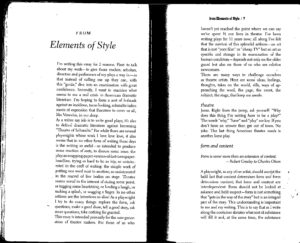
The Elements of Style, authored by William Strunk Jr., is a foundational guide on the principles of English style and composition. This classic text outlines essential rules of usage, principles of composition, and commonly misused expressions. Aimed at writers, students, and educators, it serves as a vital resource for improving clarity and precision in writing. Key topics include grammatical rules, effective sentence structure, and stylistic choices that enhance communication. First published in 1918, this edition remains relevant for anyone looking to refine their writing skills.

Key Points

  • Covers essential rules of usage for clear writing and grammar
  • Explains principles of composition to improve writing style
  • Includes commonly misused expressions and their corrections
  • Provides practical examples to illustrate writing concepts
newtopiccyclegrowin
Author:William Strunk Jr.
54 pages
Language:English
Type:Textbook
newtopiccyclegrowin
Author:William Strunk Jr.
54 pages
Language:English
Type:Textbook
392
/ 54
Transcriber's Notes:
Every effort has been made to replicate this text as faithfully as
possible, including inconsistencies in spelling and hyphenation.
Some corrections of spelling and punctuation have been made.
They are marked like this in the text. The original text appears
when hovering the cursor over the marked text. A list of
amendments is at the end of the text.
THE
ELEMENTS OF STYLE
BY
WILLIAM STRUNK, JR.
PROFESSOR OF ENGLISH
IN
CORNELL UNIVERSITY
NEW YORK
HARCOURT, BRACE AND COMPANY
COPYRIGHT, 1918, 1919, BY
WILLIAM STRUNK, JR.
COPYRIGHT, 1920, BY
HARCOURT, BRACE AND HOWE, INC.
THE MAPLE PRESS YORK PA
/ 54
End of Document
392

FAQs

What are the elementary rules of usage in Strunk's book?
In 'The Elements of Style,' William Strunk Jr. outlines several elementary rules of usage that are fundamental to writing. For instance, Rule 1 states that the possessive singular of nouns is formed by adding 's, regardless of the final consonant. Rule 2 emphasizes the use of a comma in a series of three or more terms with a single conjunction. Additionally, Rule 3 advises enclosing parenthetic expressions between commas, while Rule 4 instructs placing a comma before a conjunction introducing a coordinate clause. These rules aim to improve clarity and consistency in writing.
What is the main purpose of 'The Elements of Style'?
The primary aim of 'The Elements of Style' is to provide concise guidelines for writing in plain English. Strunk's book seeks to simplify the teaching of writing by concentrating on essential rules of usage and principles of composition that are most commonly violated. By focusing on a limited number of rules, such as those regarding punctuation and sentence structure, the book helps writers develop clarity and style in their writing. This approach allows students and instructors to address common writing issues effectively.
How does Strunk define the active voice in writing?
In 'The Elements of Style,' Strunk defines the active voice as being more direct and vigorous than the passive voice. He argues that sentences written in the active voice are usually clearer and more concise, making them preferable for effective communication. For example, he contrasts 'I shall always remember my first visit to Boston' in the active voice with the passive construction 'My first visit to Boston will always be remembered by me.' Strunk emphasizes that the active voice enhances the liveliness of writing and should be favored whenever possible.
What are some common words and expressions misused according to Strunk?
Strunk identifies several commonly misused words and expressions in 'The Elements of Style.' For instance, he points out that 'due to' is often incorrectly used for 'because of' in adverbial phrases. Additionally, he notes that the word 'literally' is frequently misused to support exaggeration, as in 'a literal flood of abuse.' Strunk also highlights the redundancy of phrases like 'acts of a hostile character,' which can simply be replaced with 'hostile acts.' These observations aim to promote clarity and precision in writing.
What is the significance of the topic sentence in a paragraph?
In 'The Elements of Style,' Strunk emphasizes the importance of the topic sentence as a guiding element in paragraph structure. He recommends that each paragraph begin with a topic sentence that clearly states the main idea, allowing readers to understand the purpose of the paragraph immediately. The succeeding sentences should support or elaborate on this statement, and the final sentence should either reinforce the topic or present a significant consequence. This organization helps maintain coherence and aids readers in following the writer's argument.
What does Strunk say about the use of commas?
Strunk provides specific guidelines on the use of commas in 'The Elements of Style.' He states that a comma should be used to separate items in a series, following Rule 2, which advises placing a comma after each term except the last. Additionally, Rule 4 instructs writers to place a comma before a conjunction that introduces a coordinate clause. Strunk also highlights the importance of enclosing parenthetic expressions between commas, which can clarify the sentence structure and improve readability.
How should a writer express co-ordinate ideas according to Strunk?
Strunk advises that co-ordinate ideas should be expressed in similar form, a principle he emphasizes in 'The Elements of Style.' This parallel construction helps readers recognize the relationship between ideas more readily. For example, he suggests that correlative expressions, like 'both...and' or 'not only...but also,' should be followed by the same grammatical construction. Strunk argues that maintaining this consistency in form enhances the clarity and effectiveness of writing.