The Basic Mathematics Syllabus for MTH104 outlines essential mathematical concepts including functions, limits, differentiation, and integration. This syllabus is designed for students seeking to understand mathematical applications in real-world scenarios. Key topics include derivatives, antiderivatives, and differential equations, providing a comprehensive foundation for further studies in mathematics. Ideal for first-semester students, it includes various exercises and worked examples to enhance learning and problem-solving skills.

Key Points

  • Covers functions, limits, and continuity essential for calculus understanding.
  • Includes differentiation techniques and applications of derivatives.
  • Explains integration concepts with a focus on antiderivatives and definite integrals.
  • Features exercises and worked examples for practical application of mathematical theories.
Sewang Rai.2
4 pages
Language:English
Type:Textbook
Sewang Rai.2
4 pages
Language:English
Type:Textbook
158
/ 4
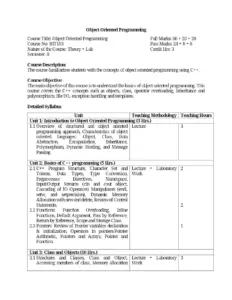
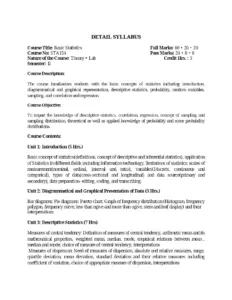
Basic Mathematics
Detail Course MTH104
Course Title: Basic Mathematics Full Marks: 60 + 40
Course No: MTH104 Pass Marks: 24 + 8 + 8
Nature of the Course: Theory Credit Hrs: 3
Semester: I
Course Description:
This course familiarizes students with functions, limits, continuity, differentiation, integra-
tion of function of one variable, logarithmic, exponential, applications of derivative and
antiderivatives, differential equations, partial derivatives.
Course Objectives:
1. Students will be able to understand and formulate real world problems into mathe-
matical statements.
2. Students will be able to develop solutions to mathematical problems at the level ap-
propriate to the course.
3. Students will be able to describe or demonstrate mathematical solutions either numer-
ically or graphically.
Unit 1 Functions and their graphs [5 Hrs.]
Definition, domain range, Graphs of functions, Representing a function numerically, the ver-
tical line test for a function, Piecewise defined functions, Increasing and decreasing functions,
Even and odd function, Common functions: linear, power, polynomial, rational functions
All worked out examples of 1.1.
Exercises 1.1: 1-8, 15, 18, 23, 25, 26.
1.2: Combining functions:Shifting and Scaling graphs
Sums, differences, products and quotients, Composite functions, Shifting a graph of a func-
tion.
Worked out examples: 1-5
Exercises 1.2: 1-8.
1.4: Graphing with calculator and computers (desmos may be easy) to plot the graph of the
functions (some of the functions):
y = x, y = x
2
, y =
1
1 x
, y = sin x, y = cos x, y = sin 100x
1.5: Exponential functions: Definition, Exponential behavior, Exponential growth and decay.
Worked out examples: 1-4.
Exercises 1.5: 29-33
1.6: Inverse Functions and Logarithms
Worked out examples: 1 - 4, 6, 7.
Exercises 1.5: 79 - 81
2.1: Rate of change and tangent to curves.
Worked out examples: 1-5.
Exercises 2.1: 1, 3, 6, 7, 9, 15, 17.
Unit 2. Limits and continuity [3 Hrs.]
2.2 Limit of a Function and Limit Laws
Limits of function values, The limit laws, Eliminating zero denominators algebraically, The
Sandwich theorem(no proof).
Worked out examples: 1-11
2.3 The Precise Definition of a Limit

Definition of limit
Worked out examples: 1-5
One sided limit: Worked out Examples 1-4
2.5 Continuity
Worked out examples: 2, 3
Intermediate Value Theorem for Continuous Functions
Worked out examples: 11, 12
2.6 Limits Involving Infinity; Asymptotes of Graphs
Worked out examples 1, 2, 3
Horizontal Asymptotes
Worked out examples: 4-9
Oblique asymptotes
Worked out examples: 10-14
Vertical asymptotes
Worked out examples: 15-19.
Some related problems
Unit 3. Differentiation [3 Hrs.]
3.1 Tangents and the Derivative at a Point
Finding a Tangent to the Graph of a Function
Rates of Change: Derivative at a point
Worked out Examples: 1, 2
Exercises 3.1: 5-8, 11, 12, 13, 23, 24, 25
3.2 The Derivative as a function
Worked out Examples: 4, 5
Differentiable Functions are continuous
3.4 The Derivative as a rate of change
Worked out Examples: 1-7 Ideas of derivatives of trigonometric, inverse trigonometric, log-
arithm, exponential functions and ideas of chain rules.
3.10 Related rates
Worked out Examples: 1-6.
Unit 4 Application of Derivative [5 Hrs.]
4.1 Extreme values of functions: Introduction
Worked out examples: 1-4
Exercise 4.1: 21, 22, 23, 31, 32
4.2 The mean value theorem
Rolle’s Theorem(no proof), Lagrange mean value theorem(no proof)
Worked out examples: 1-4
4.3 Monotonic functions and the first derivative test
Increasing functions and decreasing Functions
Worked out examples: 1, 2, 3
4.4 Concavity and curve sketching
Worked out examples: 1-9
4.5 Indeterminate Forms and LHpitals Rule
Indeterminate form, LHpitals rule
All worked out examples
Exercises 4.5: 1-7, 13, 15. 4.6 Applied optimization
Worked out examples: 1-5
4.7 Newton’s method.
Worked out examples: 1, 2
Examples 4.7: 1-4
Unit 5 Integration [5 Hrs.]
4.8 Antiderivatives
Worked out examples: 1, 2, 3
5.1 Area and Estimating with Finite Sums
Area
worked out examples: 1-4
Exercises 5.1: 1-4
5.2 Sigma notation and limits of finite sums
Worked out examples: 1-5
5.3 The definite integral
Worked out example: 4, 5
5.4 The fundamental theorem of calculus
Mean value theorem for definite integrals, Fundamental theorem of calculus Part 1 and 2
(no proof), The net change theorem
Worked out examples: 2-7
5.5 Indefinite integral and substitution method:
All worked out examples
5.6 Area between the curves
Worked out examples: 4, 5, 6, 7
Exercises 5.6 : 63-66
Unit 6 Application of Definite Integrals [5 Hrs.]
6.1 Volumes using cylindrical shells
Worked out examples: 1-10
6.2 Volumes using cross-sections
Worked out examples: 2, 3
6.3 Arc length
Worked out examples: 1, 2 3, 4, 5
6.4 Areas of surfaces of revolution
Worked out examples: 1, 2
Unit 7 Techniques of Integrations [5 Hrs.]
Review of integration by parts, trigonometric substitutions, integration of rational functions
by partial fractions. Computer algebra system (Maple)
8.6 Numerical Integration
Numerical Integration
Simpsons Rule: Approximations Using Parabolas
Error Analysis
Worked out examples:1-6
Exercises 8.6: 1, 2, 3, 4, 7, 8, 9, 10. 11, 12, 13, 17, 19, 21.
8.7 Improper integrals
Worked out examples: 1-9
Unit 8 First Order Differential Equations [4 Hrs.]
9.1 Solutions, Slope Fields, and Eulers Method
General first order differential equations and solutions
Worked out examples: 1, 2.
Slope Fields: Viewing Solution Curves
Eulers Method
Worked out examples: 3, 4
Exercises 9.1: 11, 12, 13
9.2 First order linear equation
Worked out examples 1, 2, 3
Exercises 9.2: 1-10, 15-21
9.3 Applications
/ 4
End of Document
158

FAQs

What are the main topics covered in the MTH104 Basic Mathematics syllabus?
The MTH104 Basic Mathematics syllabus covers several key topics including functions and their graphs, limits and continuity, differentiation, applications of derivatives, integration, and differential equations. Specifically, it addresses functions, their properties, and various types such as linear, polynomial, and exponential functions. Additionally, the course delves into limits, continuity, and the fundamental concepts of differentiation and integration, along with their applications in real-world scenarios.
What is the significance of the Mean Value Theorem in this syllabus?
The Mean Value Theorem is a crucial concept in the MTH104 syllabus, particularly in Unit 4, which focuses on the application of derivatives. It states that if a function is continuous on a closed interval and differentiable on the open interval, then there exists at least one point in the interval where the derivative of the function equals the average rate of change over that interval. This theorem is fundamental for understanding the behavior of functions and is used to analyze extreme values and monotonic functions.
How does the syllabus address the topic of integration?
Integration is a significant part of the MTH104 syllabus, covered extensively in Unit 5. It includes topics such as antiderivatives, the definite integral, and the fundamental theorem of calculus. The syllabus explains how to estimate areas using finite sums and introduces sigma notation. Additionally, it explores the applications of definite integrals in calculating volumes and areas between curves, providing students with practical techniques for solving real-world problems involving integration.
What types of functions are introduced in the syllabus?
The MTH104 syllabus introduces several types of functions, including linear, power, polynomial, rational, exponential, and trigonometric functions. It emphasizes understanding their graphs, domains, and ranges, as well as characteristics such as increasing and decreasing behavior. The syllabus also covers piecewise defined functions and the concept of inverse functions, providing students with a comprehensive foundation in function analysis.
What is the focus of Unit 3 on Differentiation?
Unit 3 of the MTH104 syllabus focuses on differentiation, examining the concept of the derivative and its applications. It covers the process of finding tangents to the graph of a function and understanding rates of change. The unit also discusses the derivative as a function and introduces ideas related to trigonometric, logarithmic, and exponential functions. Additionally, it includes related rates, which are essential for solving real-world problems involving changing quantities.
What are the applications of derivatives discussed in the syllabus?
The syllabus outlines several applications of derivatives in Unit 4, including finding extreme values of functions, understanding monotonic functions, and analyzing concavity. It discusses the first derivative test for determining increasing and decreasing functions and introduces L'Hôpital's Rule for evaluating indeterminate forms. These applications are crucial for optimizing functions and solving practical problems in various fields.
How does the syllabus define continuity and limits?
In the MTH104 syllabus, continuity and limits are defined in Unit 2. It explains the concept of limits of function values and the limit laws, including techniques for eliminating zero denominators. The syllabus also introduces the precise definition of a limit and discusses one-sided limits. Furthermore, it covers the Intermediate Value Theorem for continuous functions, emphasizing its significance in understanding the behavior of functions.