Justice
Social Justice
54
Political Theory
4.1 WHAT IS JUSTICE?
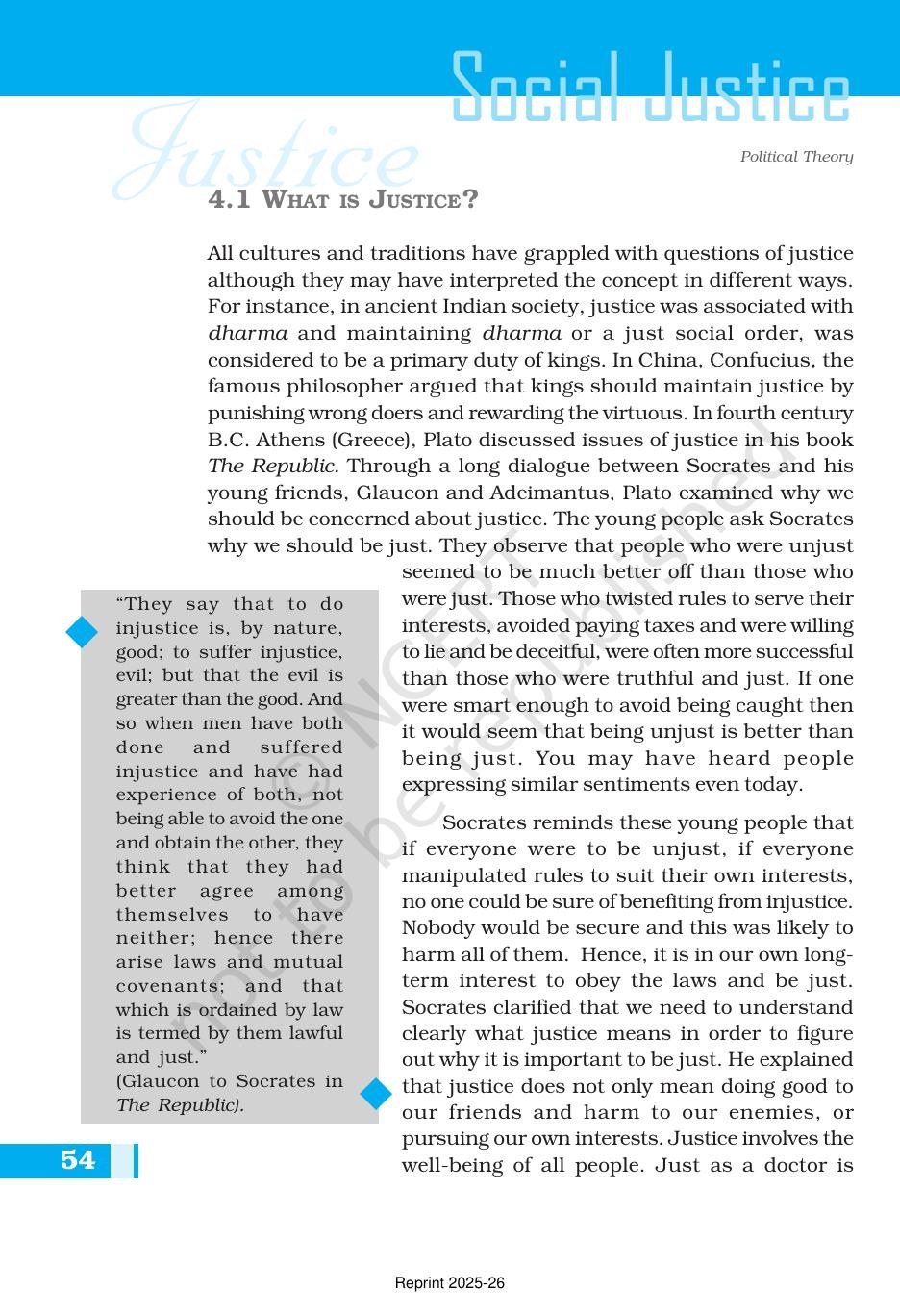
All cultures and traditions have grappled with questions of justice
although they may have interpreted the concept in differ
ent ways.
For instance, in ancient Indian society, justice was associated with
dharma and maintaining dharma or a just social order, was
considered to be a primary duty of kings. In China, Confucius, the
famous philosopher argued that kings should maintain justice by
punishing wrong doers and rewarding the virtuous. In fourth century
B.C. Athens (Greece), Plato discussed issues of justice in his book
The Republic. Through a long dialogue between Socrates and his
young friends, Glaucon and Adeimantus, Plato examined why we
should be concerned about justice. The young people ask Socrates
why we should be just. They observe that people who were unjust
seemed to be much better off than those who
were just. Those who twisted rules to serve their
interests, avoided paying taxes and were willing
to lie and be deceitful, were often more successful
than those who were truthful and just. If one
were smart enough to avoid being caught then
it would seem that being unjust is better than
being just. You may have heard people
expressing similar sentiments even today.
Socrates reminds these young people that
if everyone were to be unjust, if everyone
manipulated rules to suit their own interests,
no one could be sure of benefiting from injustice.
Nobody would be secure and this was likely to
harm all of them. Hence, it is in our own long-
term interest to obey the laws and be just.
Socrates clarified that we need to understand
clearly what justice means in order to figure
out why it is important to be just. He explained
that justice does not only mean doing good to
our friends and harm to our enemies, or
pursuing our own interests. Justice involves the
well-being of all people. Just as a doctor is
“They say that to do
injustice is, by nature,
good; to suffer injustice,
evil; but that the evil is
greater than the good. And
so when men have both
done and suffered
injustice and have had
experience of both, not
being able to avoid the one
and obtain the other, they
think that they had
better agree among
themselves to have
neither; hence there
arise laws and mutual
covenants; and that
which is ordained by law
is termed by them lawful
and just.”
(Glaucon to Socrates in
The Republic).