Geological time outlines the Earth’s history, detailing major evolutionary events in the fossil record. This work by William L. Kruczynski and Pamela J. Fletcher explores the geological time scale, including Eons, Eras, and Periods, and highlights significant events such as the emergence of life and mass extinctions. Ideal for students and researchers interested in paleontology and earth sciences, it provides insights into the evolution of life forms and geological changes over billions of years. The document also discusses the implications of these events on the environment and biodiversity.

Key Points

  • Explains the geological time scale and its significance in understanding Earth’s history
  • Covers major evolutionary events, including the emergence of life and mass extinctions
  • Details the division of geological time into Eons, Eras, and Periods
  • Discusses the impact of geological events on biodiversity and environmental changes
Hameedah
Author:William L. Kruczynski, Pamela J. Fletcher
1 page
Language:English
Type:Textbook
Hameedah
Author:William L. Kruczynski, Pamela J. Fletcher
1 page
Language:English
Type:Textbook
373
/ 1

Chapter : Geographic Setting and Impacts to the Environment
Geographic Setting and Impacts to the Environment
Geological time with major evolutionary events in the
fossil record
William L. Kruczynski and Pamela J. Fletcher
7KHgeological time scale is a method of relating the timing and relationship between events that have occurred
GXULQJWKHKLVWRU\RI WKH(DUWK7KH(DUWKLVPRUHWKDQELOOLRQ\HDUVROGDQGDQDSSUHFLDWLRQRI WKHH[SDQVH
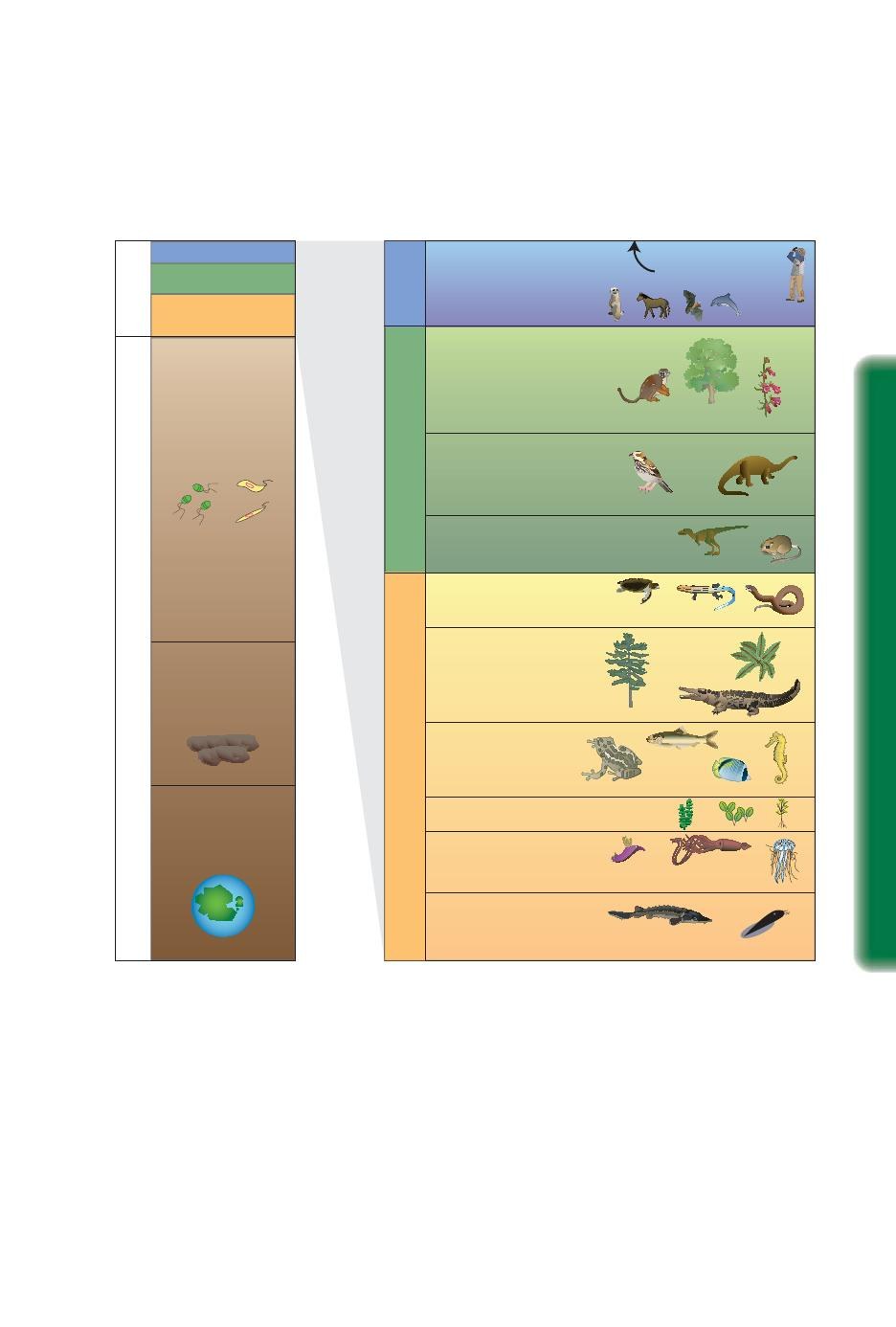
RI JHRORJLFDOWLPHLVGLIÀFXOWWRYLVXDOL]H7KLVFKDUWVKRZVWKHVHTXHQFHRI PDMRUHYROXWLRQDU\HYHQWVWKDWDSSHDU
in the geologic record. Geologists and earth scientists have used the relationship between layers and types of rocks,
presence of plant and animal fossils, and radioactive dating to assemble a sequence of historical events that have
occurred over geologic time.
Geologic time is divided into four large segments called Eons: Hadean, Archean, 3URWHUR]RLFDQG3KDQHUR]RLF
7KH3KDQHUR]RLF(RQLVGLYLGHGLQWR(UDV3DOHR]RLF0HVR]RLFDQG&HQR]RLF7KHGLYLVLRQVDPRQJ(UDVUHÁHFW
PDMRUFKDQJHVLQWKHIRVVLOUHFRUGLQFOXGLQJWKHH[WLQFWLRQDQGDSSHDUDQFHRI QHZOLIHIRUPV(UDVDUHGLYLGHGLQWR
Periods, a unit of geologic time in which a single type of rock system is formed. Some Periods are divided into
Epochs that are not shown on this chart, but a discussion of Epochs appears on subsequent pages in this chapter
WKDWVXPPDUL]HWKHFUHDWLRQRI WKH)ORULGDSHQLQVXODWKHJHRORJ\RI VRXWK)ORULGDDQGWKHFlorida Keys, and the
appearance and disappearance of shorelines and coral reefs.
'DWHVIURPWKH,QWHUQDWLRQDO&RPPLVVLRQRQ6WUDWLJUDSK\0<$ 0LOOLRQ\HDUVDJR
4600
4000
PRECAMBRIAN
PHANEROZOIC
2500
Hadean:
Earth forms
Archean:
Oldest rocks,
Earth curst forms
Proterozoic:
Life begins in sea
542
Paleozoic
Mesozoic
Cenozoic
542
251
65
Paleozoic CenozoicMesozoic
Cambrian:
First fish,
First chordates (animal with backbone)
Ordovician:
Major diversification of animal life
Silurian: First vascular plants
Devonian:
First amphibians,
Fish diversity
Carboniferous:
First reptiles,
Trees, seed ferns
Permian:
Major extinction, Reptiles diversify
Triassic:
First mammals, First dinosaurs
Jurassic:
First birds,
Dinosaurs diversify
Cretaceous:
Extinction of dinosaurs,
First primates,
First flowering plants
Tertiary:
Mammals diversify
Quaternary:
Human evolution
251
65
00
1.8
145
199
299
359
416
444
488
Eon Major eventsMYA PeriodEraMYA
Adapted from Encyclopedia Britanica and www.enchantedlearning.com

/ 1
End of Document
373

FAQs

what is geological time with major evolutionary events in fossil record

Geological time with major evolutionary events in the fossil record is a framework that organizes Earth's history into distinct periods based on significant geological and biological changes.

  • Eons: The largest divisions, including Hadean, Archean, Proterozoic, and Phanerozoic.
  • Periods: Subdivisions of eons, such as the Cambrian and Jurassic, which mark major events like the emergence of life and the age of dinosaurs.
  • Fossil Record: Provides evidence of the evolution of life forms through time, showcasing major transitions in biodiversity.

how is geological time divided in geological time with major evolutionary events in fossil record

Geological time is divided into four main eons, which are further broken down into periods and epochs.

  • Hadean: Formation of Earth.
  • Archean: Oldest rocks and the formation of the Earth's crust.
  • Proterozoic: Emergence of early life forms in the oceans.
  • Phanerozoic: Divided into three eras: Paleozoic, Mesozoic, and Cenozoic, each characterized by significant evolutionary milestones.

what are the major events in geological time with major evolutionary events in fossil record

Major events in geological time with major evolutionary events in the fossil record include significant milestones in the evolution of life on Earth.

  • Cambrian Explosion: Rapid diversification of life forms.
  • Permian Extinction: The largest mass extinction event, leading to the loss of many species.
  • Dinosaur Evolution: Dominance of dinosaurs during the Mesozoic Era.
  • Human Evolution: Development of modern humans in the Quaternary period.

what does geological time with major evolutionary events in fossil record show

Geological time with major evolutionary events in the fossil record shows the chronological sequence of life and major geological changes on Earth.

  • Evolutionary Patterns: Illustrates how life forms evolved from simple organisms to complex ones.
  • Mass Extinctions: Highlights periods of significant biodiversity loss and recovery.
  • Environmental Changes: Reflects how changes in climate and geography influenced the evolution of life.

how does geological time with major evolutionary events in fossil record relate to Earth's history

Geological time with major evolutionary events in the fossil record is essential for understanding Earth's history and the development of life.

  • Chronological Framework: Provides a timeline for significant geological and biological events.
  • Fossil Evidence: Offers insights into past environments and the evolution of species.
  • Geological Processes: Shows how tectonic activity, climate change, and other processes shaped the planet.

what are the epochs in geological time with major evolutionary events in fossil record

Epochs are subdivisions of geological periods that mark significant changes in Earth's history and the evolution of life.

  • Paleocene: Early mammals begin to diversify after the extinction of dinosaurs.
  • Eocene: Development of modern mammal families.
  • Oligocene: Further diversification of mammals and birds.
  • Miocene: Expansion of grasslands and evolution of large herbivores.
  • Pleistocene: Ice ages and the rise of Homo sapiens.