VE
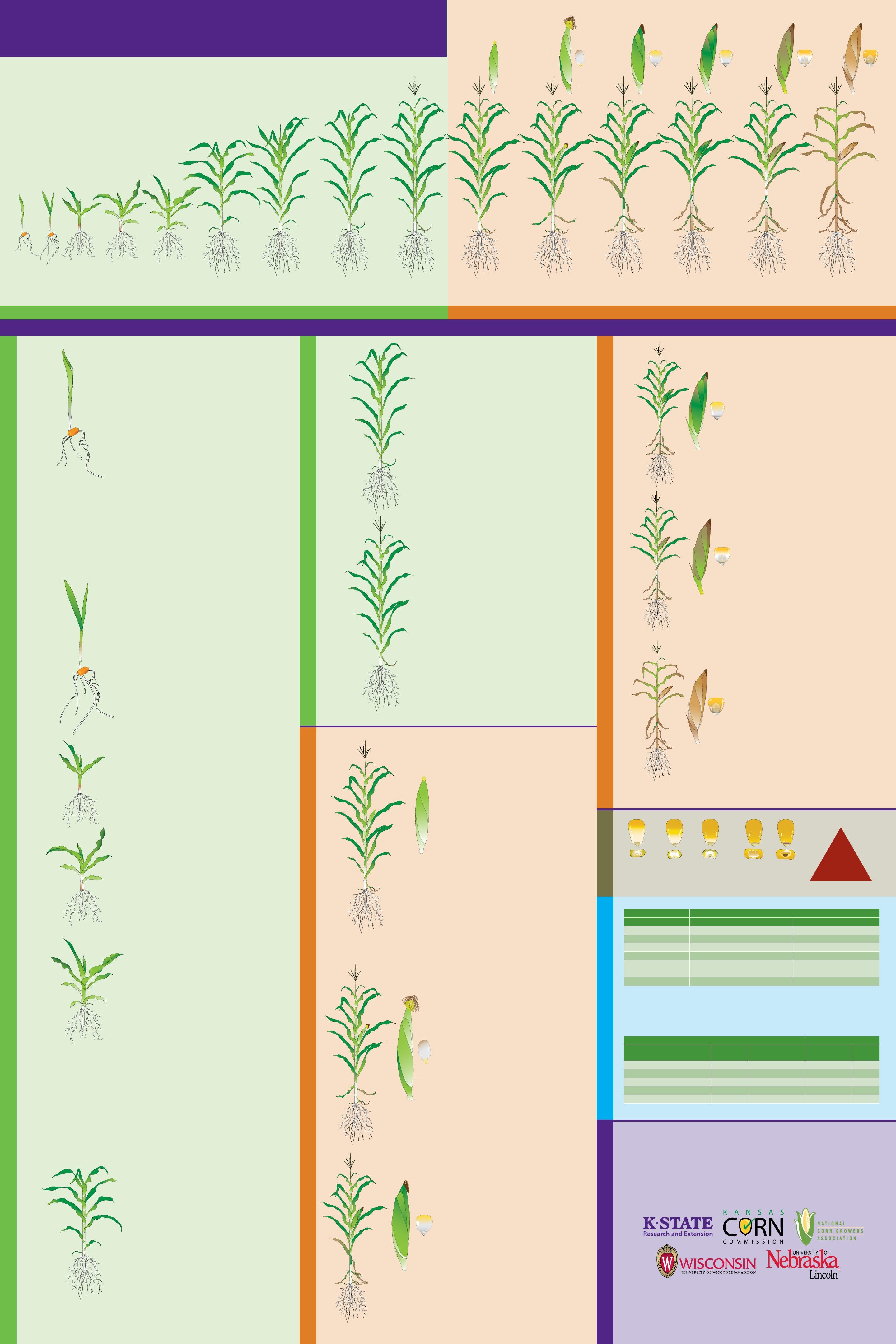
V1 V2 V4 V6 V10 V12 V14 VT R2 R3 R4 R5 R6R1
Vegetative
Reproductive
Reproductive Vegetative
VE – Emergence
Emergence occurs when the first leaves,
called the spike or the coleoptile, appear
above the soil surface. The seed absorbs
water (about 30% of its weight) and
oxygen for germination. The radicle
root quickly emerges near the tip of the
kernel, depending on soil moisture and
temperature conditions. The coleoptile
emerges from the embryo side of the
kernel and is pushed to the soil surface
by mesocotyl elongation. The mesocotyl
encloses the plumule leaves that open as
the structure approaches the soil surface.
Management
Ideal soil temperatures (50 to 55 degrees
Fahrenheit) and moisture conditions
promote rapid emergence (5 to 7 days).
Optimum seed placement varies from
1 to 2 inches deep. Appropriate planting
depth is critical for optimal emergence.
Cold, dry, and deep planting can delay
emergence for several days.
V1 – First-Leaf
One leaf with collar visible (structure
found at the base of the leaf). The first
leaf in corn has a rounded tip. From this
point until flowering (R1 stage), leaf
stages are defined by the uppermost
leaf with visible collars. The growing
point is located below the surface until
the late V5 stage.
Management
Scout for proper emergence (e.g., 30
plants in 171/2 feet for 30-inch row
spacing = 30,000 plants per acre), early-
season weeds, insects, diseases, and
other production issues.
V2 – Second-Leaf
Nodal roots begin to emerge below
ground. Seminal roots begin to senesce.
Frost is unlikely to damage corn
seedling, unless it is extremely cold or
the corn was shallowly planted.
V4 – Fourth-Leaf
Nodal roots are dominant, occupying
more soil volume than seminal roots.
Leaves still developing on apical
meristem (primary growth of the plant).
V6 – Sixth-Leaf
Six leaves with collar visible. The first
leaf with the rounded tip is senescent;
consider this point when counting
leaves. The growing point emerges
above the soil surface. All plant parts
are initiated. Sometime between V6
and V10, the potential number of rows
(ear girth) is determined. Potential row
number is affected by genetics and
environment and is reduced by stress
conditions. The plant increases in height
due to stalk elongation; nodal roots are
established in the lowest, below-ground
nodes of the plant.
Management
Scout for weeds, insects, and diseases.
Rapid nutrient uptake begins at this
stage. Timing nutrient applications
to match this uptake enhances the
potential for greater nutrient use
efficiency, particularly for mobile
nutrients such as nitrogen.
V10 – Tenth-Leaf
Brace roots begin to develop in the
lower above-ground nodes of the plants.
Until this stage, rate of leaf development
is approximately 2 to 3 days per leaf.
Management
Nutrient (potassium = K > nitrogen = N
> phosphorous = P) and water (0.25 inch
per day) demands for the crop are high.
Heat, drought, and nutrient deficiencies
will affect potential number of kernels
and ear size. Scout for root lodging
issues and diseases (e.g., common rust,
brown spot). Weed control is critical
since corn does not tolerate early-season
competition for water, nutrients, and
radiation well.
V14 – Fourteen-Leaf
Rapid growth. This stage occurs
approximately two weeks before
flowering. Highly sensitive to heat and
drought stress. Four to six extra leaves
will expand from this stage until VT.
Management
Scout for root lodging issues,
greensnap (likely to occur from V10 to
VT) and diseases (e.g., common rust,
brown spot). Abnormal corn ears can
occur and be obvious from this time
until flowering.
VT – Tassel
Potential kernels per row is set, final
potential grain number (number of
ovules), and potential ear size are
being determined. Last branch of the
tassel is visible at the top of the plant.
Silks may or may not have emerged.
The plant is almost at its maximum
height.
Management
Nutrient (K > N > P) and water (0.30
inch per day) demands for the crop are
close to maximum. Heat and drought
will affect potential number of kernels.
Scout for insects (e.g., corn leaf aphid,
western bean cutworm, corn earworm,
fall armyworm) and diseases (e.g., gray
leaf spot, southern rust, northern leaf
blight). Total leaf defoliation severely
affects final yields.
R1 – Silking
Flowering begins when a silk is visible
outside the husks. The first silks to
emerge from the husk leaves are
those attached to potential kernels
near the base of the ear. Silks remain
active until pollinated. Pollen falls from
the tassel to the silks, fertilizing the
ovule to produce an embryo. Potential
kernel number is determined.
Maximum plant height is achieved.
Following fertilization, cell division is
occurring within the embryo.
Management
Nutrient (N and P accumulation is still
progressing, K is almost complete) and
water (0.33 inch per day) demands
are at the peak. Heat and drought
will affect pollination and final grain
number. Defoliation by hail or other
factors such as insects will produce a
large yield loss.
R2 – Blister
Silks darken and begin to dry out
(approximately 12 days after R1).
Kernels are white and blister-like in
shape and contain a clear fluid. Kernels
are approximately 85% moisture;
embryos develop in each kernel.
Cell division is complete. Grain filling
commences.
Management
Stress can reduce yield potential
by reducing final grain number
(abortion).
R3 – Milk
Silks dry out (approximately 20 days
after R1). Kernels are yellow, and a
milk-like fluid can be squeezed out of
the kernels when crushed between
fingers. This fluid is the result of the
starch accumulation process.
Management
Stress will still cause kernel abortion,
initially from the ear tip.
R4 – Dough
Starchy material within the kernels has
dough-like consistency (approximately
26 to 30 days after R1). Rapid
accumulation of starch and nutrients
occurs; kernels have 70% moisture
and begin to dent on the top. Material
squeezed out of the kernel has dough-
like consistency.
Management
Stress can produce unfilled or shallow
kernels and “chaffy” ears. Impact of frost
on grain quality can be severe when it
occurs at this stage (25 to 40% yield loss
from light to killing frost, respectively).
R5 – Dent
Most of the kernels are dented. Kernel
moisture declines to approximately 55%
(38 to 42 days after R1) as the starch
content increases.
Management
Stress can reduce kernel weight. Silage
harvest is approaching (at around 50%
kernel milk).
R6 – Maturity
A black layer forms at the base of the
kernel, blocking movement of dry
matter and nutrients from the plant
to the kernel (50 to 60 days after
R1). Kernels achieve maximum dry
weight (30 to 35% moisture) and are
physiologically mature.
Management
Grain is not ready for safe storage. Frost
or any biotic or abiotic stress does not
impact yields after this development
stage. Lodging from disease, insect
damage, or hail can result in physical
loss of yield. Harvest can proceed, but
recommended moisture for long-term
storage is 14.5%. Scout fields for ear
drop due to things such as European
corn borer damage.
Kansas State University Agricultural Experiment Station and Cooperative Extension Service
K-State Research and Extension is an equal opportunity provider and employer. Issued in furtherance of Cooperative Extension Work, Acts of May 8 and June 30, 1914, as
amended. Kansas State University, County Extension Councils, Extension Districts, and United States Department of Agriculture Cooperating, John D. Floros, Director.
June 2016 | MF3305
Average per Substage
R Stage Moisture %
Dry Matter (% of
Total Dry Weight)
Growing
Degree Days, °F
Days
5.0 60 45 75 3
5.25 (1/4 milk line) 52 65 120 6
5.5 (1/2 milk line) 40 90 175 10
5.75 (3/4 milk line) 37 97 205 14
6.0 (Physiological maturity) 35 100
Yield Components
Stage Potential Actual
VE Ears/area —
V6 Kernel rows/ear “Factory”
3
V12 — Kernel rows/ear
V18 Kernels/row —
R1
1, 2
Kernel weight
Ears/area
Kernel number
R1 to R5
R6 — Ker
nel weight
Vegetative
nth Leaf
Stage (Vn)
Reproductive
Corn Development Stages
1
Abendroth, L.J., R.W. Elmore, M.J. Boyer, and S. K. Marlay. 2011. Corn Growth and Development. PMR 1009. Iowa State Univ.
Extension. Ames Iowa.
Corn Growth and Development
Yield components and critical growth stages for their definition in corn production.
1
Potential Kernel Weight = set when cell division takes place in the endosperm, 7 to 10 days after pollination (R1-R2 or the
“lag” phase of the sigmoidal kernel growth curve).
2
R1 = potential kernel ovules and kernel number, if no stress is affecting pollination and final kernel development.
3
Factory = After tassel initiation at V5, all corn plant parts are already developed to support ear and grain development.
Growth stages, moisture content, and total dry matter progression for corn during the
reproductive period.
1
Ignacio A. Ciampitti, Crop Production and Cropping Systems Specialist,
Department of Agronomy, Kansas State University.
Roger W. Elmore, Cropping Systems Agronomist,
Department of Agronomy and Horticulture, University of Nebraska-Lincoln.
Joe Lauer, Corn Specialist,
Department of Agronomy, University of Wisconsin.
R5.25
Early
Dent
R5.5
Mid
Dent
R5.75
Late
Dent
Milk Line Progression Black Layer
Yield Components of Corn
Ears per area
Kernel weight
Dented
Kernel.
Black layer
not
developed.
Grain
Yield
Mature
Kernel.
Black layer
formed.
¼
milk
line
½
milk
line
¾
milk
line
Milk line progresses from the top of the
kernel early dent to the bottom late dent).
A4126
EC3001
Based on information from How a Corn Plant Develops, Special Report No. 48, 1986 and
Corn Growth and Development, PMR 1009, 2011. Iowa State University Extension.
Reviewers: J. Coulter, University of Minnesota and D. Fjell, Kansas State University.