Marketing Management Study Material 2025 provides comprehensive insights into consumer behavior, product management, and marketing strategies. This resource is essential for BBA students focusing on marketing principles and practices. It covers key topics such as the product life cycle, market segmentation, and consumer understanding. Designed for academic use, this material aids in exam preparation and enhances understanding of marketing concepts. Ideal for students aiming to excel in their marketing courses.

Key Points

  • Explains the role of consumer understanding in marketing success
  • Covers product management strategies and marketing mix
  • Details the stages of the product life cycle and their implications
  • Discusses market segmentation techniques for competitive advantage
Arth gupta
23 pages
Language:English
Type:Textbook
Arth gupta
23 pages
Language:English
Type:Textbook
47
/ 23
Srinivas University 2nd Semester, BBA
49
Marketing Management
1. Discuss the role of consumer understanding in Nike’s marketing success.
2. Explain how Nike uses market segmentation to gain a competitive edge.
MODULE-3
PRODUCT MANAGEMENT
3.1- Product concept introduction:
Product Concept states that customers or consumers prefer product which is of the
highest quality, performance and features. Product concept is a mandatory concept in
order to give the best possible product to the customer as per the demand and
expectation. A product is not complete in itself and requires other factors of business-
like marketing, distribution, sales, service etc. to be successful. Product concept relies
completely on the superiority and functional value of the product being sold to the
customer and assumes that the customer would also demand and buy the product
because of its values for the money offered.
When a marketer starts his operation, he has to content with certain environmental
forces that tend to influence his activities. To match such forces, keeping organisational
strengths and limitations in mind, he develops an overall marketing programme called
marketing mix. The marketing mix is composed of four elements viz., product mix,
pricing mix, place mix and promotion mix. It is also referred to as four 'Ps' of the
marketing mix. In this unit you will study the first element of the marketing mix, i.e.,
the product.
3.2- Meaning and Definition:
Meaning:
Srinivas University 2nd Semester, BBA
50
Marketing Management
Philip Kotler: A product is anything that can be offered to a market for attention,
acquisition, use or consumption that might satisfy a want or a need.
Ex-TV, washing machine, Vacation trip package, hotel stay etc.
Definition: William J. Stanton defined the term 'product' as a set of tangible and intangible
attributes including packaging, colour, price, manufacturer's prestige, retailer's prestige
and manufacturer's and retailer's services which buyer may accept as offering
satisfaction of wants or needs.
According to W. Alderson, a product is a bundle of utilities conskting of various product
features and accompanying services.
Essential Attributes of a Product
Based on the above definitions, we can list out the essential characteristics of a product
as follows:
1) Tangible or Intangible: It may be capable of being touched, seen and presence felt. For
example, products like a comb, refrigerator and, motor cycle are tangible. At the same
time, a product need not necessarily be tangible. It can be intangible but capable of
providing a service. For instance, repairing, hair-dressing, insurance, etc., are intangible
but provide satisfaction to the customers.
2) Associated Attributes: A product consists of various product features and accompanying
services. Thus, a product is comprised of attributes including colour, package, brand
name, accessories, installation, instructions to use, manufacturer's prestige, retailer's
prestige, after sale service, etc. These attributes differentiate the products from each other.
3. Exchange Value: A product must be capable of being exchanged between a buyer and a
seller at a mutually acceptable cost.
4. Satisfaction: It should be capable of providing satisfaction to the buyer, both real and
psychological. As far as the seller is concerned, it should provide the much-needed
business profit.
3.3-Product mix decision strategies:
PRODUCT MIX AND PRODUCT LINE STRATEGIES:
Product mix of a seller, while giving expression to its current position, is also an
indicator of the future. Thus, product mix is not a static position but a highly dynamic
Concept: A company may withdraw a product from its existing mix, if the product is
not contributing to the profitability and growth of the company. Similarly, a new
product may also be added to cash on some attractive opportunity that comes its way.
Thus, the companies always attempt to maintain an optimal product mix with a view to
maintain a balance between current profitability, and future growth and stability. For

Srinivas University 2nd Semester, BBA
51
Marketing Management
this end, a company alters or modifies the existing product line in any of the following
ways:
1) Contraction of the Product Line: When a company finds that some of its products
are no more profitable, it may decide to suspend their production. Similarly, changes in
the marketing environment may also necessitate withdrawal of a product.
A product may also be dropped 'from the product line if it is found that the same
resources used for the production of the product can be put to more profitable use by
producing another product. Decisions relating to these aspects are termed as
"Contraction of the Product Line".
2) Expansion of Product Mix: To cash on available opportunities, a company decides
to expand its present product line. It may also increase the number of product lines
and/or the depth within a line. Such new lines may be related or unrelated to the existing
product mix. For example, a company dealing in drugs and, chemicals may add
products in a relatively new area like Computers.
3) Changes in Quality Standards: When the market expectations undergo a change,
a firm may have to react by altering the quality standards of the existing products. Such
changes can be brought about through Trading Up and Trading Down techniques.
4) Affecting Change in Model/Style CP an Existing Product: The desire of the
consumer varies with varying times. To cope with such change in, the consumer mood,
a company can react by offering new models of a product or changing the style of an
existing product.
5) Product Differentiation: Under this strategy, a firm tries to differentiate its products
from the competitor's products or other products within the same product line offered
by the company by highlighting quality or design. This strategy is aimed at avoiding
competition on price basis. The competition is then met at non-price front and a price-
war is avoided. The firm, thus, promotes awareness of the good attributes of the product
offering. In view of the fact that this strategy involves large promotional effort with
huge financial outlays, it is also known as promotional strategy.
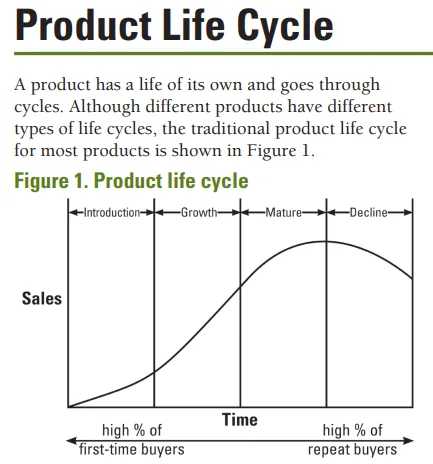
3.5- Meaning and definition-PLC
All products have certain length of life during which they pass through certain identifiable
stages. The PLC is a conceptual representation of product ageing process. Like your life is
divided in to stages same as life of a product is also divided.
Product start with introduction in the market for the purpose of sale. The demand of that product
is gradually increased in the market and it reach to its maximum, from where it starts decline.
It is effective lifespan of a product.
/ 23
End of Document
47

FAQs

what is Marketing Management Study Material 2025 about

The Marketing Management Study Material 2025 provides comprehensive insights into marketing principles and practices.

  • It covers key concepts such as market segmentation, consumer behavior, and product management.
  • The material includes strategies for effective marketing mix and product life cycle management.
  • Students will find detailed explanations of various marketing theories and their applications in real-world scenarios.

what are the key topics in Marketing Management Study Material 2025

The key topics in Marketing Management Study Material 2025 include essential marketing concepts and strategies.

  • Market Segmentation: Understanding different market segments and targeting strategies.
  • Consumer Behavior: Analyzing how consumers make purchasing decisions.
  • Product Management: Strategies for product development and life cycle management.
  • Pricing Strategies: Techniques for setting competitive prices.
  • Promotion Mix: Various promotional strategies to enhance product visibility.

how to apply concepts from Marketing Management Study Material 2025

Applying concepts from Marketing Management Study Material 2025 involves practical implementation of marketing theories.

  • Utilize market segmentation to identify and target specific consumer groups effectively.
  • Implement consumer behavior analysis to tailor marketing strategies that resonate with your audience.
  • Employ product life cycle strategies to manage products from introduction to decline.
  • Adjust pricing strategies based on market demand and competition analysis.
  • Incorporate promotional strategies to maximize reach and engagement with potential customers.

what are the formulas in Marketing Management Study Material 2025

The Marketing Management Study Material 2025 includes essential formulas for effective marketing analysis.

  • Market Share Formula: (Company Sales / Total Market Sales) x 100
  • Customer Lifetime Value (CLV): Average Purchase Value x Purchase Frequency x Customer Lifespan
  • Return on Investment (ROI): (Net Profit / Cost of Investment) x 100
  • Break-even Point: Fixed Costs / (Selling Price - Variable Costs)

what are the tips for studying Marketing Management Study Material 2025

Effective study tips for Marketing Management Study Material 2025 can enhance understanding and retention of concepts.

  • Active Reading: Engage with the material by taking notes and highlighting key points.
  • Practice Application: Apply concepts to real-world scenarios or case studies to solidify understanding.
  • Group Discussions: Collaborate with peers to discuss and debate marketing strategies and theories.
  • Regular Reviews: Schedule periodic reviews of the material to reinforce knowledge and identify areas needing improvement.

what are the examples of Marketing Management concepts from the study material

The Marketing Management Study Material 2025 provides numerous examples to illustrate key concepts.

  • Market Segmentation: A company targeting millennials with digital marketing strategies.
  • Consumer Behavior: Analyzing how social media influences purchasing decisions.
  • Product Life Cycle: The introduction of a new smartphone model and its subsequent marketing strategies.
  • Pricing Strategy: Implementing discounts during holiday seasons to boost sales.