Ecological factors explore the interactions between organisms and their environments, focusing on freshwater, seawater, arboreal, and terrestrial ecosystems. This document delves into abiotic and biotic factors that influence ecological dynamics, including soil composition, climate, and species interactions. It serves as a comprehensive resource for students studying ecology and environmental science, providing insights into how these factors shape biodiversity and ecosystem health.

Key Points

  • Explains abiotic factors like soil composition, temperature, and water availability.
  • Discusses biotic interactions including mutualism, predation, and competition.
  • Covers the significance of ecological factors in environmental adaptation.
  • Examines the impact of climate on various ecosystems, including freshwater and marine environments.
Akerele Joyce
9 pages
Language:English
Type:Textbook
Akerele Joyce
9 pages
Language:English
Type:Textbook
119
/ 9
1
Ecological Factors: Meaning, Classification & Factors
Ecological Factors: Ecology is the branch of biology that deals with the study of interactions
between organisms and their environment. A major goal of ecology is to document and
understand the consequences for life on Earth of human actions that are changing the
biosphere. To reveal the exciting facts about the inter-relationship of living beings
and ecological factors, we must know about different types of ecological factors.
Ecological Factors affect dynamic change in a population in a particular environment. It is
important for humanity to understand the different types of ecological factors. In this article, we
will provide detailed information on ecological factors.
Ecological Factors Definition
Ecological factors are environmental variables that impact organisms and contribute to their
characteristic modes of behaviour. These factors cause dynamic changes in a population or
species in a particular geographical region.
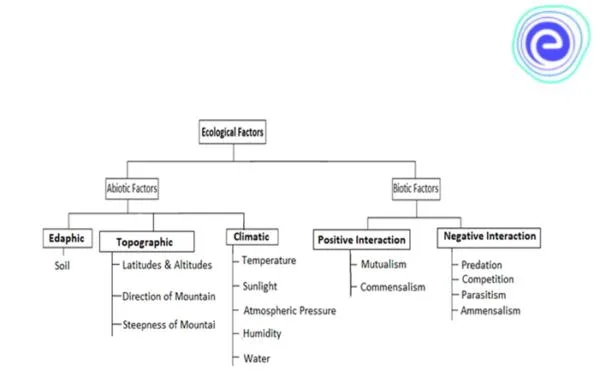
What are the Types of Ecological Factors?
2
Fig: Types of Ecological Factors
Abiotic Factors
Abiotic factors are non-living factors that make up the environment of an organism.
A biotope is a habitat with uniform environmental conditions that are characterised by a
particular set of abiotic ecological factors. Abiotic factors can be classified into the following
three categories:
1. Edaphic Factor: It is an abiotic factor related to the physical or chemical composition of
the soil found in a particular region. Soil is the uppermost weathered layer of Earths crust. It is
formed due to interactions among parent rock, climate, living organisms, time, and topography.
The following properties of soil influence the growth of different types of vegetation:
2. a. The pH of the soil: Soil may be acidic, alkaline, or neutral. The pH value determines the
availability of plant nutrients in the soil. The best soil for the cultivation of crops is loamy soil
3
having a pH range between 5.5 to 6.8.
3. b. Soil Water: Soil water is more important than any other ecological factor as it is one of
the inorganic substances required for photosynthesis. Capillary water held between spaces of soil
particles is the most important form of water available to the plants.
4. c. Soil Temperature: Soil temperature plays an essential role in determining the
geographical distribution of plants. Low temperature reduces the use of water and solute
absorption by roots and vice-versa.
5. d. Soil Atmosphere (soil air): Soil contains several gases in the pores found between the soil
particles. These gases mainly include oxygen, carbon dioxide, nitrogen, and water vapour.
6. e. Soil Organisms: Many organisms inhabit the soil, such as bacteria, fungi, algae,
protozoans, nematodes, insects, earthworms, etc. These are called soil organisms. These organisms
help in the aeration of soil, nitrogen fixation, and therefore affect the growth of vegetation.
Besides this, soil organisms are also affected by the other physical and chemical properties of soil.
7. 2. Topographic Factor: These factors are concerned with the surface features of the Earth.
Topographic factors affect the climate of different regions. These factors include latitude,
altitude, the direction of the mountain, the steepness of the mountain etc.
8. a. Latitudes and Altitudes: Latitudes represent the distance from the equator. Altitudes
represent the height above sea level. These factors affect the temperature values, the velocity of
wind, oxygen availability, and light intensity. The temperature is maximum at the equator and
minimum at the poles.
At high altitudes, the velocity of wind increases, air pressure and temperature decrease while the
intensity of light and humidity increases. Because of these variations, vegetation at different
altitudes varies, showing distinct zonation.
b. The Direction of Mountains: North and south faces of mountains possess different types of
flora and fauna because they differ in certain climatic factors such as humidity, rainfall, light
intensity, light duration, and temperature regions.
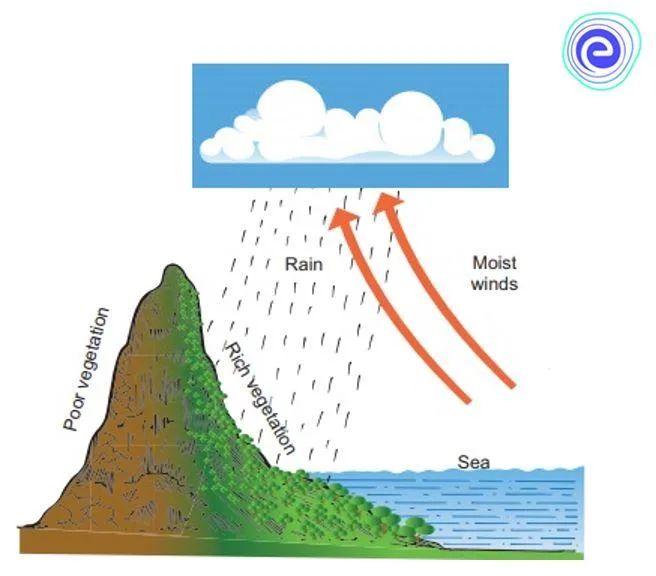
c. The Steepness of the Mountains: The steepness of the mountain affects the rainfall in a specific
region and allows the rainwater to run off. The loss of hilly areas causes water deficit and quick
erosion of the topsoil that results in poor vegetation. On the other hand, the plains are rich in
vegetation due to the slow drain of surface water and better retention of water in the soil.

/ 9
End of Document
119

FAQs

what are ecological factors and environmental interactions

Ecological factors are environmental variables that impact organisms and contribute to their characteristic modes of behavior.

  • They cause dynamic changes in populations or species in specific geographical regions.
  • Understanding these factors is essential for studying the interactions between living beings and their environment.
  • Key categories include abiotic factors (like soil composition and climate) and biotic factors (like interactions among species).

what are the types of ecological factors

The types of ecological factors include abiotic and biotic factors.

  • Abiotic Factors: Non-living components such as soil, water, temperature, and atmospheric pressure.
  • Biotic Factors: Living components that include producers, consumers, and decomposers.
  • Each type plays a crucial role in shaping ecosystems and influencing the survival of species.

how do abiotic factors affect ecosystems

Abiotic factors significantly influence ecosystems by determining the physical environment in which organisms live.

  • Soil composition affects plant growth and biodiversity.
  • Temperature and sunlight impact photosynthesis and animal behavior.
  • Water availability is crucial for all life forms, affecting their distribution and survival.

what is the role of biotic factors in ecology

Biotic factors play a crucial role in ecology by influencing the interactions among living organisms.

  • They include relationships such as predation, competition, and mutualism.
  • These interactions shape community structures and affect population dynamics.
  • Understanding biotic factors helps in studying ecosystem health and biodiversity.

how do climatic factors influence ecological interactions

Climatic factors are critical in determining the ecological interactions within a region.

  • Temperature affects species distribution and metabolic rates.
  • Sunlight availability impacts photosynthesis, influencing plant growth and food chains.
  • Humidity and atmospheric pressure also influence species adaptations and behaviors.

what is mutualism in ecological factors

Mutualism is a type of positive interaction where both species benefit from their relationship.

  • An example is nitrogen-fixing bacteria in legumes, where both organisms gain nutrients.
  • This interaction enhances biodiversity and ecosystem resilience.
  • Understanding mutualism is essential for ecological studies and conservation efforts.

what are examples of negative interactions in ecology

Negative interactions in ecology include predation, competition, and parasitism.

  • Predation: One species (predator) kills and consumes another (prey).
  • Competition: Two species vie for the same resources, leading to adverse effects on both.
  • Parasitism: One organism (parasite) benefits at the expense of another (host).

how do ecological factors affect biodiversity

Ecological factors significantly influence biodiversity by shaping the conditions under which species thrive.

  • Variations in abiotic factors like soil and climate determine which species can survive in an area.
  • Biotic interactions, such as competition and mutualism, also affect species richness and ecosystem stability.
  • Understanding these factors is crucial for biodiversity conservation efforts.

what is the significance of ecological factors in environmental science

Ecological factors are significant in environmental science as they help explain the interactions between organisms and their environments.

  • They inform conservation strategies and resource management.
  • Understanding these factors aids in predicting ecological changes due to human activities.
  • They are essential for developing sustainable practices and policies.

how do topographic factors influence ecosystems

Topographic factors influence ecosystems by affecting climate and habitat conditions.

  • Latitude and altitude determine temperature and light availability.
  • Mountain orientation can create microclimates, affecting local flora and fauna.
  • These variations lead to distinct ecological zones and biodiversity patterns.