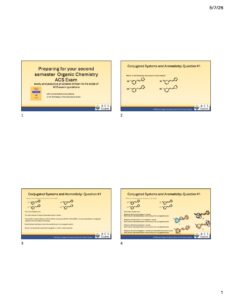
The ACS Exams ORS Classroom Practice Student Handout provides essential practice questions and study materials for students preparing for the ACS Organic Chemistry exam. It includes a variety of exercises focused on key concepts such as conjugated systems, aromaticity, and carbonyl chemistry. This resource is designed for students in organic chemistry courses, helping them to reinforce their understanding and improve their exam performance. With detailed questions and practice scenarios, this handout is an invaluable tool for mastering organic chemistry topics.

Key Points

  • Includes practice questions on conjugated systems and aromaticity
  • Covers carbonyl chemistry concepts relevant for ACS exams
  • Designed for students preparing for organic chemistry assessments
  • Helps reinforce key organic chemistry principles through targeted exercises
Kayla Tomasik
15 pages
Language:English
Type:Study Guide
Kayla Tomasik
15 pages
Language:English
Type:Study Guide
53
/ 15
American Chemical Society
Division of Chemical Education
Examinations Institute
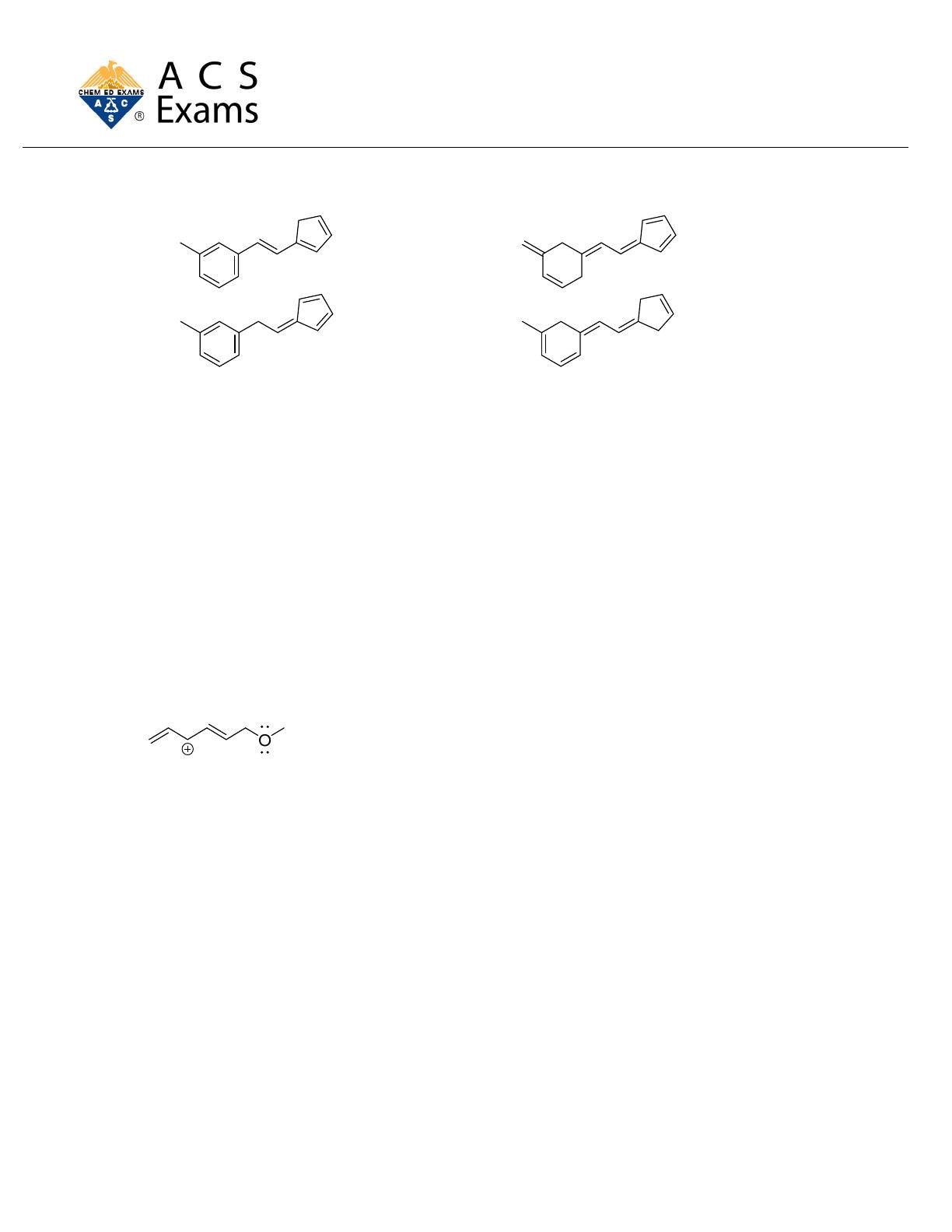
StudyQuestionChapter11(ConjugatedSystemsandAromaticity)
1A. Whichofthefollowingmoleculesismos tstable?
(A)
(B)
(C)
(D)
Work:
PracticeQuestionChapter11(ConjugatedSystemsandAromaticity)
1B. Howmanyelectronsareinthebondingpmolecularorbitals(pMOs)forthefollowingmolecule
(inthegroundstate)?
(A) 2 (B) 4 (C) 6 (D) 8
Work:
Formorepractice,pleasesee: StudyQuestions:SQ1,8(p.152,156)
PracticeQuestions:PQ14,2427(p.157161)
2
StudyQuestionChapter11(ConjugatedsystemsandAromaticity)
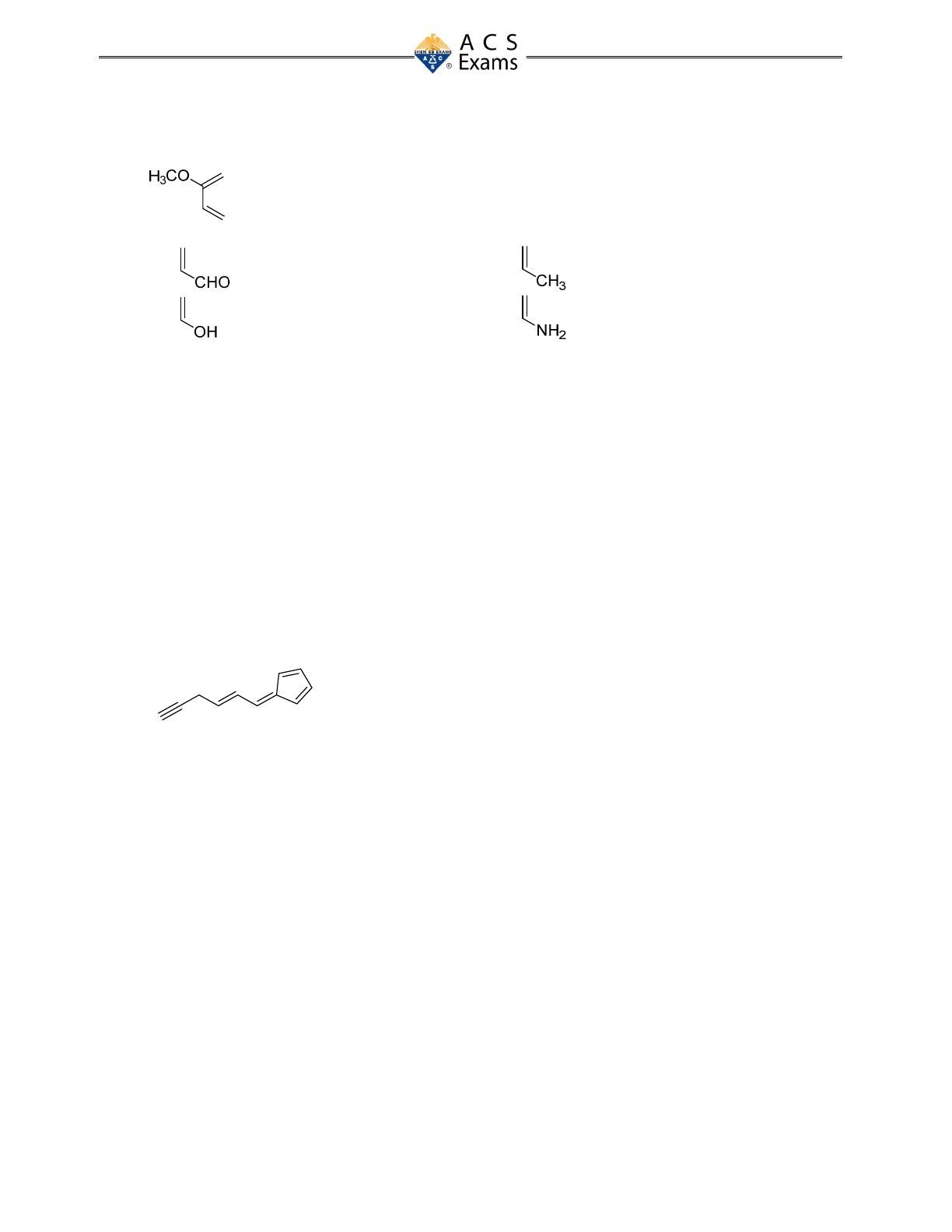
2A. Fromthestandpointofreactivity,whichisthebestdienophiletoreactwiththefollowingdienein
aDielsAlderreaction?
(A)
(B)
(C)
(D)
Work:
PracticeQuestionChapter11(ConjugatedsystemsandAromaticity)
2B. Howmanyelectronsareintheconj ugatedπ‐systemofthismolecule?
(A) 6 (B) 8 (C) 10 (D) 12
Formorepractice,pleasesee: StudyQuestions:SQ6,8(p.155156)
PracticeQuestions:PQ1621,2427(p.159161)
3
StudyQuestionChapter11(ConjugatedsystemsandAromaticity)
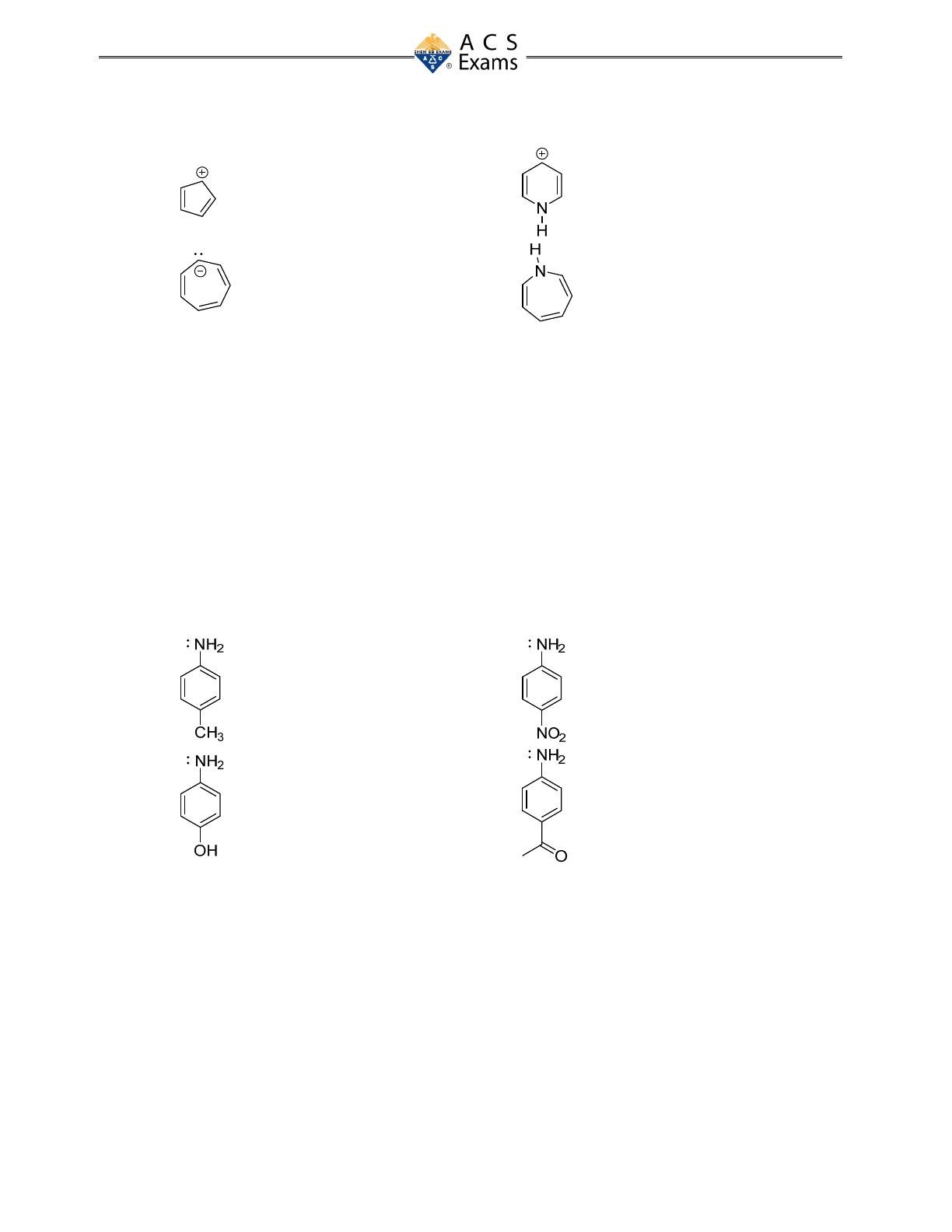
3A. Whichofthefollowingisaromatic?
(A)
(B)
(C)
(D)
Work:
PracticeQuestionChapter11(ConjugatedsystemsandAromaticity)
3B. Whichofthefollowingaminesismostbasic?
(A)
(B)
(C)
(D)
Work:
Formorepractice,pleasesee: StudyQuestions:SQ2,4(p.152153,154)
PracticeQuestions:PQ58,1213(p.158159)
/ 15
End of Document
53

FAQs

What are the key concepts covered in Chapter 11 of the ACS Exams study guide?
Chapter 11 focuses on conjugated systems and aromaticity. It includes questions about the stability of various molecules, the number of electrons in bonding p-molecular orbitals, and the reactivity of dienes in Diels-Alder reactions. Additionally, it addresses the identification of aromatic compounds and the basicity of different amines, providing a comprehensive overview of these fundamental concepts in organic chemistry.
How does the study guide define aromaticity in Chapter 11?
Aromaticity is defined through the characteristics of certain cyclic compounds that exhibit enhanced stability due to resonance and delocalization of electrons. The chapter presents questions that require students to identify which compounds meet the criteria for aromaticity, emphasizing the importance of Huckel's rule, which states that a compound must have a planar structure and a specific number of π electrons to be considered aromatic.
What types of reactions are explored in Chapter 12 of the ACS Exams study guide?
Chapter 12 delves into aromatic reactions, particularly electrophilic aromatic substitution. It includes questions about identifying reagents that facilitate transformations and determining which molecules react fastest in these reactions. The chapter also covers the major products of specific reactions, helping students understand the mechanisms and outcomes of various electrophilic substitutions.
What is the focus of Chapter 13 in the ACS Exams study guide?
Chapter 13 is centered on carbonyl chemistry, exploring the reactivity of carbonyl compounds with various nucleophiles. It includes questions that rank compounds based on their reaction rates with cyanide anion and discusses acid-catalyzed hydrolysis. The chapter also addresses the formation of different products from reactions involving secondary amines and acetone, providing a detailed examination of carbonyl reaction mechanisms.
What are the main topics addressed in Chapter 14 of the ACS Exams study guide?
Chapter 14 covers enols and enolates, focusing on their formation, reactions, and the products generated from these processes. It discusses the conditions under which enols and enolates are formed, as well as their roles in various organic reactions. The chapter includes practice questions that help students understand how to predict products and identify key reagents in enolate chemistry.
How does Chapter 15 of the study guide approach multistep synthesis?
Chapter 15 emphasizes the strategies for multistep synthesis in organic chemistry. It presents questions that require students to determine the predominant products from sequences of reactions and to identify the best sequences to achieve specific synthetic goals. This chapter is crucial for understanding how to plan and execute complex synthetic pathways in organic chemistry.
What is the significance of understanding reactivity in cationic polymerization as mentioned in Chapter 16?
Chapter 16 highlights the importance of understanding the reactivity of different monomers in cationic polymerization. It provides a ranking of monomers based on their reactivity, which is essential for predicting outcomes in polymer synthesis. This knowledge is vital for students aiming to apply these concepts in practical scenarios, such as designing new materials or understanding polymer behavior.