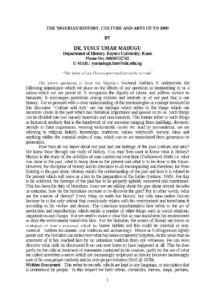
GST 201 Summary focuses on Nigerian Peoples and Culture, providing an overview of major ethnic groups such as the Yoruba, Bini, and Igbo. It covers their historical origins, cultural practices, political structures, and social organizations in both pre-colonial and colonial contexts. This summary is essential for students studying Nigerian history and culture, particularly those preparing for exams in related subjects. Key topics include the political systems of the Yoruba and Bini, the segmentary nature of Igbo society, and the impact of colonialism on these cultures.

Key Points

  • Explains the origins and cultural practices of the Yoruba, Bini, and Igbo ethnic groups.
  • Describes the political structures and social organizations in pre-colonial Nigeria.
  • Covers the impact of colonialism on Nigerian cultures and societies.
  • Highlights the significance of traditional religion and festivals in Nigerian communities.
Yahaya Mary
33 pages
Language:English
Type:Study Guide
Yahaya Mary
33 pages
Language:English
Type:Study Guide
120
/ 33
PLEASE PATRONIZE US FOR MORE EXAM SUMMARIES, TMA SUBMISSION WITH GOOD GRADES
ADMISSION PROCESSING. WHATSAPP: 07062412190; 09011055579 Page 1
PSALMDATA TELECOM AND COMPUTER CAFÉ
Motto: I CAN DO ALL THINGS
Website: http://psalmedu.com
Contacts: 07062412190; 09011055579
GST 201 - NIGERIAN PEOPLES AND CULTURE (SUMMARY)
Unit 1: The Peoples of Southern Nigeria and their Culture in Pre-Colonial Times (Part
I)
Nigerian Peoples and Culture is one of the best channels that will help you have a sound
knowledge and understanding of __________.
Southern Nigeria and its peoples
The major ethnic groups discussed in this unit are __________.
the Yoruba, the Bini and the Igbo
Among several others, at least six (06) major ethnic groups in Southern Nigeria are
__________.
the Yoruba, the Bini, the Igbo, the Itsekiri, the Urhobo and the Ijaw
The Yoruba are mostly found in the __________ States of Nigeria.
Western and Central
The Yoruba population stretches across __________.
Oyo, Osun, Ogun, Ondo, Lagos, Kwara and Kogi
The Yoruba are believed to have come into existence between __________.
2000-1000 BC
The Yoruba are traditionalists but they also practice __________.
Islam and Christianity
The history of the origins of the Yoruba remains __________.
controversial
The most popular Yoruba origin theory is the one that relates to __________.
Oduduwa
Oduduwa was believed to have migrated from __________.
Mecca
RC771280
0
PLEASE PATRONIZE US FOR MORE EXAM SUMMARIES, TMA SUBMISSION WITH GOOD GRADES
ADMISSION PROCESSING. WHATSAPP: 07062412190; 09011055579 Page 2
According to the Mecca version, Oduduwa was the __________.
father of the Yoruba race
Ile-Ife is regarded as the __________ of the Yoruba people.
ancestral home
The Yoruba kings are generally referred to as __________.
Oba
The Yoruba political organization is described as __________.
monarchical and hereditary
The Oba is assisted in administration by a council of chiefs called __________.
Ijoye
The Ijoye includes the __________.
Balogun, Iyalode and others
In Yoruba towns, the Oba is both a political and __________ leader.
spiritual
The Bini people are located in present-day __________.
Edo State
The term “Bini” is derived from the word __________.
Benin
The Bini trace their origin to a figure called __________.
Ogiso
The Ogiso was later replaced by __________.
Oba Eweka I
Eweka I was the son of __________.
Oranmiyan
Oranmiyan was sent from __________.
Ile-Ife
The Benin Kingdom developed a highly __________ system of government.
centralized
The Oba of Benin is assisted by a group of chiefs called __________.
Uzama
The Uzama include __________.
the Oliha, Edohen, Ero, Eholor and others
PLEASE PATRONIZE US FOR MORE EXAM SUMMARIES, TMA SUBMISSION WITH GOOD GRADES
ADMISSION PROCESSING. WHATSAPP: 07062412190; 09011055579 Page 3
The Bini also had the __________, which acted as a town council.
Eghaevbo
The Igbo are found mainly in __________ Nigeria.
Eastern
The traditional Igbo society is described as __________.
segmentary and acephalous
The Igbo political system is based on __________.
kinship and age grades
The Igbo political system is often referred to as __________.
direct democracy
The general assembly in traditional Igbo society is called __________.
Amala Oha
The Igbo respected __________ more than family background.
individual capability and age
The elders in Igbo society formed the __________.
core of village administration
In traditional Igbo society, the village square served as the venue for __________.
Amala Oha meetings
Unit 2: The Peoples of Southern Nigeria and their Culture in Pre-Colonial Times (Part
II)
The three ethnic groups discussed in this unit are __________.
the Itsekiri, the Urhobo and the Ijaw
The kingdom of the Itsekiri was established by __________.
Iginuwa
Iginuwa was the son of __________.
Oba Olua of Benin
Iginuwa became unpopular because he __________.
wrongly advised his father on a particular issue
To avoid problems, Oba Olua arranged a __________ for Iginuwa.
kingdom outside Benin
/ 33
End of Document
120

FAQs

what is GST 201 summary - Nigerian Peoples and Culture about

The GST 201 Summary - Nigerian Peoples and Culture provides an overview of the major ethnic groups in Nigeria, their cultures, and historical contexts.

  • It covers the Yoruba, Bini, Igbo, Itsekiri, Urhobo, and Ijaw peoples.
  • Key aspects include traditional governance, societal structures, and cultural practices.
  • The document also discusses the impact of colonialism and the evolution of Nigeria as a political unit.

what are the key points in GST 201 summary - Nigerian Peoples and Culture

The key points in the GST 201 Summary - Nigerian Peoples and Culture include the examination of various ethnic groups and their cultural significance.

  • The Yoruba are known for their rich traditions and monarchical systems.
  • The Bini trace their origins to Ogiso and have a centralized political system.
  • The Igbo practice direct democracy and emphasize individual capability.
  • The document also highlights the socio-political structures of the Itsekiri and Urhobo.

who are the major ethnic groups in GST 201 summary - Nigerian Peoples and Culture

The major ethnic groups discussed in the GST 201 Summary - Nigerian Peoples and Culture include the Yoruba, Bini, Igbo, Itsekiri, Urhobo, and Ijaw.

  • The Yoruba are primarily located in Western and Central Nigeria.
  • The Bini people are found in Edo State and have a rich historical background.
  • The Igbo are mainly in Eastern Nigeria and have a unique segmentary political structure.
  • The Itsekiri and Urhobo inhabit the Niger Delta region and have distinct cultural practices.

what is the significance of the Yoruba in GST 201 summary - Nigerian Peoples and Culture

The Yoruba hold significant cultural and historical importance in the GST 201 Summary - Nigerian Peoples and Culture.

  • They are known for their traditional governance system led by the Oba.
  • The Yoruba culture is rich in festivals, arts, and spiritual beliefs.
  • Historically, they are believed to have originated from Oduduwa, who migrated from Mecca.
  • The document outlines their contributions to Nigeria's political landscape.

how does GST 201 summary - Nigerian Peoples and Culture describe the Igbo

The GST 201 Summary - Nigerian Peoples and Culture describes the Igbo as a prominent ethnic group known for their unique societal structure.

  • They practice a segmentary and acephalous political system.
  • The Igbo value individual capability over family background.
  • Key gatherings like the Amala Oha serve as platforms for community decision-making.
  • The document emphasizes their rich cultural heritage and respect for elders.

what are the cultural practices of the Ijaw in GST 201 summary - Nigerian Peoples and Culture

The Ijaw are highlighted in the GST 201 Summary - Nigerian Peoples and Culture for their distinct cultural practices.

  • They traditionally engage in fishing and trading.
  • The Ijaw operate in small, decentralized communities.
  • Their societal structure is characterized by the House System.
  • The document discusses their traditional festivals and spiritual beliefs.

what impact did colonialism have on Nigerian Peoples and Culture in GST 201 summary

The GST 201 Summary - Nigerian Peoples and Culture discusses the significant impact of colonialism on various ethnic groups.

  • Colonial rule introduced new political structures that disrupted traditional governance.
  • It emphasized the export of raw materials, altering economic practices.
  • The document outlines how colonialism influenced cultural exchanges and conflicts among ethnic groups.

what is the political structure of the Bini in GST 201 summary - Nigerian Peoples and Culture

The political structure of the Bini, as described in the GST 201 Summary - Nigerian Peoples and Culture, is centralized and hierarchical.

  • The Oba of Benin serves as the traditional ruler supported by the Uzama chiefs.
  • The document details the historical evolution of their governance from Ogiso to Oba Eweka I.
  • The Bini Kingdom is noted for its administrative efficiency and cultural richness.

how does GST 201 summary - Nigerian Peoples and Culture define the Itsekiri

The Itsekiri are defined in the GST 201 Summary - Nigerian Peoples and Culture as a significant ethnic group in the Niger Delta.

  • They are known for their centralized political structure led by the Olu.
  • The document details their historical origins linked to the Bini Kingdom.
  • The Itsekiri Kingdom is characterized by its unique cultural practices and economic activities.

what are the main themes in GST 201 summary - Nigerian Peoples and Culture

The main themes in the GST 201 Summary - Nigerian Peoples and Culture include cultural diversity, historical evolution, and the impact of colonialism.

  • It explores the rich traditions of major ethnic groups in Nigeria.
  • The document emphasizes the significance of traditional governance and societal structures.
  • Another theme is the interaction between different cultures and the resultant socio-political dynamics.