The Grade 10 Mathematics Framework for June 2026 outlines key topics and question types for the upcoming examination. It includes a comprehensive breakdown of algebra, number patterns, and functions, ensuring students are well-prepared for various cognitive levels. This framework serves as a vital resource for educators and students aiming to excel in mathematics assessments. Key areas covered include algebraic expressions, equations, inequalities, and types of functions, with specific marks allocated to each section. This structured approach aids in effective exam preparation for Grade 10 learners.

Key Points

  • Covers essential algebra topics including expressions, equations, and inequalities.
  • Details the structure of the June 2026 examination with mark allocations.
  • Includes a focus on number patterns and functions relevant to Grade 10 mathematics.
  • Aids students in understanding cognitive levels required for exam success.
Hopewell Mbokane
1 page
Language:English
Type:Study Guide
Hopewell Mbokane
1 page
Language:English
Type:Study Guide
Hopewell Mbokane
1 page
Language:English
Type:Study Guide
376

Grade 10 Mathematics Framework 2026 June Paper 1 pdf

/ 1
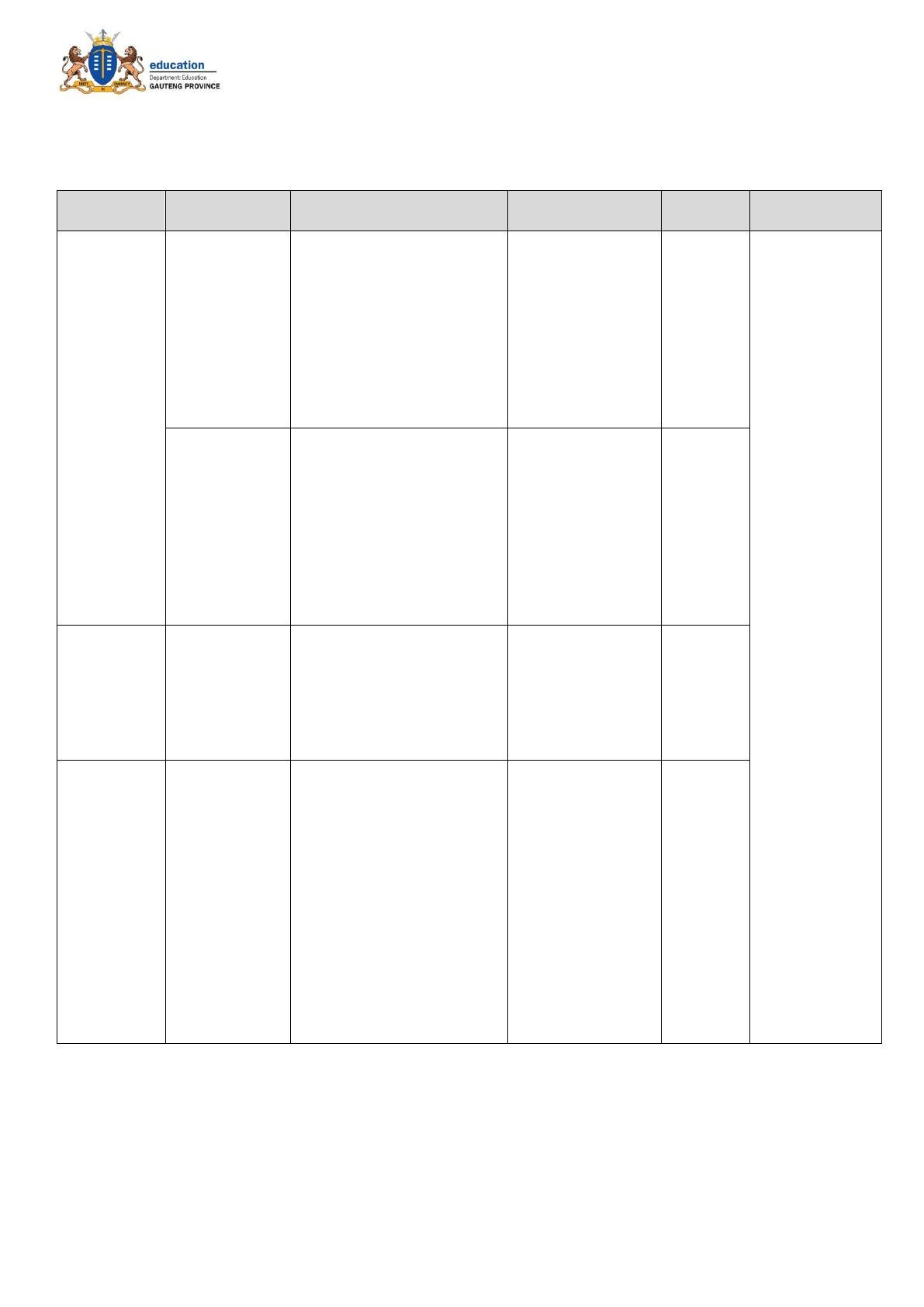
Grade 10 Mathematics Framework (2026 updated)
June Examination Paper 1
Marks : 75
Duration : 1 hour 30 minutes
TOPICS
QUESTIONS
SUB-TOPIC
MARK
ALLOCATION
MARKS
RANGE
COGNITIVE
LEVELS
Algebra
1
Number Systems
Algebraic Expressions:
-Products
-Factorisations
-Fractions
Exponents:
-Rules/laws
(Simplifications)
30±𝟑
27 - 33
L1 (20%)
15 marks
L2 (35%)
26 marks
L3 (30%)
23 marks
L4 (15%)
11 marks
2
Equations and
Inequalities:
-Linear
-Quadratic
-Simultaneous
-Literal equations
-Exponential equations
-Inequalities
-Word Problem
22±𝟑
19-25
Number
Patterns
3
Linear Number Patters
13±𝟑
10-16
Functions
and graphs
4 & 5
Types of Functions:
*Straight line
- domain (input values), -
range (output values),
--Interpretation
(Combination of
Functions)
10±𝟑
07-13
Please note: Parabolic and Hyperbolic functions are not included in the 2026 June Exams.
/ 1
End of Document
376

FAQs

What topics are covered in the Grade 10 Mathematics Framework for June 2026?
The Grade 10 Mathematics Framework for June 2026 includes several key topics such as Number Systems, Algebraic Expressions, Exponents, Equations and Inequalities, Number Patterns, and Functions and Graphs. Each of these topics is further divided into sub-topics. For instance, Algebraic Expressions encompasses Products, Factorisations, and Fractions, while Equations and Inequalities includes Linear, Quadratic, and Exponential equations.
How is the marks allocation structured in the June 2026 Mathematics exam?
The marks allocation for the June 2026 Mathematics exam totals 75 marks, distributed across various topics. For Algebra, the allocation is approximately 30 marks, with 15 marks from Algebraic Expressions and 22 marks from Equations and Inequalities. Number Patterns contribute around 13 marks, and Functions and Graphs account for about 10 marks. The cognitive levels vary, with different percentages assigned to each level.
What cognitive levels are assessed in the Grade 10 Mathematics exam?
The Grade 10 Mathematics exam assesses four cognitive levels: Level 1 (L1) at 20%, Level 2 (L2) at 35%, Level 3 (L3) at 30%, and Level 4 (L4) at 15%. Each level corresponds to different types of questions, with L1 focusing on basic understanding and L4 on higher-order thinking skills. This structure ensures a comprehensive evaluation of students' mathematical abilities.
Which types of functions are included in the Grade 10 Mathematics Framework?
The Grade 10 Mathematics Framework specifies that the types of functions included are straight-line functions. The framework emphasizes understanding the domain (input values) and range (output values) of these functions, as well as their interpretation. Notably, parabolic and hyperbolic functions are excluded from the 2026 June exams.
What specific algebraic concepts are included in the exam framework?
The exam framework includes several algebraic concepts such as Number Systems, Algebraic Expressions (including Products, Factorisations, and Fractions), and Exponents, which cover rules and simplifications. Additionally, it addresses various types of equations, including linear, quadratic, and simultaneous equations, as well as inequalities and word problems, providing a comprehensive overview of essential algebraic skills.