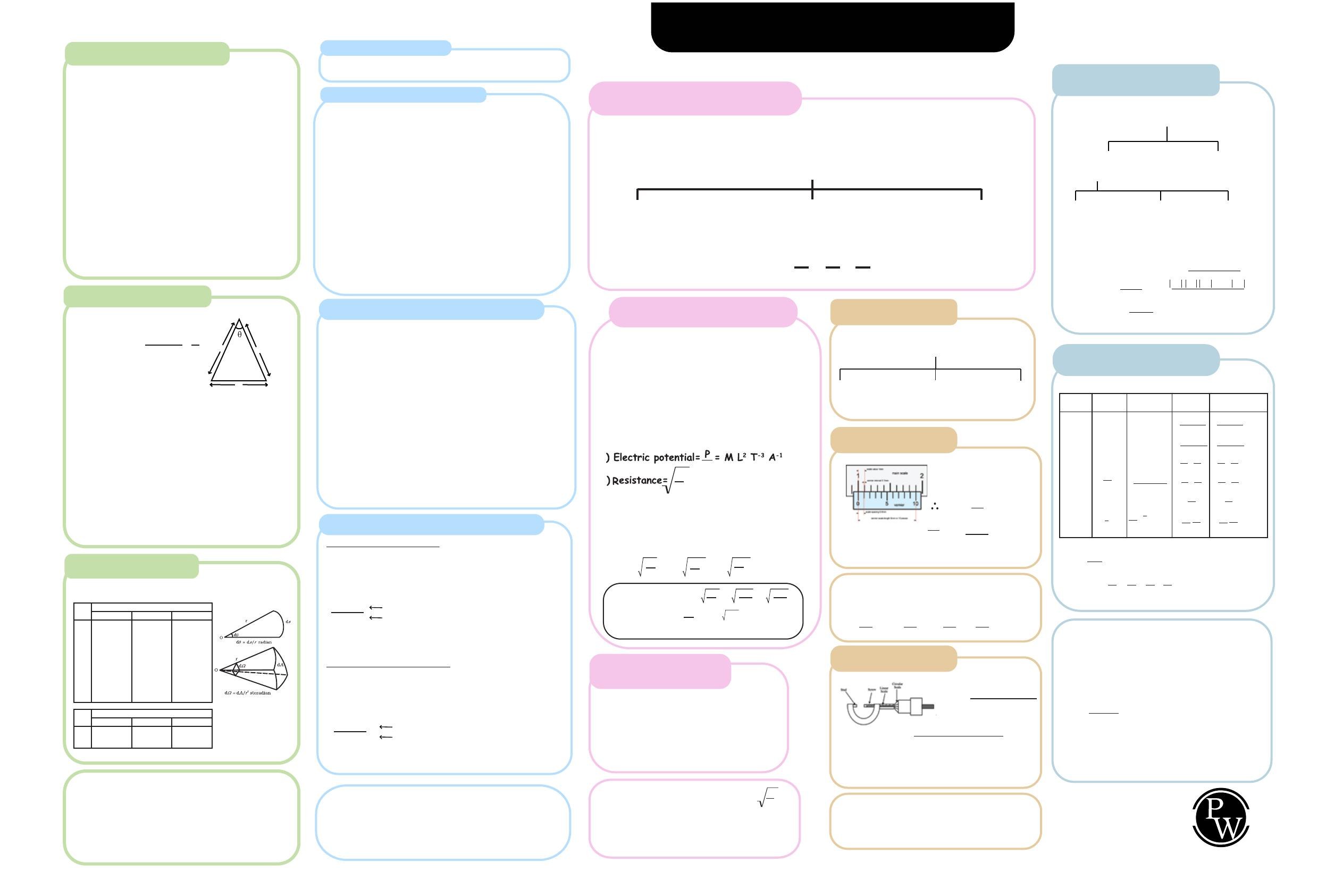
•Large distance is measured by
parallax method
•Parallax angle=
•1
O
=1.745 x 10
-2
rad
•1"=4.85×10
6
rad.
•1‛=2.91×10
4
rad.
•1 AU = 1.496×10
11
m
•1 ly = 9.46 × 10
15
m
•1parsec= 3.08 x 10
16
m
•Size of proton: 10
-15
m
•Radius Of Earth: 10
7
m
•Distance to Boundary Of
Observable Universe : 10
26
m
•For very small sizes, optical microscope,
tunneling microscope, electron microscope
are used.
7 Base units and 2 supplementary units
SI SYSTEM
Base Units
Supplementary Units
Quantity
Quantity
Plane angle
Solid angle
radian
steradian
rad
sr
NO.
1
2
Unit Symbol
Length
NO.
1
Unit
meter
Symbol
m
Mass
2 kilogram
kg
Time
3 second
s
Temperature
4 kelvin
K
Electric current
5 ampere
A
Luminous intensity
6
candela
cd
Amount of
substance
7 mole
mol
What is the unit of permittivity
of free space
?
ε
0
(a) coloumb/newton-metre
(b) newton-metre
2
/coloumb²
(c) coloumb²/newton-metre
2
(d) coloumb
2
/(newton-metre)
2
MEASUREMENT OF LENGTH
RULES FOR SIGNIFICANT FIGURES
BASIS
DISTANCE
MEASUREMENT OF MASS & TIME
TIME
MASS
•SI unit is second (based on caesium clock with an
uncertainity less than 1 part in 10
-13
ie,3μs loss every year)
•Timespan of unstable particle: 10
-24
s
•Age of universe: 10
17
s
•1amu =(1/12)
th
mass of
one C
12
atom
•1amu = 1.66×10
-27
kg
•Electron mass- 10
-30
kg
•Earth mass : 10
25
kg
•Observable Universe 10
55
kg
•
Unified atomic mass unit(amu) is used to measure
mass of atoms & molecules
SIGNIFICANT FIGURES
RULES FOR ROUNDING OF A MEASUREMENT
RULES FOR ROUNDING OF A MEASUREMENT
The digits in a measured quantity which are reliable and confidence
in our measurement + the digit which is uncertain.
1. All non-zero digits are significant. For example, 42.3 has three
significant figures; 243.4 has four significant figures; and 24.123 has
five significant figures.
2. A zero becomes significant figure if it appears between two
non-zero digits. For example, 5.03 has three significant figures;
5.604 has four significant figures; and 4.004 has four significant
figures.
3. Leading zeros or the zeros placed to the left of the number are
never significant. For example,0.543 has three significant figures;
0.045 has two significant figures; and 0.006 has one significant figure.
4. Trailing zeros or the zeros placed to the right of the number are
significant.
For example, 4.330 has four significant figures; 433.00
has five significant figures; and 343.000 has six significant figures.
5. In exponential notation, the numerical portion gives the number of
significant figures. For example,1.32 x 10
-
² has three significant
figures and 1.32 x 10
4
has three significant figures.
1. If the digit to be dropped is less than 5, then the preceding digit is
left unchanged. For example,x = 7.82 is rounded off to 7.8 and
x = 3.94 is rounded off to 3.9.
2. If the digit to be dropped is more than 5, then the preceding digit
is raised by one. For example, x = 6.87 is rounded off to 6.9 and
x = 12.78 is rounded off to 12.8.
3. If the digit to be dropped is 5
followed by digits other than zero,
then the preceding digit is raised by one. For example, x = 16.351 is
rounded off to 16.4 and x = 6.758 is rounded off to 6.8.
4. If the digit to be dropped is 5 or 5 followed by zeros, then the
preceding digit, if it is even, is left unchanged. For example,
x = 3.250 becomes 3.2 on rounding off and x = 12.650 becomes 12.6
on rounding off.
5. If the digit to be dropped is 5 or 5 followed by zeros, then the
preceding digit, if it is odd, is raised by one. For example,
x = 3.750 is rounded off to 3.8, again x = 16.150 is rounded off
to 16.2.
In SI Units, the dimensions of
is:
ERRORS IN MEASUREMENT
COMBINATION OF ERRORS
Difference between true value
& measured value of a quantity
Systematic Errors
Instrumental
Experimental
Personal
Random Errors
Errors which tend to occur
only in one direction,
either positive or negative
• Least count error is the smallest value that can be measured by
instrument (occurs with random & systematic errors)
• Absolute Error :- Δa = a
i
-a
mean
, a
mean
=
• Relative Error:-
General rule:
,Then the maximum fractional relative
error in Z will be:
Due to inbuilt defect
of measuring instrument
Limitations in
experimental
technique
Due to individual
bias,Lack of proper
setting of apparatus
Irregular and random
in magnitude & direction
a
1
+a
2
+a
3
+ ....+a
n
n
Δa
1
Δa
2
Δa
3
+ ....+Δa
n
n
a
mean
Δa
mean
Δa
mean
=
• Percentage Error:-
a
mean
Δa
mean
x 100
ΔZ
Z
ΔA
A
ΔB
B
ΔC
C
Operations
Sum
A+B
ΔA+ ΔB
ΔA+ ΔB
AΔB+ BΔA
B
2
BΔA+ AΔB
A-B
AxB
A
n
A
A
B
Difference
Multiplication
Division
Power
Root
Formula Z
Absolute
error
ΔZ
Percentage error
100 x
ΔZ/Z
Relative
error
ΔZ/Z
ΔA
ΔB
A B
1
n
1
n
A+B
ΔA+ΔB
A-B
ΔA+ΔB
n A
n-1
ΔA
A
ΔA
+
ΔA
ΔB
A
ΔA
A
B
+
n
ΔA
A
ΔA
ΔB
A B
1
n
A+B
ΔA+ΔB
A-B
ΔA+ΔB
+
ΔA
ΔB
A
ΔA
A
B
+
n
ΔA
A
x 100
x 100
x 100
x 100
x 100
x 100
(
(
(
(
If Z =
A
P
B
q
C
r
=p +q
+r
P=
a
2
b
2
cd
In an expirement four quantities a,b,c
and d are measured with percentage
error1%, 2%, 3% and 4% respectievely.
Quantity P is calculated as shown below.
What is the percentage error in P?
(a) 14% (b) 10%
(c) 7% (d) 4%
If L=2.331cm, B= 2.1cm,then L+B = ?
(a) 4.431 cm (b) 4.43 cm
(c) 4.4 cm (d) 4 cm
Dimensional Analysis
INSTRUMENTS
Least Count:
Smallest quantity an instrument can
measure
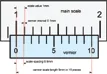
mm scale vernier scale
screw gauge
a)A
-1
T M L
3
b)A T
2
M
-1
L
-1
c)A T
-3
M
L
3/2
d)A
2
T
3
M
-1
L
-2
UNITS & MEASUREMENTS
μ
0
ε
0
DIMENSIONAL FORMULA
1) Pressure=stress=Young‛s modulus=ML
-1
T
-2
2) Work=Energy=Torque=M L
2
T
-2
3) Power P=M L
2
T
-3
4) Gravitational constant G=M
-1
L
3
T
-2
5) Force constant=Spring constant=M T
-2
6) Coefficient of viscosity=M L
-1
T
-1
7) Latent heat = L
2
T
-2
μ
0
10) Capacitance=M
-1
L
-2
T
4
A
2
11) Permittivity ε
0
=M
-1
L
-3
T
4
A
2
12) Angular momentum = planck‛s constant
=M
1
L
2
T
-1
ε
0
=M L
2
T
-3
A
-2
I
8
9
DIMENSIONLESS
QUANTITIES
1) Strain
2) Refractive index
3) Relative density
4) Plane angle
5) Solid angle
↓
1mm
↓
0.1mm
↓
0.01mm
VERNIER CALIPERS
Least Count = 1 MSD - 1VSD
Least Count = 1MSD -
Total Reading = Main Scale Reading + (coinciding
Vernier Scale division x least count)
In a vernier calipers, one main scale division is x cm
& n division of vernier scale coincide with n-1 divisions
of the main scle. The least count (in cm) of the
calipers is;
If n VSD Coincides with (n-1)
MSD,
then (n-1) MSD= n VSD
1VSD =
MSD
n-1
n
MSD
= 1MSD
n-1
n
n
Least Count =
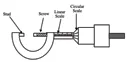
pitch
Total no.of divisions on
circlular scale
Pitch =
Dimensions of a physical quantity are the powers to which units of base
quantity are raised. Eg: [M]
a
[L]
b
[T]
c
[A]
d
[K]
e
checking the correctness of
various formulae
Eg: If Z=A+B,[Z]=[A]=[B]
Deducing relation
among physical
quantity
conversion of one system
of unit into another
n
1
u
1
=n
2
u
2
Eg: n
1
[M
1
A
L
1
B
T
1
C
] = n
2
[M
2
A
L
2
B
T
2
C
]
APPLICATIONS
M
1
A
M
2
]
[
L
1
B
L
2
]
[
T
1
C
T
2
]
[
n
1
= n
2
Main Scale Reading
No.of rotations
a)
n-1
n
( )
x
b)
nx
n-1
( )
c)
x
n-1
( )
d)
x
n
The least count of the main scale of a screw gauge
is 1mm. The minimum no.of divisions on its circular
scale required to measure 5μm diameter of wire is;
a) 200 b) 50 c) 400 d) 100
x
b
x
p
=
b
x
Total Reading = Linear Scale Reading + circular scale
reading x least count
SCREW GAUGE
L
R
RC
LC
= =
T
l
g
m
k
R
g
α α α
Time period
13)
M=
k k
hc
G
L= hG
c
2
T=k
hG
c
5
In addition or subtraction, the final result should be reported
to the same number of decimal places as that of the original
number with minimum number of decimal places
When numbers are multiplied or divided, the number of
significant figures in the answer equals the smallest number
of significant figures in any of the original numbers
(has two decimal places)
(Answer should be reported to two decimal
places after rounding off)
Answer = 3.47
3.1421
0.241
+0.09
3.4731
ADDITION & SUBTRACTION
MULTIPLICATION & DIVISION
(Three significant figures)
(Answer should have three significant figures
after rounding off)
Answer = 66.8
51.028
x 1.31
66.84668
+
+
1
n
1
n
-1