Physical Quantities, Units, and Measurements – O Level Physics
Physical quantities, units, and measurements are fundamental concepts in physics that describe the properties of matter and energy. This resource is tailored for O Level Physics students preparing for their examinations, covering essential topics such as vector and scalar quantities, measurement techniques, and the use of various instruments. Key concepts include the distinction between different types of quantities, the significance of accurate measurements, and practical applications in experiments. Ideal for students looking to enhance their understanding and performance in physics assessments.
Key Points
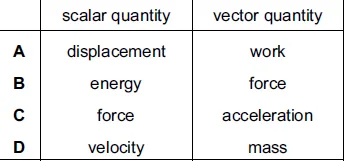
Explains the difference between scalar and vector quantities in physics.
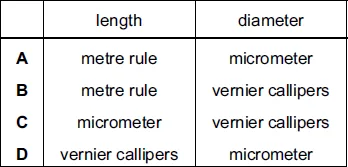
Covers measurement techniques and the use of instruments like micrometers and calipers.
Includes practical examples and applications of physical quantities in experiments.
Focuses on essential topics for O Level Physics examinations.
This link leads to an external site. We do not know or endorse its content, and are not responsible for its safety. Click the link to proceed only if you trust this site.
Pearson Edexcel International Advanced Level Physics Mark Scheme Summer 2025Past Paper
PDFPast Paper
Kinematics in Newtonian Mechanics – Cambridge O Level PhysicsPast Paper
PDFPast Paper
Cambridge O Level Physics 5054/12 Past Paper May/June 2024Past Paper
PDFPast Paper
Cambridge O Level Physics 5054 2025 Winter Paper 1 Multiple ChoicePast Paper
PDFPast Paper
Grade 11 Physics Exam Preparation – Practice Questions and NotesPast Paper
PDFPast Paper
Grade 12 Physical Sciences June 2024 Paper 2 and MemoPast Paper
PDFPast Paper
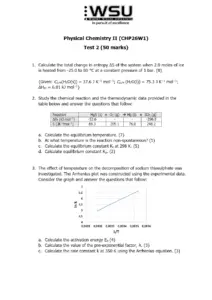
Physical Chemistry II Test 2 – CHP26W1Past Paper
PDFPast Paper
Cambridge IGCSE Physics 0972/41 October/November 2022Past Paper
PDFPast Paper
Cambridge IGCSE Physics 0972/04 Specimen Paper 2023Past Paper
PDFPast Paper
Physics Unit 5 Question PaperPast Paper
PDFPast Paper
Chemistry Unit 4 Question Paper – Edexcel International A LevelPast Paper
PDFPast Paper
January 2019 IAL Mark Scheme Paper 5 Edexcel Chemistry A LevelPast Paper
FAQs
What are the key vector quantities in physics?
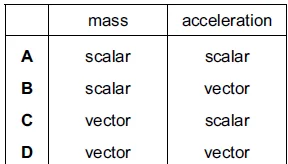
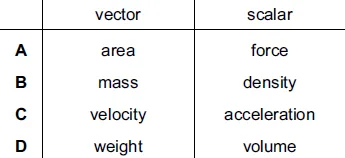
Key vector quantities in physics include acceleration, displacement, and velocity. These quantities have both magnitude and direction, distinguishing them from scalar quantities, which only have magnitude. Understanding these vectors is crucial for solving problems related to motion and forces.
Which instruments are best for measuring the diameter of a wire?
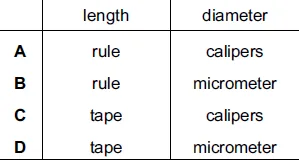
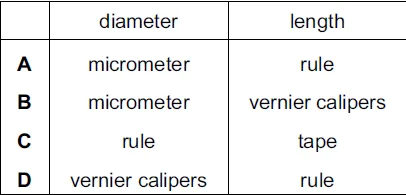
To measure the diameter of a wire accurately, a micrometer is recommended due to its precision. For measuring length, a ruler or tape measure can be used. The combination of these instruments allows for accurate measurements of both the diameter and length of the wire.
What is Newton’s third law of motion?
Newton’s third law states that for every action, there is an equal and opposite reaction. This means that when one object exerts a force on another object, the second object exerts a force of equal size but in the opposite direction on the first object. This principle is fundamental in understanding interactions between objects in motion.
How is density measured using a measuring cylinder?
To find the density of a stone using a measuring cylinder, the stone is lowered into water, which is partially filled in the cylinder. The difference between the water level before and after the stone is submerged gives the volume of the stone. Density can then be calculated using the formula: density = mass/volume.
What is the significance of measuring instruments in physics experiments?
Measuring instruments are crucial in physics experiments as they provide the necessary precision and accuracy required for obtaining reliable data. Instruments like vernier calipers, micrometers, and measuring tapes are used to measure lengths, diameters, and other physical quantities accurately, which is essential for validating experimental results.
Which quantities are considered scalar in physics?
Scalar quantities in physics include mass, temperature, and energy. These quantities are defined by their magnitude only and do not have a directional component. Understanding the difference between scalar and vector quantities is important in physics, as it affects how calculations and analyses are performed.
What is the correct unit for measuring power?
The correct unit for measuring power is the watt (W). Power is defined as the rate at which work is done or energy is transferred over time. In the context of physics, understanding power is essential for analyzing systems and processes that involve energy transfer.