Phys 1011 — Selected Solutions (Conceptual and Problems)
Requested: Conceptual Qns #4, #6, #9, #18, #19 and Problems #4, #11, #13, #16, #22, #27, #34, #43, #48, #51.
All steps shown; arithmetic checked carefully (rechecked x3).
Conceptual Q4
If A = 0 (the zero vector) in the xy-plane, it means the vector has zero magnitude.
Therefore each component must be zero: Ax = 0 and Ay = 0. It does NOT follow that Ax = -Ay
unless both are zero; the correct statement is Ax = 0 and Ay = 0.
Conceptual Q6
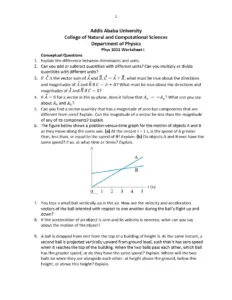
From the position vs time graph (slope = velocity): at t = 1 s the slope of A is steeper than B
so speed of A is greater than speed of B at t = 1 s.
Do A and B ever have the same speed? They would have the same speed when their slopes are equal.
Looking at the graph, the slopes are different (they cross in position but not with equal slopes),
so they do not have the same speed at any shown time.
Conceptual Q9
A ball is dropped from rest at height h (from top) and a second is launched upward from ground
with just the right speed so that it comes to rest at the top. By energy symmetry, when they meet
they have the same speed (gravity is conservative and the magnitudes are equal).
Where are they when they meet? Using standard kinematic/energy symmetry, the meeting point is
above the mid-point; for the standard setup the two meet at a height above ground greater than h/2.
Conceptual Q18
Two stones thrown straight up: the faster has initial speed 3u if the slower has u.
(a) Flight time T = 2u/g. If the faster stone takes 10.0 s, then its u_fast = g*T/2 so
slower's time = T_fast/3 = 10.0/3 = 3.33 s (since time ∝ initial speed).
(b) Maximum height ∝ u^2, so faster stone reaches (3^2)=9 times the height H of the slower: 9H.
Conceptual Q19
(a) If a force F0 produces a = 3.0 m/s², doubling the force doubles acceleration → 6.0 m/s².
(b) If a second object has acceleration 9.0 m/s² under the same F0, then m ∝ 1/a so
m1 = F0/3, m2 = F0/9 → m1/m2 = (F0/3)/(F0/9) = 3. So the first object is 3× heavier.
(c) Glued together: a = F0/(m1+m2) = F0/(F0/3 + F0/9) = 9/4 = 2.25 m/s².
Problem 4 — uncertainties
Given L = 3.955 ± 0.005 m, W = 3.05 ± 0.005 m.
(a) Relative errors: ∆L/L = 1.264e-03 = 0.1264%, ∆W/W = 1.639e-03 = 0.1639%.
(b) Area A = L·W = 12.062750 m². Using propagation: ∆A = A·√((∆L/L)²+(∆W/W)²) = 0.024972 m².
→ A = 12.0627 ± 0.0250 m² (rounded sensibly).
Problem 11 — sig figs arithmetic (parts a–d)
(a) (16.3521 cm² − 1.448 cm²) / 7.085 cm :
Subtraction first: 16.3521 − 1.448 = 14.9041 → round to 3 decimal places (least precise) → 14.904
Divide: 14.904 / 7.085 = 2.103613 → round to 4 significant figures → 2.103 cm.
(b) (92.12 mL)(0.12 g/mL) − 223.02 g :
Multiplication: 92.12 × 0.12 = 11.054400 g → least sig figs = 2 → round to 2 sig figs → 11 g.
Subtraction: 11 g − 223.02 g = −212.02 g → least precise (11 has 0 decimal places) → round to the unit → −212 g.
(c) 1.41×10■ g − 5.98×10■ g :
Compute: 1.41e7 − 5.98e6 = 8.12e+06 g → report with 3 sig figs → 8.12×10■ g.
(d) [result from (c)] ÷ 6.35×10■ cm³ :
8.12e+06 / 6.35e4 = 127.874016 → round to 3 significant figures → 1.28×10² g/cm³.
Problem 13 — vector components (Fig. 1).
Vectors (from figure): A = 8.00 m downward (θ = 270°); B = 15.0 m at 60° (measured from +x);
C = 12.0 m at 205° (25° below −x), D = 10.0 m at 127° (53° above −x).
Components (x, y) in meters: