Previous year questions and solutions for chemistry cover essential topics and concepts frequently tested in exams. This resource is ideal for students preparing for competitive exams and seeking to strengthen their understanding of chemistry principles. It includes a variety of questions from different years, providing a comprehensive review of key areas. Use this guide to practice problem-solving skills and enhance exam readiness.

Key Points

  • Includes a collection of previous year chemistry exam questions and solutions.
  • Covers essential chemistry topics relevant for competitive exams.
  • Helps students improve problem-solving skills in chemistry.
  • Ideal for exam preparation and review of key concepts.
Nandini Raj
5 pages
Language:English
Type:Past Paper
Nandini Raj
5 pages
Language:English
Type:Past Paper
Nandini Raj
5 pages
Language:English
Type:Past Paper
330

Chemistry Previous Year Questions and Solutions pdf

/ 5
PREVIOUS YEAR QUESTIONS
SOLUTIONS
1. Differentiate between molarity and molality values for a solution. What is the effect of change of temperature on molarity and
molality values? [March 2011] [2]
2. What is meant by reverse osmosis? [March 2011] [1]
3. What mass of NaCl must be dissolved in 65.0 g of water to lower the freezing point of water by 7.50C?
K
f
for water is 1.86C / m, molar mass of NaCl is 58.5 g. Assuming van’t Hoff factor for NaCl is 1.87.
[March 2011] [2]
4. A solution prepared by dissolving 8.95 mg of a gene fragment in 35.0 mL of water has an osmotic pressure of 0.335 torr at 25C.
Assuming that the gene fragment is a non-electrolyte, calculate its molar mass.
[March 2011] [2]
5. States the following:
(i) Raoult’s law in its general form in reference to solution
(ii) Henry’s law about partial pressure of a gas in a mixture [March 2011] [2]
6. (a) Explain the following
(i) Henry’s law about dissolution of a gas in a liquid
(ii) Boiling point elevation constant for a solvent
(b) A solution of glycerol (C
3
H
8
O
3
) in water was prepared by dissolving some glycerol in 500 g of water. This solution has a
boiling point of 100.42C. What mass of glycerol was dissolved to make this solution (K
b
for water = 0.512 K kg mol
1
)
[March 2012] [5]
7. (a) Define the following terms
(i) Mole fraction
(ii) deal solution
(b) 15.0 g of an unknown molecular substance is dissolved in 450 g of water. The resulting solution freezes at 0.34C. What
is the molar mass of the material.
(K
f
for water = 1.86 K kg mol
1
) [March 2012] [5]
8. (a) State Raoult’s law for a solution containing volatile components. How does Raoult’s law become a special case of Henry’s
law?
(b) 1.00 g of a non-electrolyte solute dissolved in 50 g of benzene lowered the freezing point of benzene by 0.40 K. Find the
molar mass of the solute (K
f
= 5.12 kg mol
1
)
[OR]
(a) Define the following terms
(i) deal solution
(ii) Azeotrope
(iii) Osmotic pressure
(b) A solution of glucose (C
6
H
12
O
6
) in water is labelled as 10% by weight. What would be the molality of the solution.
(Molar mass of glucose = 180 g mol
1
) [March 2013] [5]
9. Calculate the mass of compound (molar mass = 256 g mol
1
) to be dissolved in 75 g benzene to lower its F.P by 0.48 K (K
f
=
5.12 K kg mol
1
) [March 2014] [2]
10. What are isotonic solutions? [March 2014] [1]
11. (a) What type of deviation is shown by a mixture of ethanol and acetone? Give reason
(b) A solution of glucose (M = 180 g mol
1
) in water is labelled as 10% (by mass) what would be the molality and molarity of the
solution (Density of the solution = 1.2 g mL
1
)
[March 2014] [5]
12. (a) Define the following terms:
(i) Molarity
(ii) Molal Elevation constant (K
b
)
(b) A solution containing 15 g urea (M = 60 g mol
1
) per litre of a solution in water has the same osmotic pressure (isotonic) as
a solution of glucose (Molar mass = 180 g mol
1
) in water. Calculate the mass of glucose present in one litre of the solution.
[March 2014] [5]
13. When 1.5 g of a non-volatile solute was dissolved in 90 g of benzene, the boiling point of benzene raised from 353.23 K to
353.93 K. Calculate the molar mass of the solute (K
b
for benzene = 2.52 K kg mol
1
)
[March 2015] [2]
14. Derive the relationship between relative lowering of vapour pressure and molar mass of the solute
[March 2015] [1]
15. (a) Calculate the boiling point of solution when 2 g of Na
2
SO
4
(M = 142 g mol
1
) was dissolved in 50 g of water,assuming Na
2
SO
4
undergoes complete ionisation (K
b
for water = 0.52 K kg mol
1
)
(b) Define the following terms:
(i) Colligative properties (ii) deal solution
[OR]
(a) When 2.56 g of sulphur was dissolved in 100 g of CS
2
, the freezing point lowered by 0.383 K.Calculate the formula of sulphur (S
x
)
(b) Blood cells are isotonic with 0.9% sodium chloride solution. What happens if we place blood cells in a solution
containing
(i) 1.2% sodium chloride solution
(ii) 0.4% sodium chloride solution [March 2016] [5]
16. (a) A 10% solution (by mass) of sucrose in water has a freezing point of 269.15K. Calculate the freezing point of 10% glucose in
water if the freezing point of pure water is 273.15K. (Molar mass of sucrose = 342 g mol
1
)(molar mass of glucose = 180 g mol
1
)
(b) Define the following terms:
(i) Molality (m) (ii) Abnormal molar mass
[OR]
(a) 30 g of urea (M = 60 g mol
-1
) is dissolved in 846 g of water. Calculate the vapour pressure of water for this solution if vapour
pressure of pure water at 298 K is 23.8 mm Hg
(b) Write two difference between ideal solutions and non-ideal solutions [March 2017] [5]
17. Calculate the freezing point of a solution containing 60 g of glucose (Molar mass = 180 g mol
1
) in 250 g of
water. (K
f
of water = 1.86 K kg mol
1
) [March 2018] [2]
18. Give reason for the following:
(a) Measurement of osmotic pressure method is preferred for the determination of molar masses of
macromolecules such as proteins and polymers.
(b) Aquatic animals are more comfortable in cold water than in warm water.
(c) Elevation of boiling point of 1M KCl solution is nearly double than that of 1M sugar solution.
[March 2018] [3]
19. (a) Aquatic species are more comfortable in cold water than warm water.
(b) At higher altitudes people suffer from anoxia resulting in inability to think.
[OR]
What type of azeotropic mixture will be formed by a solution of acetone and chloroform? Justify on the basis of strength of
intermolecular interactions that develop in the solution? [March 2019] [2]
20. At 300 K, 30 g of glucose present in a litre of its solution has an osmotic pressure of 4.95 bar. If the osmotic pressure of a glucose
solution is 1.52 bar at the same temperature, what would be its concentration?
[March 2019] [3]
21. 50 mL of an aqueous solution of glucose C
6
H
12
O
6
(molar mass 180 g/mol) contains 6.022 x 10
22
molecules.
The concentration of the solution will be
(a) 0.1 M (b) 0.2 M (c) 1.0 M (d) 2.0 M [March 2020] [1]
22. Predict the state of the solute in the solution in the following situation
(i) When ‘I’ found to be more than one
(ii) When ‘I’ found to be less than one. [March 2020] [2]
23. An antifreeze solution is prepared by dissolving 31g of ethylene glycol (Molar mass 62 g/mol) in 600g of water. Calculate the
freezing point of the solution (K
f
of water = 1.86 Kkg/mol) [March 2020] [3]
24. When 1 mole of benzene is mixed with 1 mole of toluene The vapour will contain:
(Given : vapour of benzene = 12.8kPa and vapour pressure of toluene = 3.85 kPa).
a) equal amount of benzene and toluene as it forms an ideal solution
b) unequal amount of benzene and toluene as it forms a non ideal solution
c) higher percentage of benzene
d) higher percentage of toluene [Sample paper 2021] [1]
25. Assertion: Aquatic species are more comfortable in cold waters rather than in warm waters.
Reason: Different gases have different K
H
values at the same temperature
(a) Both A and R are true and R is the correct explanation of A
(b) Both A and R are true but R is not the correct explanation of A
(c) A is true but R is false
(d) A is false but R is true
OR
Assertion: Nitric acid and water form maximum boiling azeotrope.
Reason: Azeotropes are binary mixtures having the same composition in liquid and vapour phase
(a) Both A and R are true and R is the correct explanation of A
(b) Both A and R are true but R is not the correct explanation of A
(c) A is true but R is false
(d) A is false but R is true
[Sample paper 2021] [1]
26. A glucose solution which boils at 101.04
o
C at 1 atm. What will be relative lowering of vapour pressure of an aqueous solution of
urea which is equimolal to given glucose solution? (Given: K
b
for water is 0.52 K kg mol
-1
)
[Sample paper 2021] [2]

'i'
Kf of CS2 = 2.56 Kkg/mol
27. Which one of the following pairs will form an ideal solution?
(A) Chloroform and acetone
(B) Ethanol and acetone
(C) n-hexane and n-heptane
(D) Phenol and aniline [December 2021] [1]
28. Which of the following represents Raoult’s Law for a solution containing non – volatile solute?
a) P
solute
= P
0
solute
. X
solute
b) P = K
H
X
c) P
total
= P
solvent
d) P
solute
= P
0
solvent
. X
solvent
[December 2021] [1]
29. An azeotropic solution of two liquids has a boiling point lower than either of the two when it
a) shows a positive deviation from Raoult’s Law
b) shows a negative deviation from Raoult’s Law
c) shows no deviation from Raoult’s Law
d) is saturated [December 2021] [1]
30. On mixing 20mL acetone with 30mL chloroform, the total volume of the solution is
a) < 50mL b) = 50mL c) > 50mL d) = 10mL [December 2021] [1]
31. Elevation of boiling point is inversely proportional to
a) molal elevation constant (K
b
)
b) molality (m)
c) Molar mass of solute (M)
d) weight of solute (w) [December 2021] [1]
32. An unknown gas ‘X’ is dissolved in water at 2.5 bar pressure and has mole fraction 0.04 in solution. The mole fraction of ‘X’ gas
when the pressure of gas is doubled at the same temperature is
a) 0.08 b) 0.04 c) 0.02 d) 0.92 [December 2021] [1]
33. The boiling point of a 0.2 m solution of a non electrolyte in water is (Kb of water is 0.52 Kkg/mol)
a) 100
0
C b) 100.52
0
C c) 100.104
0
C d) 100.26
0
C [December 2021] [1]
34. Assertion(A): A raw mango placed in a saline solution loses water and shrivel into pickle
Reason (R): Through the process of reverse osmosis, raw mango shrivel into pickle
(a) Both A and R are true and R is the correct explanation of A
(b) Both A and R are true but R is not the correct explanation of A
(c) A is true but R is false
(d) A is false but R is true [December 2021] [1]
35. A compound undergoes complete tetramerization in a given organic solvent. The van’t Hoff factor ‘I’ is
(a) 4.0 (b) 0.25 (c) 0.125 (d) 2.0 [March 2023] [1]
36. Assertion(A): When NaCl is added to water, a depression in freezing point is observed.
Reason (R): The lowering of vapour pressure of a solution causes depression in freezing point
(a) Both A and R are true and R is the correct explanation of A
(b) Both A and R are true but R is not the correct explanation of A
(c) A is true but R is false
(d) A is false but R is true [March 2023] [1]
37. (a) What type of deviation from Raoult’s law is shown by a mixture of ethanol and acetone? Give reason
OR
(b) Define azeotrope. What type of azeotrope is formed by negative deviation from Raoult’s law? Give an example
[March 2023] [2]
38. If benzoic acid (M = 122 g/mol is associated in to a dimer when dissolved in benzene and the osmotic pressure of a solution of
6.1 g of benzoic acid in 100mL benzene is 6.5atm at 27
0
C, then what is the percentage association of benzoic acid? (Given R =
0.0821 L atm/K/mol) [March 2023] [3]
39. A compound undergoes complete dimerization in a given organic solvent. The van’t Hoff factor ‘I’ is
(a) 2.0 (b) 0.5 (c) 0.25 (d) 1.0 [March 2023] [1]
40. Assertion(A): When glucose is added to water, an elevation in boiling point is observed.
Reason (R): The lowering of vapour pressure of a solution causes elevation in the boiling point
(a) Both A and R are true and R is the correct explanation of A
(b) Both A and R are true but R is not the correct explanation of A
(c) A is true but R is false
(d) A is false but R is true [March 2023] [1]
/ 5
End of Document
330

FAQs

What is the effect of temperature on molarity and molality?
Molarity and molality are both measures of concentration, but they respond differently to temperature changes. Molarity, defined as moles of solute per liter of solution, can change with temperature because the volume of the solution can expand or contract. In contrast, molality, which is defined as moles of solute per kilogram of solvent, remains unaffected by temperature changes since the mass of the solvent does not change. This difference is crucial for calculations in chemistry, especially when dealing with colligative properties.
What is reverse osmosis?
Reverse osmosis is a process used to separate solutes from solvents by applying pressure to a solution. This technique forces the solvent through a semipermeable membrane, allowing only the solvent to pass while retaining the solute on one side. It is commonly used in water purification systems to remove impurities and salts, making it an essential method in various applications, including desalination and wastewater treatment.
What is Raoult's law in reference to solutions?
Raoult's law states that the vapor pressure of a solvent in a solution is directly proportional to the mole fraction of the solvent present. This law applies to ideal solutions, where the interactions between different molecules are similar to those in pure substances. According to Raoult's law, as the concentration of solute increases, the vapor pressure of the solvent decreases. This principle is fundamental in understanding the behavior of solutions and is applicable in various chemical calculations.
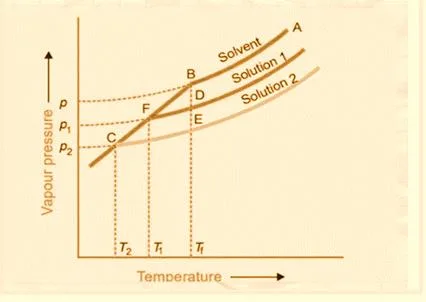
How does the freezing point depression relate to molality?
Freezing point depression is a colligative property that depends on the molality of the solute in a solution. The relationship is defined by the formula ΔTf = Kf * m, where ΔTf is the change in freezing point, Kf is the freezing point depression constant of the solvent, and m is the molality of the solution. This means that the greater the molality of the solute, the more significant the depression in the freezing point of the solvent. This concept is essential in various applications, including antifreeze formulations.
What is the van't Hoff factor and its significance?
The van't Hoff factor (i) is a measure of the number of particles a solute produces in solution. It is crucial for calculating colligative properties, such as boiling point elevation and freezing point depression. For example, a van't Hoff factor of 2 indicates that one mole of solute produces two moles of particles in solution. This factor varies for different solutes, especially electrolytes, which dissociate into ions. Understanding the van't Hoff factor is essential for accurate calculations in solution chemistry.
What happens to blood cells in hypertonic and hypotonic solutions?
When blood cells are placed in a hypertonic solution, such as a 1.2% sodium chloride solution, they lose water and shrink due to osmosis. Conversely, when blood cells are placed in a hypotonic solution, like a 0.4% sodium chloride solution, they gain water and may swell or even burst. This behavior is critical for understanding cellular responses in different osmotic environments, which has implications in medical treatments and physiological processes.
What is the significance of osmotic pressure in solutions?
Osmotic pressure is a colligative property that reflects the tendency of solvent molecules to move across a semipermeable membrane from a dilute solution to a concentrated one. It is significant in biological systems, as it influences the movement of water in and out of cells. The osmotic pressure can be calculated using the formula π = iCRT, where π is the osmotic pressure, i is the van't Hoff factor, C is the molar concentration, R is the ideal gas constant, and T is the temperature in Kelvin. Understanding osmotic pressure is essential for applications in medicine, such as intravenous fluid administration.