First Order Ordinary Differential Equations (ODEs) are solved step by step in this comprehensive guide. It covers various methods including integrating factors and exact equations, providing clear solutions to common ODE problems. Ideal for students and educators looking to deepen their understanding of differential equations. The document includes multiple examples and solutions, making it a valuable resource for anyone studying ODEs.

Key Points

  • Step-by-step solutions for first order ordinary differential equations
  • Includes methods like integrating factors and exact equations
  • Provides multiple examples to illustrate ODE problem-solving
  • Ideal for students and educators in mathematics courses
Thruptha Rao Lingampally
1 page
Language:English
Type:Solution Manual
Thruptha Rao Lingampally
1 page
Language:English
Type:Solution Manual
382
/ 1
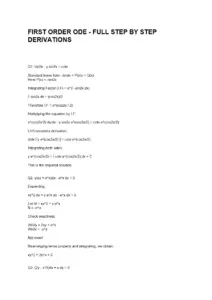
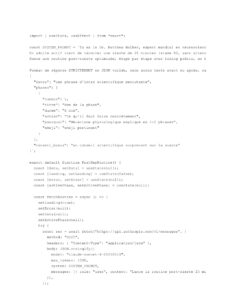
First Order ODE - Step by Step Solutions
Q1. dy/dx - y sin2x = cotx
P(x) = -sin2x
Integrating Factor = e^( -sin2x dx)
= e^(cos2x / 2)
Solution: y e^(cos2x/2) = cotx e^(cos2x/2) dx + C
Q2. y(xy + e^x)dx - e^x dy = 0
Rearranging and solving exact equation,
Final Answer: xy^2 = 2e^x + C
Q3. (2y - x^3)dx + x dy = 0
Check exactness and integrate,
Final Answer: xy - x^4/4 = C
Q4. (y+x)dx = (y-x)dy
Rearranging and separating variables,
Final Answer: x^2 + y^2 = C(x - y)
Q5. y(2x^2 - xy + 1)dx + (x-y)dy = 0
Solving exact equation,
Final Answer: x^2y - (xy^2)/2 + y = C
Q7. y(2x^2y + e^x)dx = (e^x + y^3)dy
Rearranging and solving exact equation,
Final Answer: x^2y^2 - e^x y - y^4/4 = C
Q8. ydx - xdy + 3x^2 y^2 e^(x^3)dx = 0
Method of inspection,
Final Answer: y/x + e^(x^3) = C
Q9. Family: y^2 = 4ax
Differentiate and eliminate parameter,
Orthogonal trajectory: x^2 + y^2 = C
Q10. Family: y = ax^2
Differentiate and eliminate parameter,
Orthogonal trajectory: y^2 + x^2/2 = C
Q11. xdx + ydy = (xdy - ydx)/(x^2 + y^2)
Using substitution and integration,
Final Answer: x^2 + y^2 = C e^(tan^-1(y/x))
Q12. y(2xy + e^x)dx = e^x dy
Rearranging and solving exact equation,
Final Answer: x y^2 - e^x y = C
/ 1
End of Document
382

FAQs

what is first order ODE step by step solutions

First Order ODE Step By Step Solutions provide detailed methods for solving first-order ordinary differential equations.

  • They include various techniques such as integrating factors, separation of variables, and exact equations.
  • Each solution is broken down into clear, manageable steps to enhance understanding.
  • Common examples include equations like dy/dx - y sin2x = cotx and y(2xy + e^x)dx = e^x dy.

how to solve first order ODE step by step

To solve first order ODE step by step, follow a structured approach based on the type of equation.

  • Identify the type of first-order ODE: separable, exact, or linear.
  • Apply the appropriate method: for example, use integrating factors for linear equations.
  • Integrate both sides and simplify to find the general solution.

examples of first order ODE step by step solutions

Examples of First Order ODE Step By Step Solutions include various equations that illustrate different solving techniques.

  • Example 1: dy/dx - y sin2x = cotx, solved using integrating factors.
  • Example 2: y(2xy + e^x)dx = e^x dy, solved as an exact equation.
  • Example 3: (2y - x^3)dx + x dy = 0, checked for exactness and integrated.

what are the methods in first order ODE step by step solutions

The methods in First Order ODE Step By Step Solutions include several key techniques for solving these equations.

  • Separation of Variables: Used when the equation can be expressed as a product of functions of x and y.
  • Integrating Factors: A technique applied primarily to linear first-order ODEs.
  • Exact Equations: Used when the differential equation can be expressed in a form that allows direct integration.

how to check if a first order ODE is exact

To check if a first order ODE is exact, ensure that the equation can be expressed in the form M(x,y)dx + N(x,y)dy = 0.

  • Calculate the partial derivatives: ∂M/∂y and ∂N/∂x.
  • If ∂M/∂y = ∂N/∂x, the equation is exact.
  • Proceed to solve using the method of exact equations if applicable.

what is the general solution for first order ODE

The general solution for a first order ODE is a family of solutions that includes an arbitrary constant.

  • It is typically expressed in the form y = f(x) + C, where C is the constant of integration.
  • The specific form of the general solution depends on the method used to solve the equation.
  • For example, solutions derived from linear equations often involve exponential functions.

how to find integrating factor for first order ODE

To find the integrating factor for a first order ODE, identify the standard form of the equation.

  • The integrating factor is often given by e^(∫P(x)dx), where P(x) is the coefficient of y in the equation.
  • Multiply the entire equation by this integrating factor to make it exact.
  • Solve the resulting exact equation to find the solution.

what are the applications of first order ODE

First order ODEs have various applications across different fields.

  • In physics, they model phenomena like population growth and radioactive decay.
  • In engineering, they are used to analyze systems such as electrical circuits.
  • In economics, they can represent models of supply and demand.

how to solve exact equations in first order ODE

To solve exact equations in first order ODE, start by ensuring the equation is in the form M(x,y)dx + N(x,y)dy = 0.

  • Check for exactness by verifying that ∂M/∂y = ∂N/∂x.
  • If exact, find a potential function Ψ such that ∂Ψ/∂x = M and ∂Ψ/∂y = N.
  • Set Ψ(x,y) = C to find the general solution.

what is the significance of first order ODE solutions

The significance of First Order ODE solutions lies in their ability to model real-world phenomena.

  • They provide insights into dynamic systems and their behavior over time.
  • Understanding these solutions is crucial for fields such as physics, engineering, and economics.
  • They help in predicting future states based on current conditions.