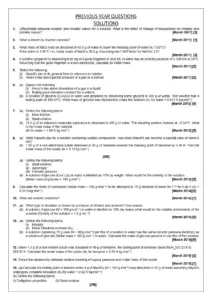
Electrochemistry Previous Year Questions provides a comprehensive collection of past exam questions focused on electrochemistry concepts. Ideal for students preparing for board exams, this resource covers key topics such as galvanic cells, electrolysis, and standard electrode potentials. Each question is designed to enhance understanding and application of electrochemical principles, making it a valuable study aid for high school and college-level chemistry courses. The document includes various question formats, ensuring a well-rounded review experience.

Key Points

  • Covers essential electrochemistry topics including galvanic cells and electrolysis.
  • Includes previous year exam questions for effective exam preparation.
  • Helps students understand standard electrode potentials and cell reactions.
  • Designed for high school and college chemistry students.
Nandini Raj
7 pages
Language:English
Type:Past Paper
Nandini Raj
7 pages
Language:English
Type:Past Paper
Nandini Raj
7 pages
Language:English
Type:Past Paper
322

Electrochemistry Previous Year Questions pdf

/ 7
PREVIOUS YEAR QUESTIONS CBSE
ELECTROCHEMISTRY
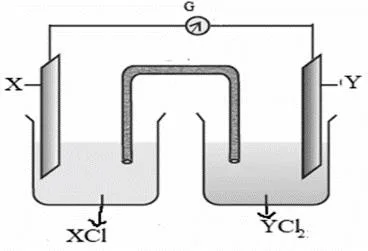
1. (a) What type of a battery is lead storage battery? Write the anode and cathode reaction and the overall cell
reaction occurring in the operation of a lead storage battery?
(b) Calculate the potential for a half cell containing 0.10 M K
2
Cr
2
O
7(aq)
, 0.20M
++
)aq(
43
)aq(
HM100.1andCr
the half cell reaction is
)(2
3
)aq()aq(
2
)aq(72
OH7Cr2e6H14OCr
+++
++
and the standard electrode potential is given as
E = 1.33 V.
[OR]
(a) How many moles of mercury will be produced by electrolyzing 1.0 M Hg(NO
3
)
2
solution with a current of
2.00 A for 3 hours? Hg(NO
3
)
2
= 200.6 g mol
1
(b) A voltaic cell is set up at 25C with the following half cells Al
3+
(0.001 M) and Ni
2+
(0.05 M). Write an
equation for the reaction that occurs when the cell generates an electric current and determine the cell
potential [March 2011] [5]
given
V66.1EV25.0E
Al/AlNi/Ni
32
==
++
E
2. A voltaic cell is set up at 25C with the following half cells Al / Al
3+
(0.001 M) and Ni / Ni
2+
(0.50 M)
Write an equation for the reaction that occurs when the cell generates an electric current and determine the
cell potential.
54.0108logV66.1EandV25.0E
6
Al/AlNi/Ni
32
===
++
[March 2012] [3]
3. The electrical resistance of a column of 0.05 M NaOH solution of diameter 1 cm and length 50 cm is 5.55
10
3
. Calculate its resistivity, conductivity and molar conductivity. [March 2012] [3]
4. The molar conductivity of a 1.5 M solution of an electrolyte is found to be 138.9 S cm
2
mol
1
. Calculate the
conductivity of this solution? [March 2012] [2]
5. Express the relation among cell constant, resistance of the solution in the cell and conductivity of the
solution. How is molar conductivity of a solution related to its conductivity? [March 2012] [2]
6. Calculate the emf of the following cell at 25C
)s(
2
)M10()M10(
)s(
Cu/Cu//Ag/Ag
13
++
cell
E
= +0.46 V and log 10
n
= n [March 2013] [3]
7. The standard electrode potential (E) for Daniel cell is +1.1 V. Calculate the G for the reaction
[March 2013] [2]
8. Calculate emf of the following cell at 298 K.
Mg(s) /
)s(Cu/Cu//Mg
2
)M01.0(
2
)M1.0(
++
[Given
, 1F = 96500 C mol
1
]
[March 2014] [3]
9. State Faraday’s law of electrolysis. How much charge in terms of Faraday is required for the reduction of 1
mol of Cu
2+
to Cu [March 2014] [2]
10. Resistance of a conductivity cell filled with 0.1 mol L
1
KCl solution is 100 . f the resistance of
the same cell when filled with 0.02 mol L
1
KCl solution is 520 , calculate the conductivity and
molar conductivity of 0.02 mol L
1
KCl solution. The conductivity of 0.1 mol L
1
KCl solution is
1.29 10
2
1
cm
1
[March 2014] [2]
11. Define the following terms:
(i) Secondary batteries
(ii) Limiting molar conductivity
)(
m
[March 2014] [2]
12. (a) Calculate the
r
G for the reaction Mg(s) + Cu
2+
(aq) Mg
2+
(aq) + Cu(s)
Given
cell
E
= 2.71 V, 1 F = 96500 C mol
1
(b) Name the type of cell which was used in Apollo space programme for providing electrical power
[March 2014] [2]
13. State Kohlrausch law of independent migration of ions. Why does the conductivity of a solution decrease with
dilution? [March 2014] [2]
14. Calculate the e.m.f and G for the following cell:

Ni(s) / Ni
2+
(0.01 M) // Ag
+
(0.001 M) / Ag(s) Given:
V80.0E,V25.0E
)Ag/Ag()Ni/Ni(
2
+==
++
[OR]
(a) The conductivity of 0.1 mol L
1
solution of NaCl is 1.06 10
2
S cm
1
. Calculate its molar conductivity and
degree of dissociation (). Given (Na
+
) = 50.1 S cm
2
mol
1
and (Cl
) = 76.5 S cm
2
mol
1
.
(b) What is the difference between primary battery and secondary battery? Give one example of each type
[March 2015] [5]
15. How much charge in Faradays is required for the reduction of 1 mol of Al
3+
to Al?
[March 2015] [1]
16. For the given cells:
Lead storage cell, Mercury cell, Fuel cell and Dry cell
Answer the following:
(i) Which cell is used in hearing aids?
(ii) Which cell was used in Apollo space programme?
(iii) Which cell is used in automobiles and inverters?
(iv) Which cell does not have long life? [March 2016] [2]
17. Calculate
cell
E
for the following reaction at 298 K:
2Cr(s) + 3Fe
2+
(0.01M) 2Cr
3+
(0.01 M) + 3Fe(s)
Given: E
cell
= 0.261 V [March 2016] [3]
18. Write the name of the cell which is generally used in inverters. Write the reactions taking place at the anode
and the cathode of this cell. [March 2017] [2]
19. (a) The cell in which the following reaction occurs:
)s(2
2
)aq()aq(
3
)aq(
Fe22Fe2 ++
++
has
cell
E
= 0.236V at 298K. Calculate the standard Gibbs energy of the cell reaction.
(Given : 1F = 96500 C mol
1
)
(b) How many electrons flow through a metallic wire if a current of 0.5 A is passed for 2 hours?
(Given: 1F = 96500 C mol
1
) [March 2017] [3]
20. (a) Write the cell reaction and calculate the emf of the following cell at 298 K:
Sn
(s)
/ Sn
2+
(0.004 M) // H
+
(0.020 M) / H
2(g)
(1 bar) / Pt
(s)
(Given :
Sn/Sn
2
E
+
= −0.14 V)
(b) Give reasons:
(i) On the basis of values, O
2
gas should be liberated at anode but it is Cl
2
gas which is liberated in
the electrolysis of aqueous NaCl
(ii) Conductivity of CH
3
COOH decreases on dilution.
[OR]
(a) For the reaction
2AgCl
(s)
+ H
2(g)
(1 atm)
2Ag
(s)
+ 2H
+
(0.1 M) + 2Cl
(0.1 M) ∆G° = −43600 J at 25°C
Calculate the emf of the cell
[log 10
−n
= −n]
(b) Define fuel cell and write its two advantages [March 2018] [5]
21. Define electrochemical cell. What happens when applied external potential becomes greater than
cel
E
of
electrochemical cell? [March 2019] [2]
22. Calculate ∆
r
G° and log K
c
for the following reaction:
Cd
+2
(aq) + Zn(s)
Zn
2+
(aq) + Cd(s)
Given :
V403.0E
Cd/Cd
2
=
+
V763.0E
Zn/Zn
2
=
+
OR
Chromium metal is electroplated using an acidic solution containing CrO
3
according to the following equation:
CrO
3
(aq) + 6H
+
+ 6e
Cr(s) + 3H
2
O
Calculate how many grams of chromium will be electroplated by 24,000 coulombs. How long will it take to
electroplate 1.5 g chromium using 12.5 A current?
[Atomic mass of Cr = 52 g mol
−1
, 1F = 96500 C mol
−1
] [March 2019] [3]
23.
[March 2020] [1]
24..
[March 2020] [2]
25.
[March 2021] [2]
26.
[March 2021] [3]
27.
[SQP 2022] [1]
/ 7
End of Document
322

FAQs

What is the overall cell reaction in a lead storage battery?
In a lead storage battery, the overall cell reaction involves the conversion of lead dioxide (PbO2) and sponge lead (Pb) into lead sulfate (PbSO4) with the release of water. The anode reaction is Pb + SO4^2- → PbSO4 + 2e-, and the cathode reaction is PbO2 + 4H+ + SO4^2- + 2e- → PbSO4 + 2H2O. This process occurs during the discharge of the battery, allowing it to generate electrical energy.
How can you calculate the emf of a cell at 25°C?
To calculate the emf of a cell at 25°C, you can use the Nernst equation. For example, given the half-cell reactions and their standard electrode potentials, you can determine the cell potential. For a cell with Al3+ (0.001 M) and Ni2+ (0.05 M), you would first identify the standard potentials, then apply the Nernst equation to find the actual cell potential based on the concentrations provided.
What is Faraday’s law of electrolysis?
Faraday’s law of electrolysis states that the amount of substance produced at an electrode during electrolysis is directly proportional to the quantity of electricity passed through the electrolyte. Specifically, the law can be expressed in terms of charge (in coulombs) and the number of moles of electrons involved in the reaction. For example, to reduce 1 mole of Cu2+ to Cu, 2 Faradays of charge are required.
How do you calculate the conductivity of a solution?
The conductivity of a solution can be calculated using the formula: Conductivity (κ) = Cell constant (k) / Resistance (R). For instance, if the resistance of a conductivity cell filled with a specific solution is known, and the cell constant is provided, you can determine the conductivity of that solution. This is essential for understanding the ionic strength of the solution.
What reactions occur in a galvanic cell composed of Mg and Ag+?
In a galvanic cell composed of Mg(s) and Ag+(aq), magnesium acts as the anode where oxidation occurs, and silver ions act as the cathode where reduction takes place. The overall cell reaction can be represented as Mg(s) + 2Ag+(aq) → Mg2+(aq) + 2Ag(s). This reaction indicates that magnesium is oxidized to Mg2+, while Ag+ is reduced to silver metal.
What is the significance of molar conductivity in electrochemistry?
Molar conductivity is a measure of how well an electrolyte conducts electricity when dissolved in a solution. It is defined as the conductivity of the solution divided by the molarity of the electrolyte. Molar conductivity is particularly significant for understanding the behavior of electrolytes at different concentrations and plays a crucial role in applications such as determining the degree of dissociation of weak electrolytes.
How is the standard Gibbs energy related to cell potential?
The standard Gibbs energy change (ΔG°) is directly related to the cell potential (E°) through the equation ΔG° = -nFE°, where n is the number of moles of electrons transferred and F is Faraday's constant (approximately 96500 C/mol). This relationship indicates that a positive cell potential corresponds to a negative Gibbs energy change, signifying a spontaneous reaction.