Strength of Materials for Technicians by J. G. Drotsky is a comprehensive textbook published by Butterworth Heinemann in 1984. This edition provides in-depth coverage of the principles of strength of materials, focusing on applications relevant to technicians. It includes numerous practical problems and examples, making it suitable for engineering students and professionals in the field. Key topics include stress analysis, material properties, and structural applications, with a strong emphasis on real-world scenarios. The textbook serves as an essential resource for those studying engineering or working in technical fields.

Key Points

  • Covers fundamental concepts of strength of materials for engineering technicians
  • Includes practical problems and examples relevant to real-world applications
  • Explains stress analysis, material properties, and structural applications
  • Designed for students in engineering courses and technical professionals
Desciplined & Sleep
Author:J. G. Drotsky
Edition:1984
263 pages
Language:English
Type:Textbook
Desciplined & Sleep
Author:J. G. Drotsky
Edition:1984
263 pages
Language:English
Type:Textbook
108
/ 263
Strength
of
Materials
for
Technicians
J
C
DROTSKY
BSC,
NDT, NTTD
Head of Department
Strength of Materials
Vaal Triangle Technikon
Butterworths
Durban/Pretoria
BUTTERWORTH PUBLISHERS (PTY) LTD
©1984
ISBN: 0 409 11082 5
THE BUTTERWORTH GROUP
South Africa
BUTTERWORTH PUBLISHERS (PTY) LTD
8 Walter Place, Waterval Park, Mayville, Durban 4091
England
BUTTERWORTH & CO. (PUBLISHERS) LTD
88 Kingsway, London WC2B 6AB
Australia
BUTTERWORTHS (PTY) LTD
PO Box 345, North Ryde, NSW 2113
Canada
BUTTERWORTH & CO. (CANADA) LTD
2265 Midland Avenue, Scarborough, Ontario MIP 4SI
New Zealand
BUTTERWORTHS OF NEW ZEALAND LTD
33-35 Cumberland Place, Wellington
USA
BUTTERWORTHS (PUBLISHERS) INC.
10 Tower Office Park, Woburn, Massachusetts 01801
House editors: Sarie Moolman, Gisela Hasse
Set and designed by Dieter Zimmermann (Pty) Ltd, Johannesburg
Cover design by Jenny Exton
Printed by Sigma Press (Pty) Ltd, Pretoria
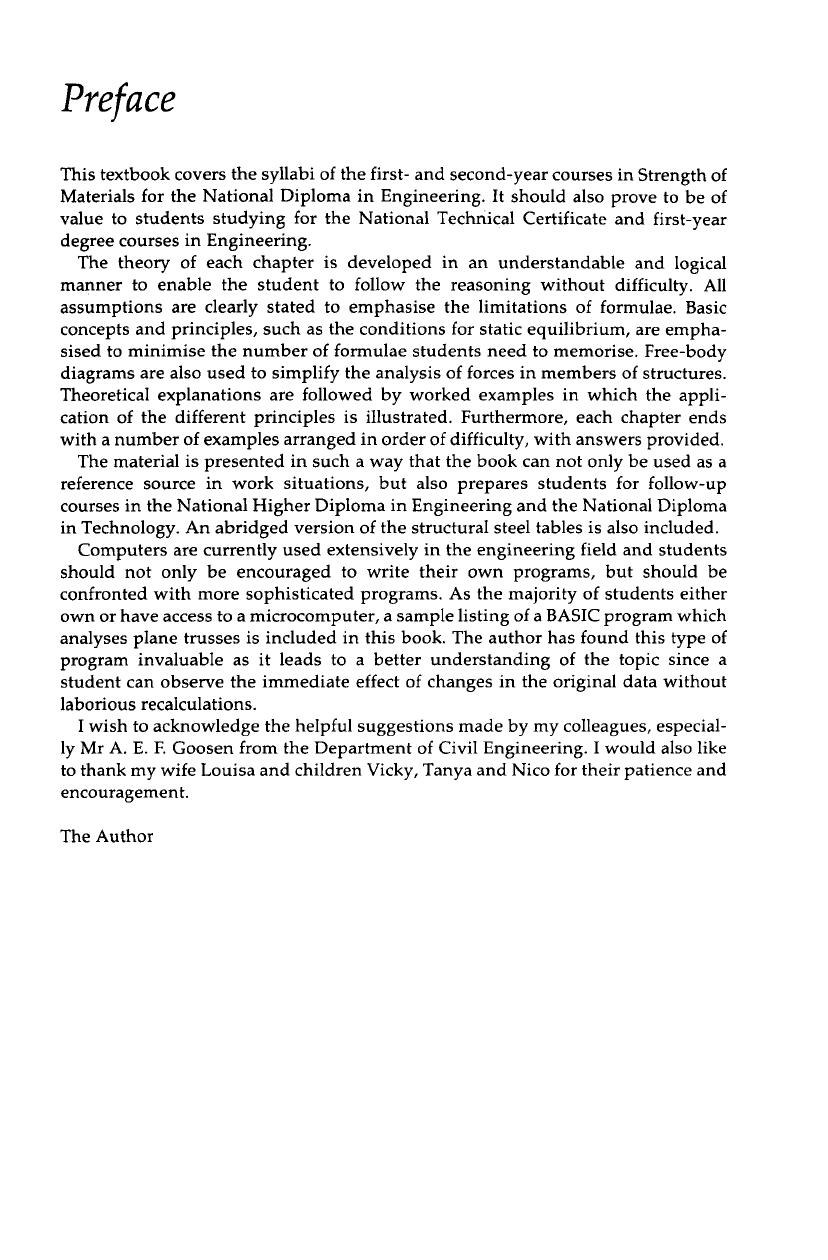
Preface
This textbook covers the syllabi of the first- and second-year courses in Strength of
Materials for the National Diploma in Engineering. It should also prove to be of
value to students studying for the National Technical Certificate and first-year
degree courses in Engineering.
The theory of each chapter is developed in an understandable and logical
manner to enable the student to follow the reasoning without difficulty. All
assumptions are clearly stated to emphasise the limitations of formulae. Basic
concepts and principles, such as the conditions for static equilibrium, are empha-
sised to minimise the number of formulae students need to memorise. Free-body
diagrams are also used to simplify the analysis of forces in members of structures.
Theoretical explanations are followed by worked examples in which the appli-
cation of the different principles is illustrated. Furthermore, each chapter ends
with a number of examples arranged in order of difficulty, with answers provided.
The material is presented in such a way that the book can not only be used as a
reference source in work situations, but also prepares students for follow-up
courses in the National Higher Diploma in Engineering and the National Diploma
in Technology. An abridged version of the structural steel tables is also included.
Computers are currently used extensively in the engineering field and students
should not only be encouraged to write their own programs, but should be
confronted with more sophisticated programs. As the majority of students either
own or have access to a microcomputer, a sample listing of a BASIC program which
analyses plane trusses is included in this book. The author has found this type of
program invaluable as it leads to a better understanding of the topic since a
student can observe the immediate effect of changes in the original data without
laborious recalculations.
I wish to acknowledge the helpful suggestions made by my colleagues, especial-
ly Mr A. E. F. Goosen from the Department of Civil Engineering. I would also like
to thank my wife Louisa and children Vicky, Tanya and Nico for their patience and
encouragement.
The Author

/ 263
End of Document
108

FAQs

What are the two types of direct forces discussed in the textbook?
The textbook identifies two types of direct forces: tensile and compressive forces. Tensile forces pull apart the members, while compressive forces push them together. These forces are crucial for understanding the internal forces that are induced in a body to counteract externally applied forces.
What are the conditions for static equilibrium outlined in the book?
The conditions for static equilibrium as outlined in the textbook are: (a) the sum of all forces acting on a body must equal zero (ΣP = 0), and (b) the sum of all moments about any point must also equal zero (ΣM = 0). These conditions are essential for solving many problems in strength of materials, particularly those that are statically determinate.
How does the textbook define a simple plane truss?
A simple plane truss is defined in the textbook as a two-dimensional assemblage of members, each connected at its ends to other members or to a foundation by frictionless pin joints. The stability of the structure relies on the arrangement of these members, with triangles being the simplest stable configuration. The text emphasizes that a sufficient number of members must be used to ensure stability.
What is the method of sections for solving simple plane trusses?
The method of sections is an analytical approach for solving simple plane trusses described in the textbook. It involves sketching a free-body diagram of the structure, determining reactions at supports if needed, and drawing a section line through the structure to analyze the forces in specific members. The method allows for calculating unknown forces by applying the conditions for static equilibrium, focusing on one side of the section line.
What assumptions are made in the analysis of trusses according to the book?
The textbook states several assumptions made in the analysis of trusses: (a) buckling of members is not considered, (b) forces due to the mass of the structure are negligible compared to applied loads, (c) all members are connected by frictionless pin joints, and (d) all external forces, including reactions at supports, are applied at the joints. These assumptions simplify computations and yield conservative results.
What is the significance of free-body diagrams in the analysis of forces?
Free-body diagrams are crucial in the analysis of forces as they provide a visual representation of the body being investigated, indicating all external forces and reactions acting on it. According to the textbook, these diagrams simplify problem-solving by clarifying the relationships between forces and moments, making it easier to apply the conditions for static equilibrium.
What formula is used to determine the state of a structure not attached to a foundation?
The textbook provides the formula m = 2j - 3 to determine the state of a structure not attached to a foundation, where m represents the number of members and j represents the number of joints. If this equation is satisfied, the structure is considered statically determinate, provided the members are arranged correctly.