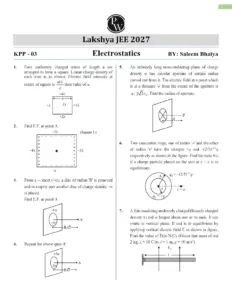
Electrostatics concepts are explored in KPP 01, authored by Saleem Sir. This resource is designed for students preparing for JEE exams, covering essential topics such as electric forces, point charges, and electric fields. The document includes various problems and solutions to reinforce understanding of electrostatic principles. Ideal for JEE aspirants, it provides a comprehensive overview of the subject matter, ensuring a solid foundation in physics.

Key Points

  • Explains the principles of electrostatics, including Coulomb’s law and electric fields.
  • Includes practice problems and solutions for JEE preparation.
  • Covers the interaction of point charges and the concept of electric force.
  • Designed for students aiming to excel in physics for competitive exams.
Sujal Ayush
Author: Saleem Sir More by Saleem Sir KPP 03 Electrostatics KPP 03 Electrostatics
3 pages
Language:English
Type:Answer Key
Sujal Ayush
Author: Saleem Sir More by Saleem Sir KPP 03 Electrostatics KPP 03 Electrostatics
3 pages
Language:English
Type:Answer Key
374
/ 3
1
Lakshya JEE 2027
KPP 01 Electrostatics By: Saleem Bhaiya
1. Two point charges q
1
= 2 μC and q
2
= –2 μC are
located at x = 0, y = 0.3 m and x = 0, y = 0.3 m
respectively. The net electric force on a third point
charge Q = 4 μC at x = 0.4 m, y = 0 is:
(1)
( )
0.46 N
ˆ
i
(2)
(0.34 N)
ˆ
j
(3)
( )
0.34 N
ˆ
j
(4)
( )
ˆ
0.46 N i
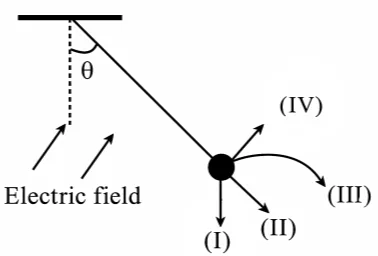
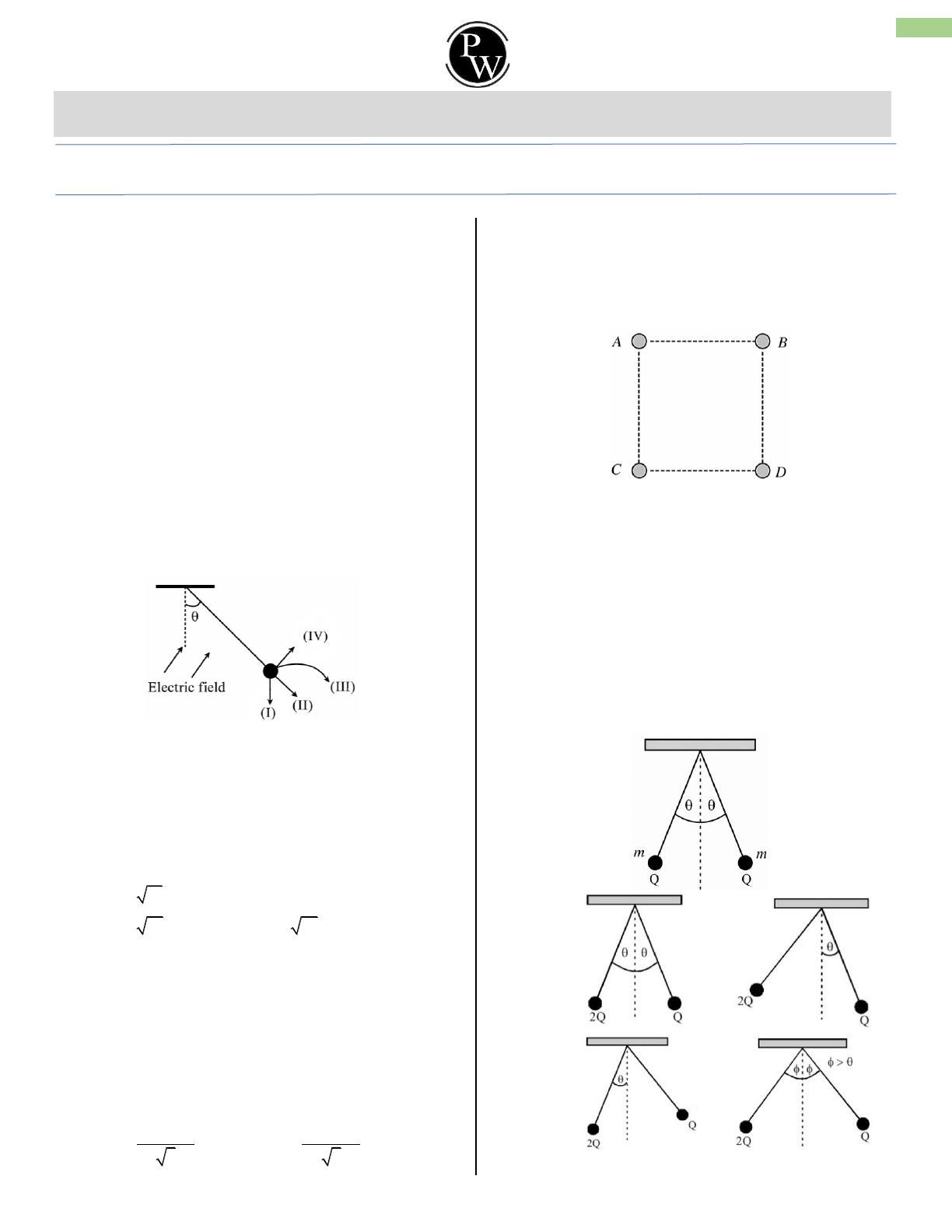
2. A small object of mass M and charge Q is
connected to an insulating massless string in
vacuum on Earth. A uniform electric field exists
throughout the region of the vacuum as indicated.
The mass remains in static equilibrium at an angle
θ with the vertical as shown in the figure. When
the string is cut, which of the illustrated paths best
indicates the trajectory of the mass?
(1) I (2) II
(3) III (4) IV
3. Two identical charges, 5 μC each, are in the air.
What is the largest charge to be transferred from
one charge to another, so that their interaction
force decreases 2.5 times?
(1)
11 C
(2)
4C
(3)
13 C
(4)
15 C
4. A point charge −3q is positioned at point (2, 1, 3)
of a Cartesian coordinate system. A test point
charge 2q is placed at point (3, 0, 4). Which of the
following is the unit vector in the direction of the
force acting on the test charge? All the coordinates
are in meters.
(1)
ˆ
ˆˆ
ijk++
(2)
( )
ˆ
ˆˆ
ijk−++
(3)
(4)
3
ˆ
ˆˆ
ijk++
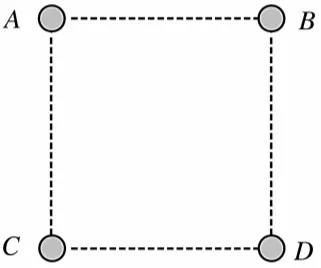
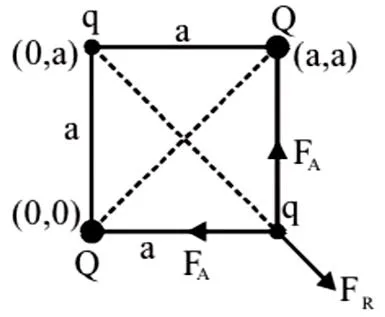
5. Four charges are at the corners of a square as
shown in the figure. Corners A and D have equal
charge, while both B and C have a charge of +1 C.
What is the charge on A so that the force on B is
zero?
(1) 1.0 C (2) 0.5 C
(3) 0.35 C (4) 0.71 C
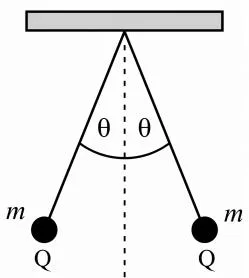
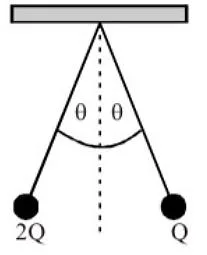
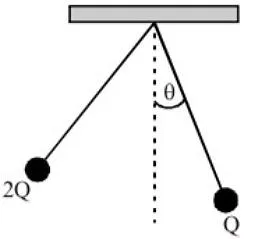
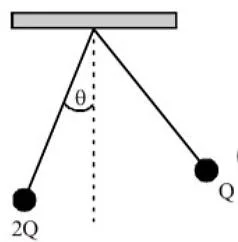
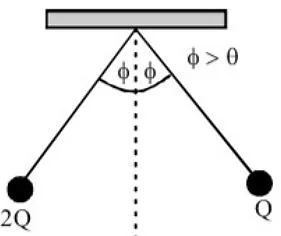
6. Two pith balls with mass m are suspended from
insulating threads. When the pith balls are given
equal positive charge Q, they hang in equilibrium
as shown. We now increase the charge on the left
pith ball from Q to 2Q while leaving its mass
essentially unchanged. Which of the following
diagrams best represents the new equilibrium
configuration?
(1) (2)
(3) (4)

2
7. Two charges, each equal to q, are kept at x = a
and x = a on the x-axis. A particle of mass m and
charge
0
2
q
q =
is placed at the origin. If charge q
0
is given a small displacement (y << a) along the
y-axis, the net force acting on the particle is
proportional to:
(1) y (2) y
(3)
1
y
(4)
1
y
8. Two identical charged spheres suspended from a
common point by two massless strings of length
are initially a distance d(dℓ) apart because of
their mutual repulsion. The charge begins to leak
from both the spheres at a constant rate. As a
result, the charges approach each other with a
velocity v. Then as a function of distance x
between them:
(1)
1/ 2
vx
(2)
vx
(3)
1/ 2
vx
(4)
1
vx
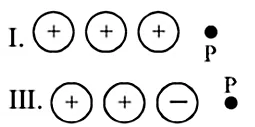
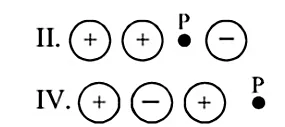
9. Given are four arrangements of three fixed electric
charges. In each arrangement, a point labeled P is
also identified test charge, +q, is placed at
point P. All of the charges are of the same
magnitude, Q, but they can be either positive or
negative as indicated. The charges and point Pall
lie on a straight line. The distances between
adjacent items, either between two charges or
between a charge and point P, are all the same.
Correct order of choices in a decreasing order of
magnitude of force on P is:
(1) II > I > III > IV (2) I > II > III > IV
(3) II > I > IV > III (4) III > IV > I > II
10. Two point charges of 100 μC and –4 μC are
positioned at points
)23,33, 4(−−
and
)43, 5( 3, 6
respectively of a Cartesian
coordinate system. Find the force vector on the
–4 μC charge? All the coordinates are in meters.
(1)
( )
4
910 3 5
ˆ
3
ˆ
3
ˆ
4ijk
−+
(2)
( )
4
4
ˆ
ˆˆ
9 10 3 3 3 5ijk
−+
(3)
( )
4
2.25 10 3 3
ˆ
43
ˆ
5
ˆ
ijk
−+
(4)
( )
4
ˆ
2.25 10 3 3 5
ˆ
3
ˆ
4ijk
−+
11. Two charged balls are connected by an
inextensible thread of length 3 m. Masses of balls
are 2 kg and 1 kg, the charges are +20 μC and
–100 μC. What minimum constant external force
F (in N) must be applied to the ball of mass 1 kg
so that the thread does not slack? Neglect gravity
and friction.
12. Four identical charges q are placed at the corners
of a square of side a, what charges Q must be
placed at the centre of the square so that whole
system of charges is in equilibrium?
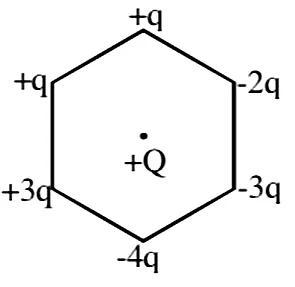
13. Six charges are kept at the vertices of a regular
hexagon as shown in the figure. If magnitude of
force applied by +Q on +q charge is F, then net
electric force on the +Q is nF. Find the value of n.
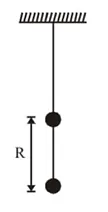
14. Two identical balls of mass m = 0.9 g each are
charged by the same charges, joined by a thread
and suspended from the ceiling (figure). Find the
charge (in μC) that each ball should have so that
the tension in both the threads are same? The
distance between the centers of balls is R = 3 m.
15. For the system shown in figure find Q for which
resultant force on q is zero.
3
Answer Key
1. (2)
2. (2)
3. (4)
4. (4)
5. (3)
6. (4)
7. (1)
8. (3)
9. (3)
10. (2)
11. (3)
12.
(1 2 2 )
4Q
+
13. (9)
14. (003)
15.
22Qq =−
/ 3
End of Document
374

FAQs

What is the net electric force on charge Q in the electrostatics problem?
In the document, the net electric force on a third point charge Q = 4 μC, located at (0.4 m, 0), is calculated based on the interactions with two point charges, q1 = 2 μC at (0, 0.3 m) and q2 = -2 μC at (0, -0.3 m). The answer options include forces such as (0.46N)ˆi, (0.34 N)ˆ-j, (0.34N)ˆj, and (0.46N)ˆ−i, with the correct answer being (0.34 N)ˆ−j, indicating the direction and magnitude of the resultant force acting on charge Q due to the other two charges.
How does the trajectory of a mass change when the string is cut in an electric field?
The document describes a scenario where a mass M with charge Q is in static equilibrium at an angle θ with the vertical in a uniform electric field. When the string is cut, the trajectory of the mass is influenced by the electric field, and the document provides options for the possible paths the mass could take. The correct choice indicates that the mass will follow a specific path, demonstrating the effect of the electric field on the motion of charged objects.
What charge must be placed at the center of a square for equilibrium?
According to the document, when four identical charges q are placed at the corners of a square with side length a, a charge Q must be placed at the center to achieve equilibrium. The document specifies the relationship between the charges, stating that the value of Q must be 4Q to ensure that the net force on the system is zero, thus maintaining equilibrium among the charges at the corners.
What is the relationship between the force on a test charge and the displacement in the electrostatics problem?
In the document, a scenario is presented where two charges, each equal to q, are positioned on the x-axis, and a particle with charge q0 is placed at the origin. If q0 is displaced slightly along the y-axis, the document states that the net force acting on the particle is proportional to the displacement y. Specifically, the force is proportional to y, indicating a linear relationship between the force and the small displacement from the equilibrium position.
How does charge leakage affect the distance between two charged spheres?
The document discusses two identical charged spheres suspended by massless strings that repel each other due to their charges. As the charges leak at a constant rate, the spheres approach each other with a velocity v. The document states that the relationship between the velocity and the distance x between the spheres is described by the equation v ∝ 1/2 x, indicating that as the distance decreases, the velocity at which they approach each other is affected.
What minimum force is needed to keep a charged ball from slackening a thread?
In the document, a situation is described where two charged balls are connected by an inextensible thread. To prevent the thread from slackening, a minimum constant external force F must be applied to the ball of mass 1 kg. The document provides the necessary calculations and considerations for determining this force, emphasizing the balance of forces acting on the charged balls due to their respective charges.
What is the correct order of force magnitudes on a test charge from different charge arrangements?
The document presents four arrangements of three fixed electric charges with a test charge +q placed at point P. It asks for the correct order of the magnitudes of the forces acting on the test charge. The answer options rank the arrangements based on the net force experienced by the test charge, with the correct order being II > I > IV > III, illustrating how different configurations of charges affect the resultant force on a test charge.