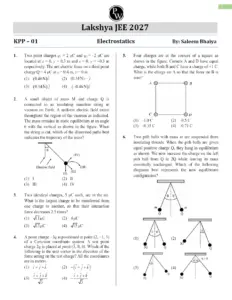
KPP 03 Electrostatics by Saleem Sir focuses on key concepts in electrostatics, including electric fields, charge distributions, and their applications. This resource is designed for students preparing for competitive exams like JEE, providing detailed explanations and problem-solving techniques. It covers various topics such as electric field intensity, charge density, and equilibrium conditions in electrostatic systems. Ideal for physics students seeking to enhance their understanding of electrostatics and improve their exam performance.

Key Points

  • Explains electric field intensity at the center of charged wire configurations.
  • Covers the effects of charge density on electric fields in various geometries.
  • Includes problems related to electric fields from charged discs and sheets.
  • Discusses equilibrium conditions for charged particles in electric fields.
Sujal Ayush
Author: Saleem Sir More by Saleem Sir KPP 01 Electrostatics KPP 01 Electrostatics
5 pages
Language:English
Type:Study Guide
Sujal Ayush
Author: Saleem Sir More by Saleem Sir KPP 01 Electrostatics KPP 01 Electrostatics
5 pages
Language:English
Type:Study Guide
364
/ 5
1
Lakshya JEE 2027
KPP - 03 Electrostatics BY: Saleem Bhaiya
1. Four uniformly charged wires of length a are
arranged to form a square. Linear charge density of
each wire is as shown. Electric field intensity at
centre of square is
nk
a
then value of n.
2. Find E.F. at point A.
3. From a sheet (+), a disc of radius 'R' is removed
and in emptiy part another disc of charge density
is placed.
Find E.F. at point A.
4. Repeat the above ques if
5. An infinitely long non-conducting plane of charge
density has circular aperture of certain radius
carved out from it. The electric field at a point which
is at a distance 'a' from the centre of the aperture is
0
/ 2 2
. Find the radius of aperture.
6. Two concentric rings, one of radius 'a' and the other
of radius 'b' have the charges +q and (2/5)
3/2
q
respectively as shown in the figure. Find the ratio b/a
if a charge particle placed on the axis at z = a is in
equilibrium.
7. A thin insulating uniformly charged (linearly charged
density λ) rod is hinged about one of its ends. It can
rotate in vertical plane. If rod is in equilibrium by
applying vertical electric field E as shown in figure.
Find the value of E(in N/C). (Given that mass of rod
2 kg, λ = 10 C/m, l = 1 m, g = 10 m/s
2
).
2
8. Five positive equal charges are placed at vertices of a
regular hexagon and net electric field at the centre is
E
1
. A negative charge having equal magnitude is
placed sixth vertex and then net electric field is E
2
.
Find
2
1
E
.
E
(1) 2 (2) 1
(3) 3 (4) None of these
9. The direction () of
E

at point P due to uniformly
charged finite rod will be:
(1) at angle 30° from x-axis
(2) 45° from x-axis
(3) 60° from x-axis
(4) none of these
10. As shown in the figure to the right, an insulating rod
is set into the shape of a semicircle. The left half of
the rod has a charge of +Q uniformly distributed
along its length, and the right half of the rod has a
charge of Q uniformly distributed along its length.
What vector shows the correct direction of the
electric field at point P, the centre of the semicircle?
(1) A (2) B
(3) C (4) D
11. A nonconducting ring of radius R has uniformly
distributed positive charge Q. A small part of the ring,
of length d, is removed (d << R). The electric field at
the centre of the ring will now be:
(1) directed towards the gap, inversely proportional
to R
3
.
(2) directed towards the gap, inversely proportional
to R
2
.
(3) directed away from the gap, inversely
proportional to R
3
.
(4) directed away from the gap, inversely
proportional to R
2
.
12. A particle of mass m, charge Q is constrained to
move along the axis of a ring of radius a. The ring
carries a uniform charge density +λ along its
circumference. Initially, the particle lies in the plane
of the ring at a point where no net force acts on it. The
period of oscillation of the particle when it is
displaced slightly from its equilibrium position is:
(1)
2
0
T4
Q
ma
=
(2)
2
0
2
T2
Q
ma
=
(3)
2
0
4
T2
Q
ma
=
(4)
2
0
T2
2Q
ma
=
13. A negatively charged particle p is placed, initially at
rest, in a constant, uniform gravitational field and a
constant, uniform electric field as shown in the
diagram. What qualitatively, is the shape of the
trajectory of the electron?
(1) (2)
(3) (4)
3
14. A particle of mass m and charge q is attached to a
light rod of length L. The rod can rotate freely in the
plane of paper about the other end, which is hinged at
P. The entire assembly lies in a uniform electric field
E also acting in the plane of paper as shown. The rod
is released from rest when it makes an angle with
the electric field direction. Determine the speed of the
particle when the rod is parallel to the electric field.
(1)
1/2
2 EL(1 cos )q
m
−



(2)
(3)
1/2
EL(1 cos )
2
q
m
−



(4)
1/2
2 ELcosq
m



15. Under the influence of the Coulomb field of charge
+Q, a charge q is moving around it in an elliptical
orbit. Find out the correct statement(s).
[IT-JEE 2009]
(1) The angular momentum of the charge q is
constant
(2) The linear momentum of the charge q is
constant
(3) The angular velocity of the charge q is constant
(4) The linear speed of the charge q is constant
16. A wooden block performs SHM on a frictionless
surface with frequency, v
0
. The block carries a charge
+Q on its surface. If now a uniform electric field
E

is switched-on as shown, then the SHM of the błock
will be: [ПТ-ЈЕЕ 2011]
(1) of the same frequency and with shifted mean
position
(2) of the same frequency and with the same mean
position
(3) of changed frequency and with shifted mean
position
(4) of changed frequency and with the same mean
position
17. The figures below depict two situations in which two
infinitely long static line charges of constant positive
line charge density λ are kept parallel to each other.
In their resulting electric field, point charges q and
q are kept in equilibrium between them. The point
charges are confined to move in the x direction only.
If they are given a small displacement about their
equlibrium positions, then the correct statement(s) is
(are): [JEE-Advance-2015]
(1) Both charges execute simple harmonic motion
(2) Both charges will continue moving in the
direction of their displacement
(3) Charge +q executes simple harmonic motion
while charge q continues moving in the
direction of its displacement.
(4) Charge q executes simple harmonic motion
while charge +q continues moving in the
direction of its displacement.
/ 5
End of Document
364

FAQs

What is the electric field intensity at the center of a square formed by charged wires?
The electric field intensity at the center of a square formed by four uniformly charged wires is expressed as nk/λ, where λ is the linear charge density of each wire. The problem requires calculating the value of n based on the arrangement of the wires and their charge densities, which is a key concept in electrostatics.
How do you find the electric field at point A from a charged sheet and disc?
To find the electric field at point A from a positively charged infinite sheet from which a disc has been removed, and where another disc of negative charge density is placed, one must consider the contributions of both charge distributions. The document outlines the methodology for calculating the resultant electric field at point A, emphasizing the superposition principle in electrostatics.
What happens to the electric field when a part of a charged ring is removed?
When a small part of a uniformly charged ring is removed, the electric field at the center of the ring is directed towards the gap created. The document states that this field is inversely proportional to R², where R is the radius of the ring. This concept illustrates how the symmetry of charge distribution affects the resultant electric field.
What is the period of oscillation for a particle near a charged ring?
The period of oscillation for a particle of mass m and charge -Q, constrained to move along the axis of a ring with uniform charge density +λ, is derived in the document. When displaced slightly from its equilibrium position, the period is given by T = 2π√(m/λ), highlighting the relationship between mass, charge, and the properties of the electric field generated by the ring.
How does the electric field affect a charged particle's trajectory?
The document discusses the trajectory of a negatively charged particle placed in a constant gravitational field and a uniform electric field. It qualitatively describes the shape of the trajectory, emphasizing how the combined effects of these fields influence the motion of the particle.
What conditions allow for equilibrium of charges between parallel line charges?
The document explains that when two infinitely long static line charges are kept parallel, point charges +q and -q can be placed in equilibrium between them. If these charges are slightly displaced from their equilibrium positions, the document outlines the conditions under which they will execute simple harmonic motion, illustrating the stability of the equilibrium.
How do you calculate the electric field due to a charged semicircular rod?
To calculate the electric field at point P, the center of a semicircular rod with positive charge +Q on one half and negative charge -Q on the other, the document provides a method for determining the resultant electric field direction. It emphasizes the contribution of both halves of the rod and how their charges interact at point P.