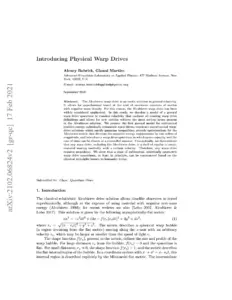
The Warp Drive explores advanced concepts in theoretical physics, focusing on creating a feasible warp drive model. Authored by Alexey Bobrick and Gianni Martire in 2021, this paper addresses the challenges of the Alcubierre solution, particularly the need for negative-mass matter. It presents alternative designs, including a subluminal, positive-energy warp drive, aiming to make interstellar travel more plausible. This research is essential for physicists and enthusiasts interested in the future of space travel and general relativity.

Key Points

  • Examines the Alcubierre warp drive solution and its limitations.
  • Proposes a subluminal, positive-energy warp drive design.
  • Discusses the implications of negative-mass matter in warp drive theories.
  • Explores the feasibility of hyper-fast travel within general relativity.
Noobmaster 69
Author:Alexey Bobrick, Gianni Martire
Edition:2021
10 pages
Language:English
Type:Research Paper
Noobmaster 69
Author:Alexey Bobrick, Gianni Martire
Edition:2021
10 pages
Language:English
Type:Research Paper
106
/ 10
arXiv:gr-qc/0009013v1 5 Sep 2000
The warp drive: hyper-fast travel
within general relativity.
Miguel Alcubierre
Department of Physi cs and Astronomy, University of Wales,
College of Car diff, P.O. Box 913, Cardiff CF1 3YB, UK.
PACS numbers : 0420, 0490.
Abstract
It is shown how, within the framework of general relativity and without the intro-
duction of wormholes, it is possible to modify a spacetime in a way that allows a
spaceship to travel with an arbitrarily large speed. By a purely local expansion of
spacetime behind the spaceship and an opposite contraction in front of it, motion
faster than the speed of light as seen by observers outside the disturbed region is
possible. The resulting distortion is reminiscent of the “warp drive” of science fic-
tion. However, jus t as it happens with wormholes, exotic matter will be needed in
order to generate a distortion of spacetime like the one discussed here.
Published in: Class. Quantum Grav. 11-5, L73-L77 (1994).
Present address: Max Planck Institut ur Gravitationsphysik, Albert Einstein Ins titut, Schlaatzweg 1,
D-14473 Potsdam, Germany.
1
2
When we study special relativity we learn that no thing can travel faster than the
speed of light. This fact is still true in g eneral relativity, though in this case one must be
somewhat more precise: in general relativity, nothing can travel locally faster than the
speed of light.
Since our everyday experience is based on an Euclidean space, it is natural to believe
that if nothing can travel locally faster than light then given two places that are separated
by a spatial proper distance D, it is impossible t o make a r ound trip between them in
a time less than 2D/c (where c is the speed of light), as measured by an observer
that remains always at the place of departure. Of course, from our knowledge of special
relativity we know that the time measured by the person making the round t r ip can be
made arbitrarily small if his (or her) speed approaches that of light. However, the fact
that within the framework of general relativity and without the need to introduce non-
trivial topolog ies (wormholes), one can actually make such a round trip in an arbitrarily
short time as measured by an o bserver that remained at rest will probably come as a
surprise to many people.
Here I wish to discuss a simple example that shows how this can be done. The
basic idea can be more easily understood if we think for a moment in the inflationary
phase of the early Universe, and consider the relative speed of separation of two comoving
observers. It is easy to convince oneself that, if we define this relative speed as the rate
of change of proper spatial distance over proper time, we will obta in a value that is much
larger than the speed of light. This doesn’t mean that our observers will be travelling
faster than light: they always move inside their local light-cones. The enormous speed of
separation comes from the expansion of spacetime itself.
1
1
This superluminal speed is very often a source of confusion. It is also a very g ood example of how
an intuition based on special relativity can be deceiving when one deals with dynamical spacetimes.
3
The previous example shows how one can use an expansion of spacetime to move away
from some object at an arbitrarily large speed. In the same way, one can use a contraction
of spacetime to approa ch an object at any speed. This is the basis of the model for hyper-
fast space travel that I wish to present here: create a local distortion of spacetime that
will produce an expansion behind the spaceship, and an opposite contraction ahead of
it. In this way, the spaceship will be pushed away from the Earth and pulled towards a
distant star by spacetime itself. One can then invert the process to come back to Earth,
taking an arbitrarily small time to complete the round trip.
I will now introduce a simple metric that has precisely the characteristics mentioned
above. I will do this using the language of the 3+1 formalism of general relativity [1, 2],
because it will permit a clear interpretation of the results. In this formalism, spacetime
is described by a foliation of spacelike hypersurfaces of constant coordinate time t . The
geometry of spacetime is then given in terms of the following quantities: the 3-metric γ
ij
of the hypersurfaces, the lapse function α that gives the interval of proper time between
nearby hypersurfaces as measured by the “Eulerian” observers (those whose four-velocity
is normal to the hypersurfaces), and the shift vector β
i
that relates the spatial coordinate
systems on different hypersurfaces. Using these quantities, the metric of spacetime can
be written as:
2
ds
2
=
2
= g
αβ
dx
α
dx
β
=
α
2
β
i
β
i
dt
2
+ 2 β
i
dx
i
dt + γ
ij
dx
i
dx
j
. (1)
Notice that as long as the metric γ
ij
is positive definite for all values of t (as it
should in order for it to b e a spatial metric), the spacetime is guaranteed to be globally
2
In the following greek indices will take the values (0,1,2,3) and latin indices the values (1,2,3).

/ 10
End of Document
106

FAQs

what is the warp drive concept about

The Warp Drive is a theoretical framework for hyper-fast travel within general relativity.

It proposes a method of distorting spacetime to allow a spacecraft to travel faster than light by creating a local expansion of spacetime behind it and a contraction in front.

  • Utilizes a local distortion of spacetime.
  • Requires exotic matter for its implementation.
  • Reminiscent of science fiction concepts.

how does the warp drive work

The Warp Drive functions by manipulating spacetime around a spaceship.

By expanding spacetime behind the vessel and contracting it in front, the ship can effectively move faster than light without violating the laws of physics.

  • Expansion of spacetime allows for rapid movement.
  • Contraction pulls the ship towards its destination.
  • Maintains a timelike trajectory within local light cones.

what are the key findings of the warp drive research paper

The research paper on the Warp Drive outlines several key findings.

It demonstrates that a spaceship can theoretically make round trips in arbitrarily short times, as measured by stationary observers, by utilizing spacetime distortions.

  • Requires exotic matter to create the necessary spacetime distortions.
  • Violates energy conditions, raising questions about feasibility.
  • Potential applications in interstellar travel.

what are the implications of the warp drive theory

The implications of the Warp Drive theory are significant for the future of space travel.

It suggests that interstellar journeys could be possible within human lifetimes, fundamentally changing our understanding of distance and travel in the universe.

  • Could enable exploration of distant star systems.
  • Challenges current physical theories regarding faster-than-light travel.
  • Requires advancements in understanding exotic matter and energy conditions.

what is exotic matter in the context of warp drive

Exotic matter refers to hypothetical materials required for the Warp Drive to function.

This type of matter would have negative energy density, which is essential for creating the spacetime distortions necessary for faster-than-light travel.

  • Negative energy density is crucial for warp bubble formation.
  • Currently, no known materials exhibit these properties.
  • Quantum field theory suggests the possibility of negative energy regions.

how does the warp drive relate to general relativity

The Warp Drive is rooted in the principles of general relativity.

It modifies the fabric of spacetime to allow for superluminal travel without breaking the fundamental laws of physics as described by Einstein.

  • Utilizes spacetime curvature to facilitate movement.
  • Maintains compliance with local light speed limitations.
  • Offers a new perspective on the dynamics of spacetime.

what are the challenges of implementing the warp drive

Implementing the Warp Drive presents several significant challenges.

The primary issues revolve around the need for exotic matter and the violation of known energy conditions, which complicate its feasibility.

  • Exotic matter is not yet proven to exist.
  • Energy conditions must be reconciled with theoretical physics.
  • Technological advancements are required for practical applications.

what does the warp drive mean for future space exploration

The Warp Drive could revolutionize future space exploration.

If feasible, it would enable humanity to reach distant galaxies and explore the universe in ways previously thought impossible.

  • Potential to shorten travel times across vast distances.
  • Could facilitate colonization of other planets.
  • May lead to new scientific discoveries about the universe.

are there real-world applications for warp drive technology

While still theoretical, Warp Drive technology has potential real-world applications.

It could pave the way for advanced spacecraft capable of interstellar travel and exploration of exoplanets.

  • Could lead to breakthroughs in propulsion technology.
  • May inspire new research in physics and engineering.
  • Potential for enhancing satellite and communication technologies.