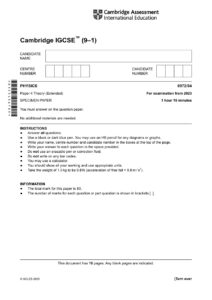
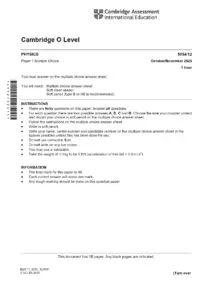
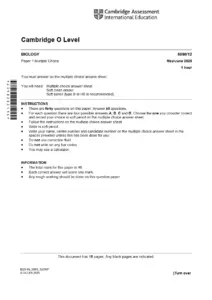
Cambridge IGCSE Physics 0972/41 is an examination paper for the October/November 2022 session. This paper assesses students’ understanding of key physics concepts, including mechanics, energy, waves, and electricity. Designed for IGCSE candidates, it features a variety of questions that challenge students to apply their knowledge and problem-solving skills. The paper includes both theoretical and practical questions, providing a comprehensive evaluation of students’ grasp of the subject matter.

Key Points

  • Covers essential physics topics for Cambridge IGCSE students.
  • Includes a variety of question types to assess understanding.
  • Focuses on mechanics, energy, waves, and electricity concepts.
  • Designed for the October/November 2022 examination session.
Matthew Abel
20 pages
Language:English
Type:Past Paper
Matthew Abel
20 pages
Language:English
Type:Past Paper
75
/ 20
This document has 20 pages. Any blank pages are indicated.
[Turn over
Cambridge IGCSE
(9–1)
DC (CE/SG) 320559
© UCLES 2022
PHYSICS 0972/41
Paper 4 Theory (Extended) October/November 2022
1 hour 15 minutes
You must answer on the question paper.
No additional materials are needed.
INSTRUCTIONS
Answer all questions.
Use a black or dark blue pen. You may use an HB pencil for any diagrams or graphs.
Write your name, centre number and candidate number in the boxes at the top of the page.
Write your answer to each question in the space provided.
Do not use an erasable pen or correction fluid.
Do not write on any bar codes.
You may use a calculator.
You should show all your working and use appropriate units.
Take the weight of 1.0 kg to be 10 N (acceleration of free fall = 10 m / s
2
).
INFORMATION
The total mark for this paper is 80.
The number of marks for each question or part question is shown in brackets [ ].
*2208443318*
2
0972/41/O/N/22© UCLES 2022
1 Two blocks, A and B, are joined by a thin thread that passes over a frictionless pulley. Block A is at
rest on a rough horizontal surface and block B is held at rest, just below the pulley.
Fig. 1.1 shows the thread hanging loose.
block A
rough horizontal surface
pulley
thread
block B
Fig. 1.1 (not to scale)
Block B is released and it falls vertically. The thread remains loose until block B has fallen a
distance of 0.45 m.
The mass of block B is 0.50 kg.
(a) Calculate the change in the gravitational potential energy (g.p.e.) of block B as it falls through
0.45 m.
change in g.p.e. ......................................................... [2]
(b) The mass of block A is 2.0 kg.
When the thread tightens, it pulls on block A which moves to the right at a speed of 0.60
m / s.
(i) Calculate the impulse exerted on block A as it accelerates from rest to 0.60 m / s.
impulse = ......................................................... [3]
3
0972/41/O/N/22© UCLES 2022 [Turn over
(ii) Both of the blocks now move at a constant speed of 0.60 m / s until block B hits the
ground and the thread becomes loose.
Explain the energy change that takes place in block A after block B stops moving.
...........................................................................................................................................
...........................................................................................................................................
...........................................................................................................................................
..................................................................................................................................... [3]
[Total: 8]
/ 20
End of Document
75

FAQs

what is Cambridge IGCSE Physics 0972/41 October/November 2022 about

The Cambridge IGCSE Physics 0972/41 October/November 2022 paper assesses students' understanding of fundamental physics concepts.

  • Topics include mechanics, thermal physics, waves, electricity, and magnetism.
  • The exam format consists of multiple-choice questions, structured questions, and data analysis.
  • Students are expected to apply their knowledge to solve problems and interpret data.

what topics are covered in Cambridge IGCSE Physics 0972/41 October/November 2022

The Cambridge IGCSE Physics 0972/41 October/November 2022 covers a wide range of physics topics.

  • Key areas include:
  • Mechanics: motion, forces, energy, and momentum.
  • Thermal Physics: heat transfer, thermodynamics, and gas laws.
  • Waves: properties of waves, sound, and light.
  • Electricity: circuits, current, voltage, and resistance.
  • Magnetism: magnetic fields and electromagnetism.

how to prepare for Cambridge IGCSE Physics 0972/41 October/November 2022

Preparing for the Cambridge IGCSE Physics 0972/41 October/November 2022 requires a structured study approach.

  • Review the syllabus to understand key topics.
  • Practice past papers to familiarize yourself with the exam format.
  • Utilize revision guides and textbooks to reinforce concepts.
  • Engage in group study sessions for collaborative learning.
  • Consider online resources and videos for visual explanations of complex topics.

what are the key formulas in Cambridge IGCSE Physics 0972/41 October/November 2022

Key formulas in Cambridge IGCSE Physics 0972/41 October/November 2022 are essential for solving problems.

  • Newton's Second Law: F = ma (Force = mass × acceleration).
  • Work done: W = Fd (Work = Force × distance).
  • Kinetic Energy: KE = 1/2 mv² (Kinetic Energy = 1/2 × mass × velocity squared).
  • Potential Energy: PE = mgh (Potential Energy = mass × gravitational field strength × height).
  • Ohm's Law: V = IR (Voltage = current × resistance).

what are the exam tips for Cambridge IGCSE Physics 0972/41 October/November 2022

Effective exam tips for the Cambridge IGCSE Physics 0972/41 October/November 2022 can enhance performance.

  • Read questions carefully to understand what is being asked.
  • Manage your time effectively, allocating time based on marks available.
  • Show all workings in calculations for partial credit.
  • Use diagrams where applicable to illustrate concepts.
  • Review your answers if time permits to catch any mistakes.

what is the format of Cambridge IGCSE Physics 0972/41 October/November 2022

The format of the Cambridge IGCSE Physics 0972/41 October/November 2022 exam includes various question types.

  • Multiple-choice questions assess quick recall and understanding.
  • Structured questions require detailed explanations and calculations.
  • Data analysis questions involve interpreting graphs and tables.
  • Practical skills may be assessed through questions related to experiments.

how is Cambridge IGCSE Physics 0972/41 October/November 2022 graded

Grading for the Cambridge IGCSE Physics 0972/41 October/November 2022 follows a standardized system.

  • Grades range from A* to G, with A* being the highest.
  • Students are assessed based on their performance across all sections of the exam.
  • Grade boundaries may vary each year depending on overall student performance.

what are common mistakes in Cambridge IGCSE Physics 0972/41 October/November 2022

Common mistakes in the Cambridge IGCSE Physics 0972/41 October/November 2022 exam can impact scores.

  • Misreading questions, leading to incorrect answers.
  • Neglecting to include units in calculations.
  • Failing to show all working steps in problem-solving.
  • Overlooking significant figures in final answers.
  • Not practicing enough past papers to familiarize with question styles.

what resources are helpful for Cambridge IGCSE Physics 0972/41 October/November 2022

Helpful resources for studying Cambridge IGCSE Physics 0972/41 October/November 2022 include various materials.

  • Textbooks aligned with the IGCSE syllabus.
  • Online platforms offering video tutorials and lectures.
  • Revision guides summarizing key concepts and formulas.
  • Past exam papers for practice and familiarity with the exam format.
  • Study groups or forums for collaborative learning and support.

what is the significance of Cambridge IGCSE Physics 0972/41 October/November 2022

The significance of the Cambridge IGCSE Physics 0972/41 October/November 2022 lies in its role in education.

  • It provides a foundational understanding of physics concepts crucial for further studies.
  • Success in this exam can enhance university applications and career prospects.
  • It encourages critical thinking and problem-solving skills applicable in real-world scenarios.