Geography P2 Marking Guidelines for May and June 2023 provide comprehensive assessment criteria for geography examinations. This document outlines marking principles, including how to allocate marks for various question types, ensuring standardized evaluation across all provinces. It covers key topics such as rural and urban settlements, economic geography, and geographical skills. Ideal for educators and examiners preparing to assess student performance in geography, this guide facilitates fair and accurate grading.

Key Points

  • Outlines marking principles for Geography P2 exams in 2023
  • Covers topics like rural and urban settlements and economic geography
  • Includes detailed assessment criteria for various question types
  • Standardizes evaluation across different provinces for fairness
  • Serves as a resource for educators and examiners in geography
ovayo
13 pages
Language:English
Type:Answer Key
ovayo
13 pages
Language:English
Type:Answer Key
385
/ 13
Copyright reserved Please turn over
SENIOR CERTIFICATE EXAMINATIONS/
NATIONAL SENIOR CERTIFICATE EXAMINATIONS
GEOGRAPHY P2
2023
MARKING GUIDELINES
MARKS: 150
These marking guidelines consist of 13 pages.
Geography/P2 2 DBE/2023
SC/NSC Marking Guidelines
Copyright reserved
MARKING PRINCIPLES FOR GEOGRAPHY- NSC NOVEMBER 2022 AND NSC/SC
JUNE 2023
The following marking principles have been developed to standardise marking in all
provinces.
MARKING
ALL questions MUST be marked, irrespective of whether it is correct or incorrect
Where the maximum marks have been allocated for a particular question, place an
over the remainder of the text to indicate the maximum marks have been achieved.
A clear, neat tick must be used:
o If ONE mark is allocated, ONE tick must be used:
o If TWO marks are allocated, TWO ticks must be used: 
o The tick must be placed at the FACT that a mark is being allocated for
o Ticks must be kept SMALL, as various layers of moderation may take place
Incorrect answers must be marked with a clear, neat cross:
o Use MORE than one cross across a paragraph/discussion style questions to
indicate that all facts have been considered
o Do NOT draw a line through an incorrect answer
o Do NOT underline the incorrect facts
For the following action words, ONE word answers are acceptable: list, name, state,
identify
For the following action words, a FULL sentence must be written: describe, explain,
evaluate, analyse, suggest, differentiate, distinguish, define, discuss, why, how
The following action words need to be read within its context to determine whether a
ONE- word answer or FULL sentence is required: provide, what, tabulate and give
NOTE THE FOLLOWING
If the numbering is incorrect or left out, as long as the sequence of answers to
questions is followed candidates can be credited
Spelling errors if recognisable, award the marks provided the meaning is correct.
Be sensitive to the sense of an answer, which may be stated in a different way
In questions where a letter is the accepted response, but the learner writes the actual
answer- award marks.
There will be additional guidelines for the marking of certain questions.
TOTALLING AND TRANSFERRING OF MARKS
Each sub-question must be totalled
o Questions in Section A has five sub-sections, therefore five sub-totals per question
required. Section B has three sub-sections and three sub-totals.
o Sub-section totals to be written in the right-hand margin at the end of the sub-
section and underlined
o Sub-totals must be written legibly
o Leave room to write in moderated marks on different levels
Total sub-totals and transfer total to top left-hand margin next to question number
Transfer total to cover of answer book

M
Geography/P2 3 DBE/2023
SC/NSC Marking Guidelines
Copyright reserved Please turn over
QUESTION 1
1.1.1
A (South Atlantic High) (1)
1.1.2
B (Kalahari High) (1)
1.1.3
B (South Indian) (1)
2
1.2.1
Melting snow
1.2.2
Mouth
1.2.3
Third order
2
1.3.1
Katabatic
1.3.2
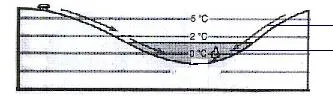
1 occurs during the day while 2 occurs at night
1.3.3
Cold air rolls down into the valley and forms an inversion
6
1.4.1
Shape of front concave
Steep gradient of front
1.4.2
Warm air undercuts the cold air
1.4.3
Air behind the cold front is colder than the air in front. Cold air moves faster than
warm air ahead of it. Cold front catches up with the warm front.
7
1.5.1
(a) A river that only flows all year round
(b) The river channel is wide
(c) Regularity of rainfall and the soil type over which the streams flow.
1.5.2
Gauteng and the Eastern Cape
1.5.3
The cost of food production will increase at it is costly to buy purified water. Farmers
will have to buy more chemicals to purify water. Chemicals cost a lot and this will
increase production costs. It will be costly to purify water for use in electricity
generation. These costs will be included in electricity prices. Costs will increase the
price of electricity during production. There will be less clean water to generate
hydro- electricity.
13


Air flows downslope









M
30
/ 13
End of Document
385

FAQs

What are the marking principles for Geography in the NSC exams?
The marking principles for Geography in the NSC exams emphasize that all questions must be marked, regardless of correctness. Marks are allocated based on clear criteria, with ticks indicating correct answers and crosses for incorrect ones. Specific action words dictate the type of response required, such as one-word answers for 'list' and full sentences for 'describe' or 'explain.' Additionally, sensitivity to spelling errors and the context of answers is encouraged to ensure fair marking.
What are the key characteristics of rural-urban migration?
Rural-urban migration is defined as the movement of people from rural areas to urban areas. This migration often occurs due to social push factors such as poverty, farm killings, and lack of job opportunities. The document highlights that rural-urban migration can create challenges regarding housing, as the demand for housing in urban areas often exceeds supply, leading to shortages and increased pressure on municipal budgets.
What are the economic factors affecting sugar production in South Africa?
Several economic factors negatively impact sugar production in South Africa, including the sugar tax, which has decreased demand. Fluctuating prices limit investment opportunities, and increases in export costs further complicate the market. Additionally, higher production costs and issues like load shedding can decrease overall production efficiency. These factors collectively challenge the sustainability of sugar farming in the region.
How do recent expansions of large cities affect the rural-urban fringe?
The expansion of large cities has several effects on the rural-urban fringe, including a decrease in land available for farming and an increase in urban functions that dominate the area. This urban sprawl can lead to increased land values and a rise in population density, which may strain services and infrastructure. Additionally, the aesthetic quality of the land-use zone may diminish, and biodiversity can be negatively impacted.
What are the characteristics of informal settlements as described in the document?
Informal settlements are characterized by limited infrastructure, high building density, and a lack of basic services. Residents often live in tiny spaces with overlapping structures, which can pose fire hazards and lead to the spread of diseases. The document notes that these settlements arise due to economic factors such as increased unemployment and high housing costs, pushing individuals to seek affordable living arrangements.