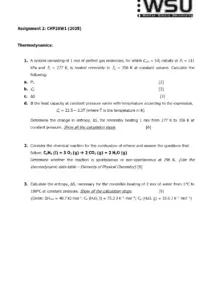
The Electrolytic Solutions Assignment focuses on calculating ionic activities, molar conductivities, and transport numbers in various electrolyte solutions. It includes practical problems related to ammonium phosphate, ammonia, and cadmium iodide, making it ideal for chemistry students. This assignment is designed to enhance understanding of electrolytic behavior and conductivity in solutions. It is suitable for undergraduate chemistry courses and can aid in exam preparation.

Key Points

  • Calculates ionic activities in a 0.14 M solution of ammonium phosphate.
  • Determines molar conductivity and degree of ionization for ammonia solutions.
  • Analyzes electrolysis of cadmium iodide in a Hittorf cell.
  • Includes practical problems and calculations for chemistry students.
Sihle Usisa mpongwana
2 pages
Language:English
Type:Assignment
Sihle Usisa mpongwana
2 pages
Language:English
Type:Assignment
330
/ 2
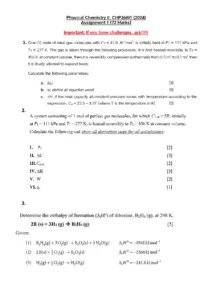
Physical Chemistry III (CHP37W1)
Electrolytic Solutions: Assignment
1. Calculate the ionic activities in a 0.14 M solution of ammonium phosphate
((NH
4
)
3
PO
4
).
2. The molar conductivity at 18 °C of a 0.0100 M aqueous solution of ammonia is
9.6 Ω
1
cm
2
mol
1
. For NH
4
Cl, Λ° = 129.8 Ω
1
cm
2
mol
1
and the molar ionic
conductivities of OH
and Cl
are 174.0 and 65.6 Ω
1
cm
2
mol
1
, respectively.
Calculate:
a. Λ° for NH
3
b. Degree of ionization in 0.01 M solution
3. A solution of cadmium iodide, CdI
2
, having a molality of 7.545 × 10
3
mol kg
1
, was
electrolyzed in a Hittorf cell. The mass of cadmium deposited at the cathode was
0.03462 g. Solution weighing 152.64 g was withdrawn from the anode
compartment and was found to contain 0.3718 g of cadmium iodide.
a. Calculate the transport numbers of Cd
2+
and I
b. Calculate the ionic mobility for the Cd having an ionic limiting molar
conductivity of 106.7 Ω
1
cm
2
mol
1
.
c. Calculate the limiting molar conductivity of the solution CdI
2
.
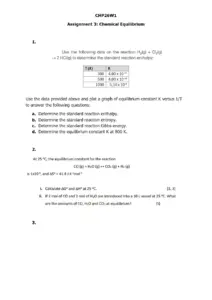
4.
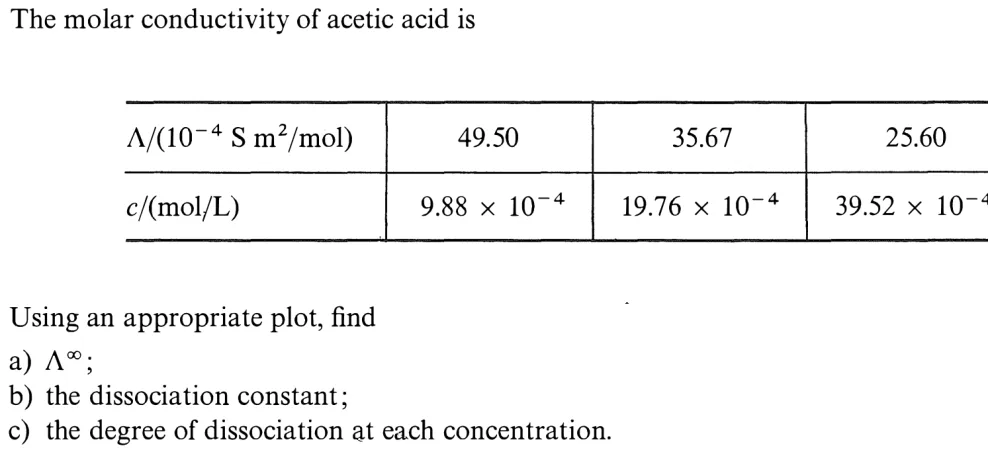
c) Calculate the speed.
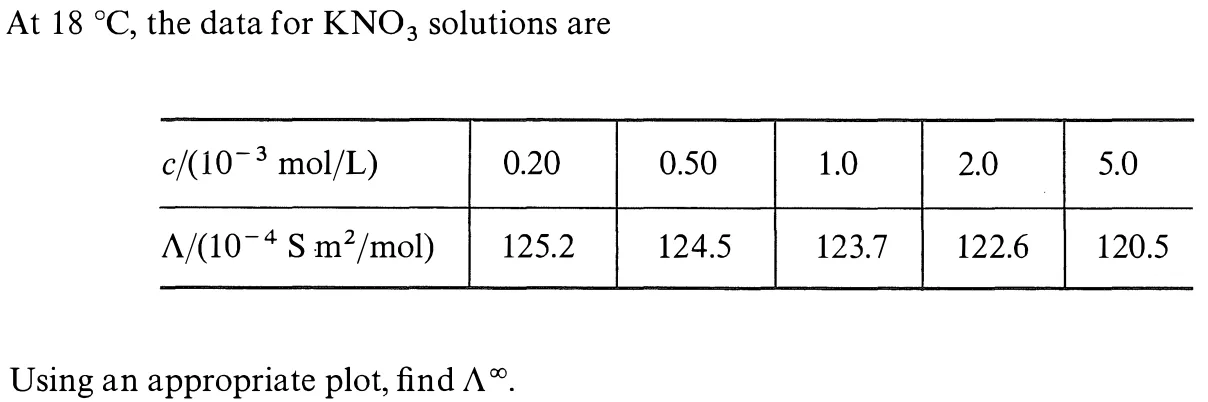
5. You may use excel to plot graphs.
6. You may use excel to plot graphs.
/ 2
End of Document
330

FAQs

what is the electrolytic solutions assignment about

The Electrolytic Solutions Assignment focuses on the study of ionic activities and molar conductivities in various electrolytic solutions.

  • It includes calculations for ionic activities in ammonium phosphate solutions.
  • The assignment also covers molar conductivity for ammonia and its degree of ionization.
  • Additionally, it examines transport numbers and ionic mobilities in cadmium iodide solutions.

how to calculate ionic activities in the electrolytic solutions assignment

To calculate ionic activities in the Electrolytic Solutions Assignment, you need to apply the principles of ionic strength and activity coefficients.

  • Start by determining the concentration of ions in the solution.
  • Use the Debye-Hückel equation to find activity coefficients for the ions involved.
  • Finally, multiply the concentration of each ion by its activity coefficient to find the ionic activities.

what are the key concepts in the electrolytic solutions assignment

The key concepts in the Electrolytic Solutions Assignment include ionic strength, molar conductivity, and electrolysis.

  • Ionic Strength: A measure of the concentration of ions in a solution.
  • Molar Conductivity: The conductivity of a solution divided by its molar concentration.
  • Electrolysis: The process of using electrical energy to drive a non-spontaneous chemical reaction.

how to calculate molar conductivity in the electrolytic solutions assignment

Calculating molar conductivity in the Electrolytic Solutions Assignment involves using the formula for molar conductivity, which is the conductivity divided by the molar concentration.

  • For example, if you have a solution with a known conductivity, divide that value by the molarity of the solution.
  • Additionally, you may need to reference limiting molar conductivities for specific ions.

what is the degree of ionization in the electrolytic solutions assignment

The degree of ionization in the Electrolytic Solutions Assignment refers to the fraction of a solute that dissociates into ions in solution.

  • It can be calculated by dividing the concentration of ionized solute by the initial concentration of the solute.
  • This concept is crucial for understanding the behavior of weak electrolytes like ammonia in solution.

how to find transport numbers in the electrolytic solutions assignment

Transport numbers in the Electrolytic Solutions Assignment can be found using the mass of ions deposited during electrolysis and the total current passed through the solution.

  • Calculate the transport number for each ion by dividing the charge carried by that ion by the total charge passed.
  • This helps in understanding the distribution of current in electrolytic processes.

what are the steps to solve the electrolytic solutions assignment

Solving the Electrolytic Solutions Assignment involves several key steps to ensure accurate calculations.

  1. Identify the specific problems presented in the assignment.
  2. Gather necessary data, such as concentrations and molar conductivities.
  3. Apply relevant formulas for ionic activities, molar conductivity, and transport numbers.
  4. Perform calculations carefully, checking each step for accuracy.

what is the significance of cadmium iodide in the electrolytic solutions assignment

Cadmium iodide is significant in the Electrolytic Solutions Assignment as it serves as an example for studying electrolysis and ionic transport.

  • It allows for the examination of transport numbers and ionic mobilities, which are essential for understanding electrolytic behavior.
  • Analyzing cadmium iodide helps illustrate the principles of ionic solutions and their applications in electrochemistry.

how to plot graphs for the electrolytic solutions assignment

Plotting graphs for the Electrolytic Solutions Assignment can be done using software like Excel to visualize data trends.

  • Input your calculated values, such as molar conductivities or ionic activities, into the software.
  • Select appropriate graph types, such as line or scatter plots, to represent the data clearly.
  • Label axes and include legends for clarity and better understanding of the results.

what are the findings from the electrolytic solutions assignment

The findings from the Electrolytic Solutions Assignment provide insights into the behavior of electrolytic solutions under various conditions.

  • Key findings include the relationships between molar conductivity and concentration.
  • Results also highlight the importance of ionic strength in determining activity coefficients.
  • Overall, the assignment enhances understanding of electrochemical principles and their practical applications.