Graph Algorithms II focuses on implementing Tarjan’s algorithm to identify articulation points in undirected graphs and the Bellman-Ford algorithm for finding single-source shortest paths. This resource is essential for computer science students and professionals looking to deepen their understanding of graph theory and algorithm design. It includes detailed code examples and explanations, making it suitable for both beginners and advanced learners. The document serves as a practical guide for implementing these algorithms effectively in programming environments.

Key Points

  • Explains Tarjan’s algorithm for finding articulation points in graphs
  • Details the Bellman-Ford algorithm for single-source shortest paths
  • Includes code examples for practical implementation in C++
  • Suitable for computer science students studying graph theory
Mahek Patel
7 pages
Language:English
Type:Lab Report
Mahek Patel
7 pages
Language:English
Type:Lab Report
394
/ 7
Lab-9: Graph Algorithms-II
Aim:
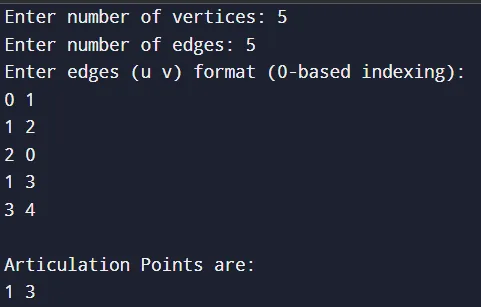
1. Implement Tarjan's algorithm to find the Articulation points from the given
undirected graph.
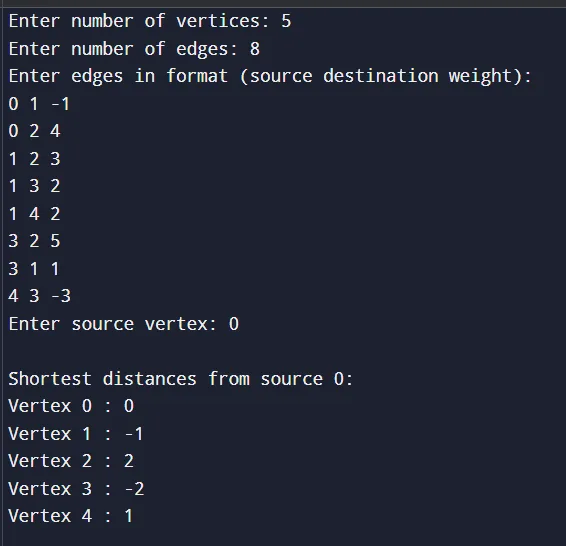
2. Implement Bellman Ford algorithm to find the Single source shortest
path.
1.) CODE:
#include <iostream>
#include <vector>
using namespace std;
class Graph {
int V;
vector<vector<int>> adj;
vector<int> disc, low, parent;
vector<bool> visited, ap;
int timer;
public:
Graph(int V) {
this->V = V;
adj.resize(V);
disc.resize(V);
low.resize(V);
parent.resize(V);
visited.resize(V, false);
ap.resize(V, false);
timer = 0;
}
void addEdge(int u, int v) {
adj[u].push_back(v);
adj[v].push_back(u);
}
void DFS(int u) {
visited[u] = true;
disc[u] = low[u] = ++timer;
int children = 0;
for (int v : adj[u]) {
if (!visited[v]) {
children++;
parent[v] = u;
DFS(v);
low[u] = min(low[u], low[v]);
// Root node with more than one child
if (parent[u] == -1 && children > 1)
ap[u] = true;
// Non-root node
if (parent[u] != -1 && low[v] >= disc[u])
ap[u] = true;
}
else if (v != parent[u]) {
low[u] = min(low[u], disc[v]);
}
}
}
void findArticulationPoints() {
for (int i = 0; i < V; i++) {
parent[i] = -1;
visited[i] = false;
}
for (int i = 0; i < V; i++) {
if (!visited[i])
DFS(i);
}
cout << "\nArticulation Points are:\n";
bool found = false;
for (int i = 0; i < V; i++) {
if (ap[i]) {
cout << i << " ";
found = true;
}
}
if (!found)
cout << "None";
cout << endl;
}
};
int main() {
int V, E;
cout << "Enter number of vertices: ";
cin >> V;
cout << "Enter number of edges: ";
cin >> E;
Graph g(V);
cout << "Enter edges (u v) format (0-based indexing):\n";
/ 7
End of Document
394

FAQs

what is Tarjan's algorithm in Graph Algorithms II

Tarjan's algorithm is a method used to find articulation points in a graph.

  • It utilizes depth-first search (DFS) to explore the graph.
  • The algorithm maintains discovery and low values for each vertex.
  • Articulation points are identified based on the conditions of these values.

how does the Bellman-Ford algorithm work in Graph Algorithms II

The Bellman-Ford algorithm calculates the shortest paths from a single source vertex to all other vertices in a graph.

  • It works by relaxing edges repeatedly for a total of V-1 times, where V is the number of vertices.
  • The algorithm can handle graphs with negative weight edges.
  • It also checks for negative weight cycles after the relaxation process.

what are articulation points in Graph Algorithms II

Articulation points are vertices in a graph that, when removed, increase the number of connected components.

  • They are critical for maintaining the connectivity of the graph.
  • Tarjan's algorithm efficiently identifies these points using DFS.
  • Understanding articulation points is essential for network reliability analysis.

how to implement Tarjan's algorithm in Graph Algorithms II

Implementing Tarjan's algorithm involves setting up a graph structure and performing a DFS.

  • Initialize discovery and low values for each vertex.
  • Track parent vertices and mark visited nodes during traversal.
  • Identify articulation points based on the conditions derived from discovery and low values.

what is the significance of the Bellman-Ford algorithm in Graph Algorithms II

The Bellman-Ford algorithm is significant for its ability to find shortest paths in graphs with negative weights.

  • It is widely used in various applications like routing and network optimization.
  • The algorithm's ability to detect negative cycles is crucial for ensuring valid path calculations.
  • It serves as a foundational algorithm in graph theory and computer science.

what are the key steps in Bellman-Ford algorithm in Graph Algorithms II

The key steps in the Bellman-Ford algorithm include edge relaxation and cycle detection.

  1. Initialize distances from the source vertex.
  2. Relax all edges V-1 times.
  3. Check for negative weight cycles by re-evaluating edges.

how to find shortest paths using Bellman-Ford in Graph Algorithms II

To find shortest paths using the Bellman-Ford algorithm, follow these steps:

  • Set the distance to the source vertex as zero and all others to infinity.
  • Iterate through all edges and update distances based on the edge weights.
  • After V-1 iterations, check for any further updates to detect negative cycles.

what are the limitations of Tarjan's algorithm in Graph Algorithms II

While Tarjan's algorithm is efficient, it has some limitations.

  • It may not perform well on dense graphs compared to other algorithms.
  • The algorithm requires a well-defined graph structure for accurate results.
  • It is primarily focused on articulation points, not on other graph properties.

how to analyze graph connectivity using Tarjan's algorithm in Graph Algorithms II

Analyzing graph connectivity with Tarjan's algorithm involves identifying articulation points.

  • Articulation points indicate critical connections in the graph.
  • Removing these points can help assess the impact on overall connectivity.
  • This analysis is vital for network design and fault tolerance.

what is the output of Bellman-Ford algorithm in Graph Algorithms II

The output of the Bellman-Ford algorithm is the shortest distance from the source vertex to all other vertices.

  • If a vertex is unreachable, it is marked as infinity.
  • The algorithm also indicates if a negative weight cycle exists in the graph.
  • This information is crucial for pathfinding applications.