Chemical Equilibrium Assignment 3 focuses on calculating equilibrium constants and analyzing thermodynamic properties. It includes data for reactions involving hydrogen and chlorine, as well as carbon dioxide and oxygen. Students will determine standard reaction enthalpy, entropy, and Gibbs energy using provided temperature and equilibrium constant data. This assignment is ideal for chemistry students preparing for exams or coursework in thermodynamics and chemical kinetics.

Key Points

  • Calculates standard reaction enthalpy and entropy for chemical reactions.
  • Determines Gibbs energy and equilibrium constants at various temperatures.
  • Includes data for reactions involving H2, Cl2, CO2, and O2.
  • Suitable for chemistry students studying thermodynamics and equilibrium.
Sihle Usisa mpongwana
2 pages
Language:English
Type:Assignment
Sihle Usisa mpongwana
2 pages
Language:English
Type:Assignment
309
/ 2
CHP26W1
Assignment 3: Chemical Equilibrium
1.
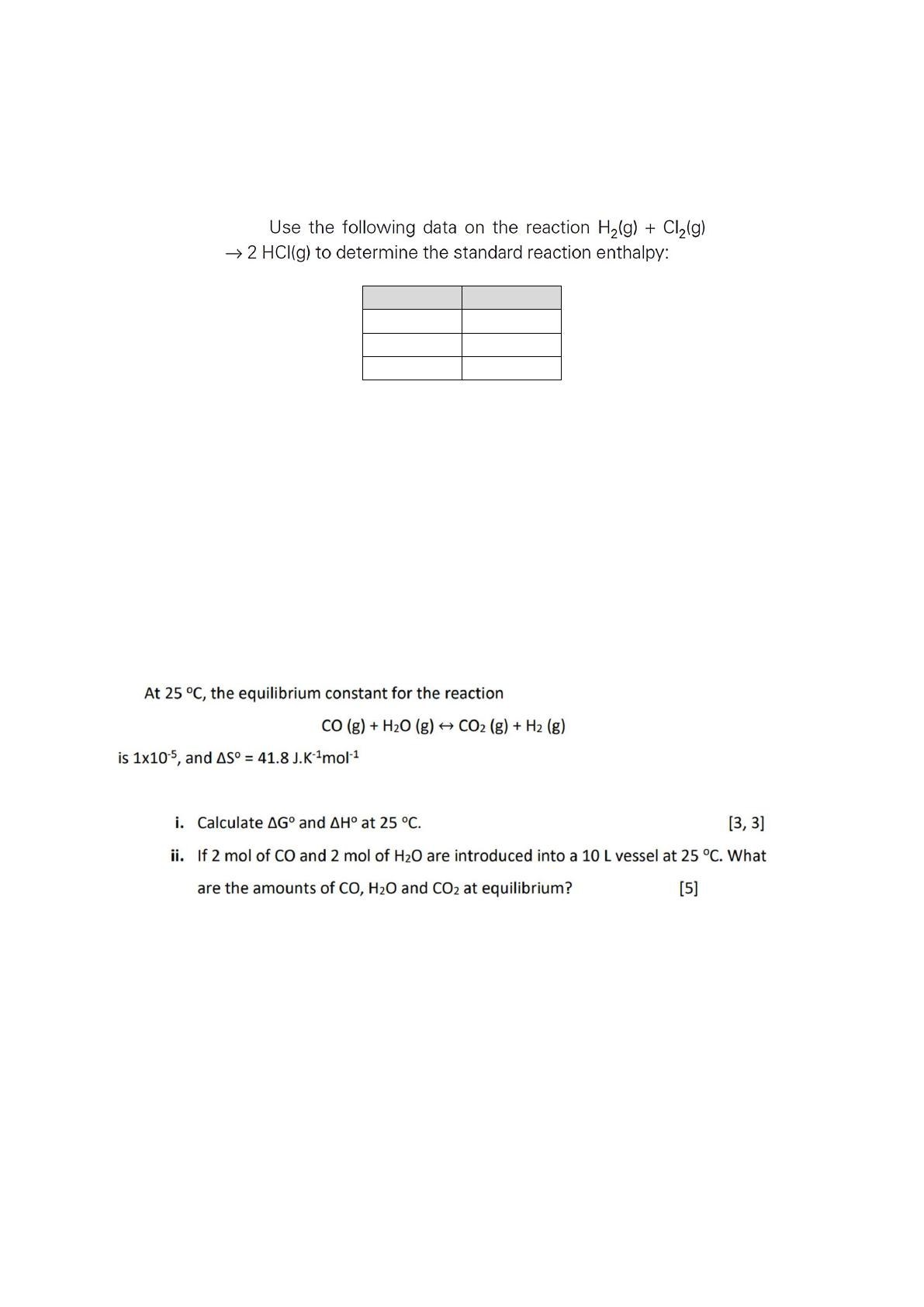
T (K)
K
300
4,00 x 10
-31
500
4,00 x 10
-18
1000
5,10 x 10
-8
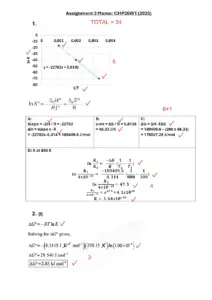
Use the data provided above and plot a graph of equilibrium constant K versus 1/T
to answer the following questions:
a. Determine the standard reaction enthalpy.
b. Determine the standard reaction entropy.
c. Determine the standard reaction Gibbs energy.
d. Determine the equilibrium constant K at 800 K.
2.
3.
/ 2
End of Document
309

FAQs

what is chemical equilibrium assignment 3 about

Chemical Equilibrium Assignment 3 focuses on understanding the principles of chemical equilibrium through various calculations and data analysis.

  • It includes determining the standard reaction enthalpy, entropy, and Gibbs energy.
  • The assignment also requires plotting equilibrium constants against temperature.
  • Students will analyze the relationship between temperature and the equilibrium constant K.

how to calculate equilibrium constant K in chemical equilibrium assignment 3

To calculate the equilibrium constant K in Chemical Equilibrium Assignment 3, you will use the provided temperature data and the corresponding K values.

  • First, plot K versus 1/T to visualize the relationship.
  • Use the equation derived from the plot to calculate K at different temperatures, such as 800 K.
  • Apply the Van 't Hoff equation for further analysis of enthalpy and entropy.

what are the key formulas in chemical equilibrium assignment 3

The key formulas in Chemical Equilibrium Assignment 3 involve the Van 't Hoff equation and the relationship between Gibbs free energy and equilibrium constants.

  • Van 't Hoff equation: ln(K2/K1) = -ΔH/R(1/T2 - 1/T1)
  • Gibbs free energy: ΔG = ΔH - TΔS
  • These formulas help in calculating the standard reaction enthalpy, entropy, and Gibbs energy.

how to determine standard reaction enthalpy in chemical equilibrium assignment 3

To determine the standard reaction enthalpy in Chemical Equilibrium Assignment 3, you will analyze the plotted data of K versus 1/T.

  • Use the slope from the linear plot, which represents -ΔH/R.
  • Rearrange the equation to find ΔH: ΔH = -slope × R.
  • Ensure to convert the units appropriately to obtain ΔH in kJ/mol.

what is the significance of standard reaction entropy in chemical equilibrium assignment 3

The standard reaction entropy is crucial in Chemical Equilibrium Assignment 3 as it helps understand the disorder associated with a chemical reaction.

  • It is calculated using the relationship between Gibbs free energy and enthalpy.
  • Higher entropy values indicate greater disorder, impacting the spontaneity of reactions.
  • Entropy changes can be derived from the Gibbs free energy equation: ΔS = (ΔH - ΔG)/T.

how to find Gibbs energy in chemical equilibrium assignment 3

Finding the Gibbs energy in Chemical Equilibrium Assignment 3 involves using the relationship between enthalpy, entropy, and temperature.

  • Utilize the formula: ΔG = ΔH - TΔS.
  • Substitute the calculated values of ΔH and ΔS into the equation.
  • This will provide insights into the spontaneity of the reaction at different temperatures.

how to interpret the graph of K versus 1/T in chemical equilibrium assignment 3

Interpreting the graph of K versus 1/T in Chemical Equilibrium Assignment 3 reveals the relationship between the equilibrium constant and temperature.

  • A linear relationship indicates that the reaction follows the Van 't Hoff equation.
  • The slope of the line provides information about the enthalpy change of the reaction.
  • This graph is essential for predicting how K changes with temperature, aiding in understanding reaction dynamics.

what is the equilibrium constant K at 800 K in chemical equilibrium assignment 3

To find the equilibrium constant K at 800 K in Chemical Equilibrium Assignment 3, you will need to interpolate from the plotted data of K versus 1/T.

  • Use the linear equation derived from the plot to estimate K at this temperature.
  • This value is crucial for understanding the position of equilibrium at 800 K.
  • Ensure to apply the correct units and conversions for accuracy.

what are the gas phase reactions in chemical equilibrium assignment 3

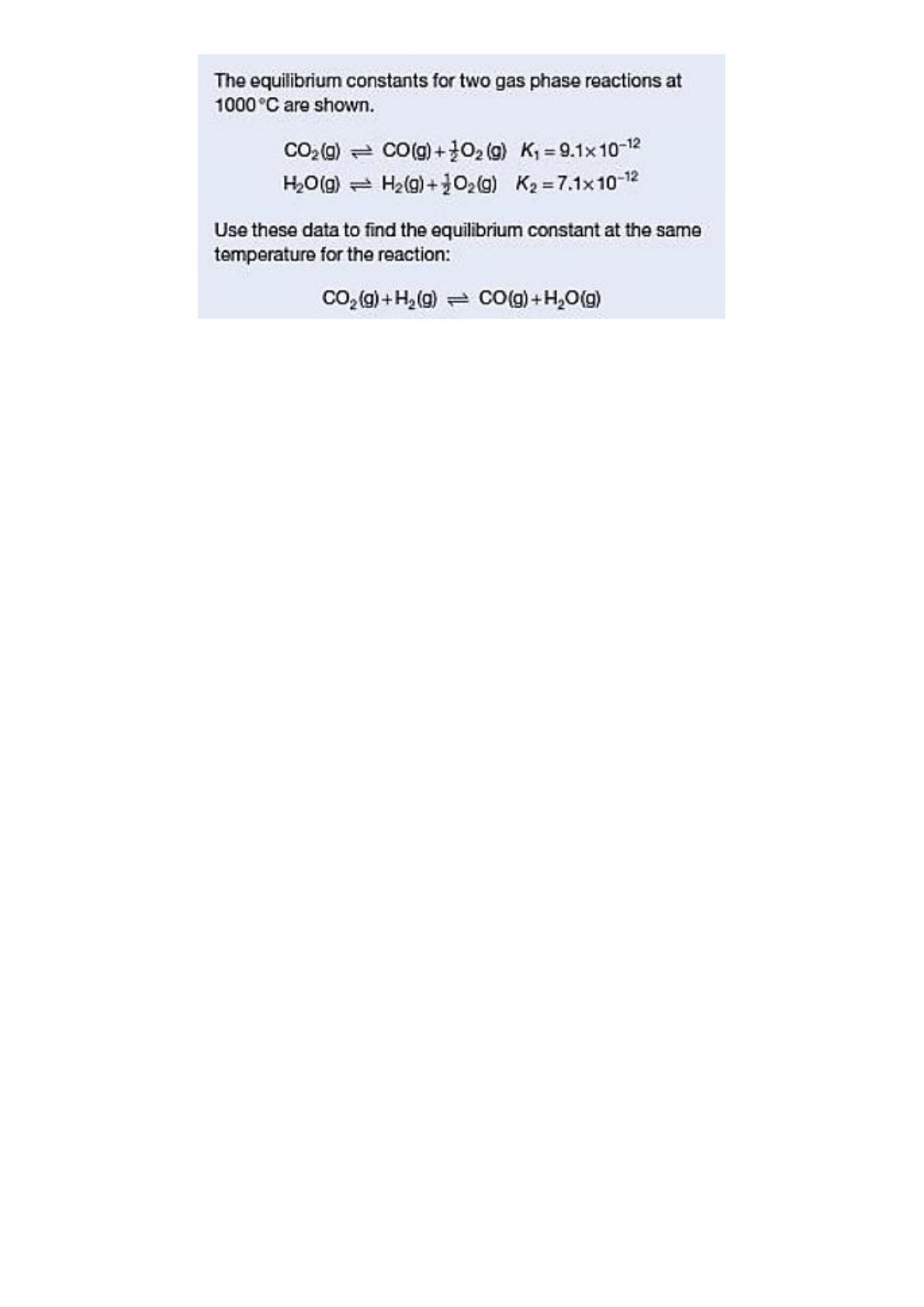
The gas phase reactions in Chemical Equilibrium Assignment 3 focus on the equilibrium constants for reactions involving CO2 and H2.

  • Reactions include: CO2(g) ⇌ CO(g) + 1/2 O2(g) and H2(g) + 1/2 O2(g) ⇌ H2O(g).
  • These reactions help in calculating the overall equilibrium constant for combined reactions.
  • Understanding these reactions is essential for mastering gas phase equilibria.

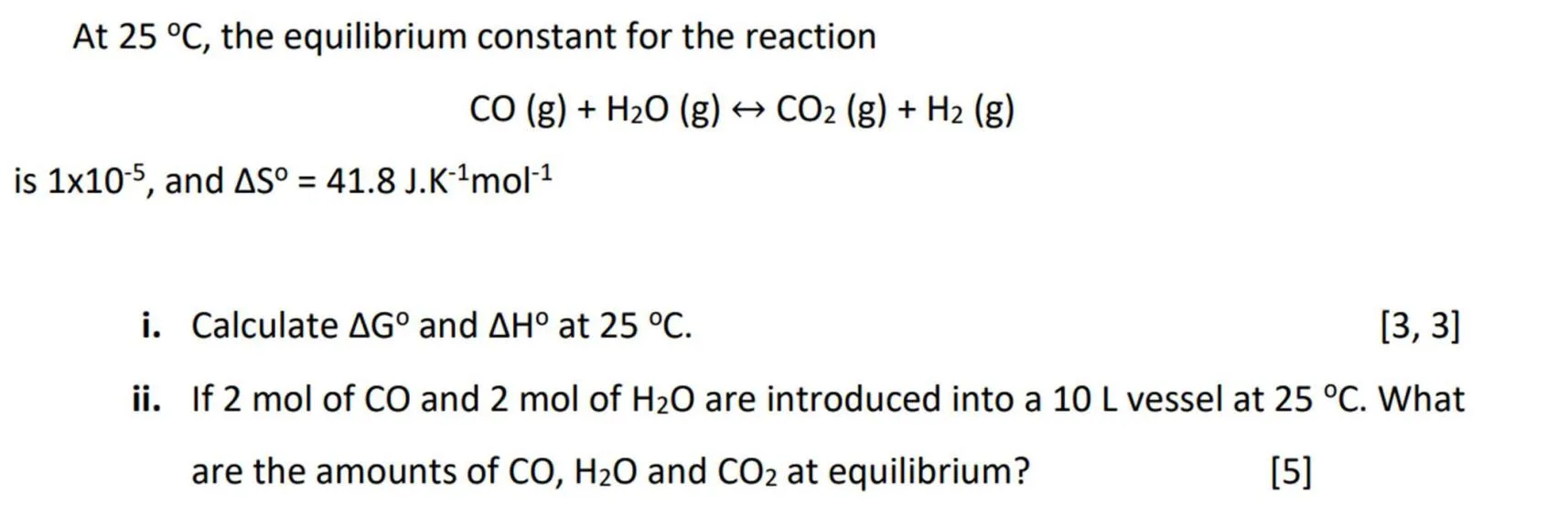
how to calculate the amounts of CO and H2O at equilibrium in chemical equilibrium assignment 3

To calculate the amounts of CO and H2O at equilibrium in Chemical Equilibrium Assignment 3, you will need to set up an ICE table (Initial, Change, Equilibrium).

  • Determine initial concentrations and the changes based on stoichiometry.
  • Apply the equilibrium constant expression to solve for unknown concentrations.
  • This process is crucial for predicting the outcome of the reactions at equilibrium.