Physical Chemistry practice problems and memos provide comprehensive assignments for mastering key concepts in thermodynamics and chemical kinetics. This resource is ideal for students preparing for exams or seeking to enhance their problem-solving skills. It includes a variety of practice problems, detailed solutions, and explanations for each topic covered. Topics include the behavior of gases, entropy calculations, and reaction kinetics, making it a valuable tool for anyone studying physical chemistry.

Key Points

  • Includes practice problems on thermodynamics and chemical kinetics.
  • Provides detailed solutions and explanations for each problem.
  • Covers key topics such as gas behavior and entropy calculations.
  • Ideal for students preparing for exams in physical chemistry.
Sihle Usisa mpongwana
2 pages
Language:English
Type:Assignment
Sihle Usisa mpongwana
2 pages
Language:English
Type:Assignment
293
/ 2
Assignment 2: CHP26W1 (2025)
Thermodynamics:
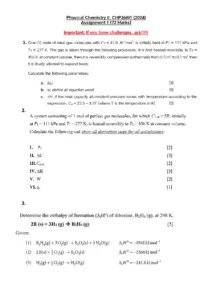
1. A system consisting of 1 mol of perfect gas molecules, for which
C
V
,m
= 5
R
, initially at
P
1
= 111
kPa and
T
1
= 277 K, is heated reversibly to
T
2
= 356 K at constant volume. Calculate the
following:
a. P
2
[2]
b.
C
p
[2]
c. ∆S [3]
d. If the heat capacity at constant pressure varies with temperature according to the expression,
C
p
= 23.5 – 3.3T (where T is the temperature in K)
Determine the change in entropy, ∆S, for reversibly heating 1 mol from 277 K to 356 K at
constant pressure.
Show all the calculation steps.
[6]
2. Consider the chemical reaction for the combustion of ethene and answer the questions that
follow: C
2
H
4
(l) + 3 O
2
(g) 2 CO
2
(g) + 2 H
2
O (g)
Determine whether the reaction is spontaneous or non-spontaneous at 298 K.
{Use the
thermodynamic data table – Elements of Physical Chemistry}
[8]
3. Calculate the entropy, ∆S, necessary for the reversible heating of 2 mol of water from 1°C to
150°C at constant pressure.
Show all the calculation steps.
[9]
{Given: ΔH
vap
= 40.7 kJ mol
-1
; C
p
(H
2
O, l) = 75.3 J K
−1
mol
−1
; C
p
(H
2
O, g) = 33.6 J K
−1
mol
−1
}
Chemical Kinetics:
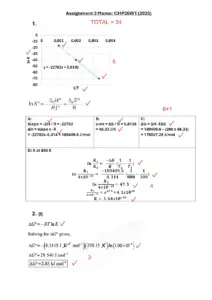
4. The following data were collected for the reaction: 2 HI (g) H
2
(g) + I
2
(g) at 580 K.
Time (s)
[HI] (M)
0
1
1000
0.112
2000
0.061
3000
0.041
4000
0.031
a. Plot the data in an appropriate fashion to determine the order of the reaction. [5x3]
b. Write the rate law for the above reaction.[1]
c. Graphically, determine the rate constant, k.[2]
d. Calculate the half-life, t
1/2
.[3]
5. An x molar solution of hydrogen peroxide (H
2
O
2
) decomposes according to the equation
below. The graph below shows the results obtained from the study during the first 3200
minutes.
a. Determine the order of the above reaction. Give a reason for your answer. [2]
b. Determine the initial concentration, [H
2
O
2
]
0
. [2]
c. Determine the rate constant (k). [3]
d. Calculate the half-life (t
1/2
) for the reaction. [3]
6. The rate of the decomposition of a compound was measured over a temperature range of
730-1000 K, and the rate constants were recorded as shown in the table below. Use this
information to calculate E
a
, rate constant x and the frequency factor, 𝑓, at 745 K. [10]
T (K)
k
r
(mol
-1
dm
3
s
-1
)
730
0.035
745
x
760
0.105
/ 2
End of Document
293

FAQs

what are physical chemistry practice problems and memos

Physical Chemistry Practice Problems and Memos provide a comprehensive set of exercises and solutions designed to enhance understanding of physical chemistry concepts.

  • They cover various topics including thermodynamics, kinetics, and quantum chemistry.
  • Each problem typically includes detailed solutions or memos for better comprehension.
  • These resources are invaluable for students preparing for exams or seeking to reinforce their knowledge.

how to solve physical chemistry practice problems

To solve Physical Chemistry Practice Problems effectively, follow a systematic approach.

  • Read the problem carefully to identify the key concepts involved.
  • Determine the relevant equations and principles that apply to the problem.
  • Perform calculations step-by-step, ensuring units are consistent.
  • Check your work by verifying that the answer makes sense in the context of the problem.

what topics are covered in physical chemistry practice problems

Physical Chemistry Practice Problems cover a wide range of topics essential for mastering the subject.

  • Thermodynamics: Laws, enthalpy, entropy, and Gibbs free energy.
  • Kinetics: Reaction rates, rate laws, and mechanisms.
  • Quantum Chemistry: Wave functions, Schrödinger equation, and molecular orbitals.
  • Equilibrium: Chemical equilibrium, Le Chatelier's principle, and equilibrium constants.

how to prepare for physical chemistry exams

Preparing for Physical Chemistry exams requires a strategic approach to studying.

  • Review key concepts and formulas regularly.
  • Practice with Physical Chemistry Practice Problems to reinforce understanding.
  • Form study groups to discuss challenging topics and share insights.
  • Utilize past exam papers for familiarity with question formats.

what are common mistakes in physical chemistry problems

Common mistakes in Physical Chemistry problems can hinder understanding and performance.

  • Misapplying equations: Ensure you understand when to use specific formulas.
  • Ignoring units: Always keep track of units throughout calculations.
  • Overlooking assumptions: Be aware of any assumptions made in problems.
  • Not checking answers: Verify that your solutions are reasonable and consistent.

what is the importance of physical chemistry practice problems

Physical Chemistry Practice Problems are crucial for mastering the subject and preparing for exams.

  • They help reinforce theoretical concepts through practical application.
  • Solving problems enhances critical thinking and analytical skills.
  • Regular practice builds confidence and improves problem-solving speed.
  • They provide exposure to a variety of question types and formats.