Chemistry 12 Solutions Manual provides detailed solutions for various chemistry problems, focusing on potential energy diagrams and reaction mechanisms. It includes step-by-step explanations for calculating activation energies and enthalpy changes for both forward and reverse reactions. Ideal for high school chemistry students preparing for exams, this manual covers critical concepts such as endothermic and exothermic reactions, activation energy, and enthalpy changes. Each section is designed to enhance understanding of chemical reactions and energy transformations.
Key Points
Explains potential energy diagrams for chemical reactions, highlighting activation energies and enthalpy changes.
Covers endothermic and exothermic reactions with detailed examples and calculations.
Includes practice problems with solutions for better comprehension of reaction mechanisms.
Designed for high school chemistry students, aligning with curriculum standards.
This link leads to an external site. We do not know or endorse its content, and are not responsible for its safety. Click the link to proceed only if you trust this site.
Real Estate Finance Home Assignment 3 Solutions ManualSolution Manual
PDF
CBSE Class 12 Chemistry Solutions Chapter 1 Notes
PDF
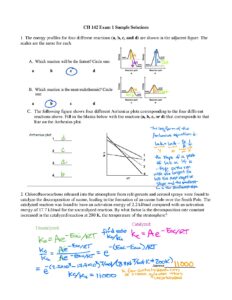
CH142 S26 Exam 1 Sample Solutions for Chemistry Students
PDF
GC Lecture Solutions for Chapter 13 Chemistry Concepts
PDF
Organic Chemistry David Klein Solution Manual
PDF
Modern Control Systems 12th Edition Solutions Manual PDF
PDFAssignment
Simple Interest Assignment Problems and SolutionsAssignment
PDFStudy Guide
NEET Chemistry Study Guide for Aspiring Medical StudentsStudy Guide
PDFBook
Manual of Diagnostic Ultrasound 9241544619 (2)Book
PDFStudy Guide
Software Requirements Specification Questions and SolutionsStudy Guide
PDFBook
Engineering Economy 3rd Edition Solution Manual by Hipolito Sta MariaBook
PDFStudy Guide
Name Reactions for JEE 2026 Organic ChemistryStudy Guide
FAQs
What is the significance of activation energy in chemical reactions?
Activation energy is the minimum energy required for a chemical reaction to occur. It determines the rate of the reaction; higher activation energy means a slower reaction rate. Understanding activation energy helps in predicting how temperature changes can influence reaction rates. In potential energy diagrams, it is represented as the energy difference between the reactants and the transition state.
How do potential energy diagrams illustrate reaction types?
Potential energy diagrams visually represent the energy changes during a chemical reaction. They show the energy of reactants, products, and the activated complex. For exothermic reactions, the products have lower energy than the reactants, while for endothermic reactions, the opposite is true. These diagrams help students understand the energy landscape of reactions and the concept of activation energy.
What are the key differences between endothermic and exothermic reactions?
Endothermic reactions absorb energy from their surroundings, resulting in products with higher energy than the reactants. In contrast, exothermic reactions release energy, leading to products with lower energy. The enthalpy change (ΔH) for endothermic reactions is positive, while for exothermic reactions, it is negative. Understanding these differences is crucial for predicting reaction behavior and energy requirements.
What role does enthalpy change play in chemical reactions?
Enthalpy change (ΔH) indicates the heat absorbed or released during a chemical reaction at constant pressure. It is a key factor in determining whether a reaction is endothermic or exothermic. A positive ΔH signifies an endothermic reaction, while a negative ΔH indicates an exothermic reaction. This concept is fundamental in thermodynamics and helps predict the feasibility of reactions.
How can students benefit from using the Chemistry 12 Solutions Manual?
The Chemistry 12 Solutions Manual provides comprehensive solutions to chemistry problems, enhancing students' understanding of complex concepts. It offers step-by-step guidance on calculating activation energies and interpreting potential energy diagrams. By working through the problems, students can improve their problem-solving skills and prepare effectively for exams. This resource aligns with high school chemistry curricula, making it an essential study aid.