Aldehyde and Ketone explores the chemical properties and reactions of these organic compounds. It details the functional groups, IUPAC naming conventions, and physical properties of aldehydes and ketones. The document also covers methods of preparation, including ozonolysis and oxidation of alcohols. Ideal for chemistry students and educators, this resource provides a comprehensive overview of key concepts and reactions related to aldehydes and ketones.

Key Points

  • Explains the functional groups and IUPAC naming of aldehydes and ketones.
  • Covers physical properties, including boiling points and solubility.
  • Details methods of preparation such as ozonolysis and alcohol oxidation.
  • Discusses the reactions of aldehydes and ketones, including addition and oxidation.
Haymanot
4 pages
Language:English
Type:Lecture Notes
Haymanot
4 pages
Language:English
Type:Lecture Notes
117
/ 4
1 | P a g e
6.3. Aldehydes and Ketones
Aldehydes and ketones are organic compounds which contain a carbonyl functional group.
The functional group of aldehyde is a carbonyl group bonded to a carbon and hydrogen
atom.
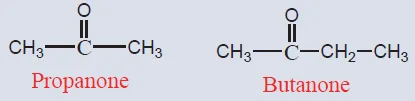
The functional group of a ketone is a carbonyl group bonded to two carbon atoms.
General structure:
Example:
Aldehyde
Ketone
The IUPAC system of naming for aldehydes and ketones follows the familiar pattern of
selecting the longest chain of carbon atoms that contains the functional group as the parent.
IUPAC naming of Aldehydes:
Aldehydes are named by changing the suffix -e of the parent alkane to al.
The suffix
-al
indicates the functional group CHO. Because the carbonyl group of an
aldehyde can appear only at the end of a parent chain
.
Example
IUPAC naming of Ketones:
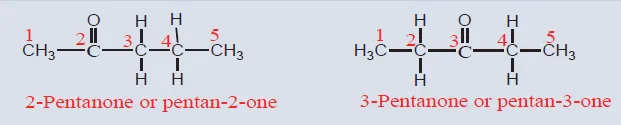
The IUPAC names of ketones are obtained by using the suffix -one to replace the terminal -e
in the corresponding alkane name. The suffix ‘-one’ indicates the functional group RCOR.
Unlike aldehydes, the position of the functional group must be indicated in the name of
higher ketones.
Example:
2 | P a g e
6.3.1. Physical properties of Aldehydes and Ketones
Formaldehyde is a gas while other aldehydes are colorless, volatile liquids up to compounds
with carbon number 10 and higher members are solids.
Lower aldehydes have an unpleasant smell while higher aldehydes and ketones have a
pleasant smell.
The lower aldehydes and ketones are soluble in water due to H-bonding, the solubility then
decreases as carbon- number increases.
Aromatic aldehydes and ketones are insoluble in water.
They have lower boiling points than alcohols and acids due to lack of intermolecular
hydrogen bonding.
Ketones and aldehydes are polar compounds so they have higher boiling points than those of
non-polar compounds with same molecular weight like alkanes or alkenes.
6.3.2. Method of preparation of Aldehydes and Ketones
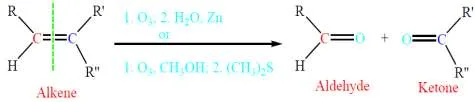
1. Ozonolysis of alkenes
When an alkene is treated with ozone (O
3
) followed by hydrolysis of the resulting ozonids,
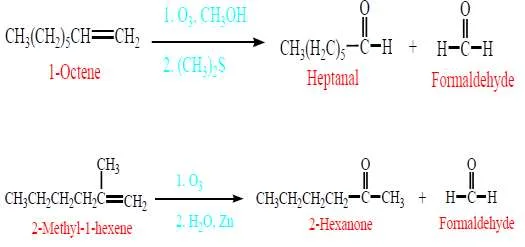
two aldehydes, two ketones, or one aldehyde and one ketone may be formed. The two-stage
reaction sequence is called ozonolysis.
General structure:
Each carbon of the double bond becomes the carbon of a carbonyl group.
Example:
3 | P a g e
2. Oxidation of Alcohols
Oxidation of primary alcohols
Oxidation of primary alcohols under mild oxidizing agent such pyridinium chloro
chromate (PCC) in an anhydrous solvent such as dichloromethane (CH
2
Cl
2
).
Example:
Oxidation of Secondary Alcohols
Oxidation of a secondary alcohol leads to a ketone.
The common oxidizing agent is chromic acid (H
2
CrO
4
), which is formed when chromium
trioxide (CrO
3
) or sodium dichromate (Na
2
Cr
2
O
7
) is dissolved in aqueous acid.
General structure:
Example:
Tollens’ reagent (Ag (NH
3
)
2+
) is added to aldehyde, the aldehyde is oxidized to a carboxylic
anion, and Ag
+
is reduced to metallic silver. If this reaction is carried out properly, silver
precipitates as a smooth, mirror like deposithence the name silver-mirror test:
Tollens’ reagent does not react with Aldehydes, which can be used to distinguish aldehydes
from ketones.
/ 4
End of Document
117

FAQs

what are the properties of aldehydes and ketones

Aldehydes and ketones are organic compounds characterized by the presence of a carbonyl functional group.

  • Aldehydes have the carbonyl group at the end of the carbon chain, while ketones have it within the chain.
  • Lower aldehydes and ketones are soluble in water due to hydrogen bonding, whereas higher members are less soluble.
  • They generally have lower boiling points compared to alcohols due to the absence of intermolecular hydrogen bonding.
  • Aromatic aldehydes and ketones are typically insoluble in water.

how are aldehydes and ketones prepared

Aldehydes and ketones can be prepared through various methods, including ozonolysis and oxidation of alcohols.

  • Ozonolysis: This involves treating alkenes with ozone, followed by hydrolysis, resulting in aldehydes or ketones.
  • Oxidation of Alcohols: Primary alcohols oxidized yield aldehydes, while secondary alcohols yield ketones.
  • Common Reagents: Pyridinium chlorochromate (PCC) is often used for primary alcohols, while chromic acid is used for secondary alcohols.

what reactions do aldehydes and ketones undergo

Aldehydes and ketones undergo several important reactions, including addition, oxidation, and reduction.

  • Addition: Grignard reagents can react with aldehydes and ketones to form alcohols.
  • Oxidation: Aldehydes can be oxidized to carboxylic acids, while ketones generally resist oxidation.
  • Reduction: Catalytic reduction can convert aldehydes and ketones into alcohols, and metal hydride reductions are also common.

what is the difference between aldehydes and ketones

The primary difference between aldehydes and ketones lies in the positioning of the carbonyl group.

  • Aldehydes feature a carbonyl group at the end of the carbon chain, while ketones have it between two carbon atoms.
  • This structural difference affects their reactivity and physical properties.
  • Aldehydes are generally more reactive than ketones due to the availability of the carbonyl carbon for nucleophilic attack.

how do you name aldehydes and ketones

The IUPAC naming of aldehydes and ketones is based on the longest carbon chain containing the functional group.

  • Aldehydes: Named by replacing the suffix -e of the parent alkane with -al.
  • Ketones: Named by replacing the terminal -e with -one, indicating the position of the carbonyl group if necessary.
  • For example, butanal is an aldehyde, while butanone is a ketone.

what are the physical properties of aldehydes and ketones

Aldehydes and ketones exhibit distinct physical properties influenced by their molecular structure.

  • Lower aldehydes are typically colorless and volatile liquids, while higher ones may be solids.
  • They have lower boiling points than alcohols due to the absence of hydrogen bonding.
  • Solubility in water decreases with increasing carbon chain length, although lower members are soluble.

what is the silver mirror test for aldehydes

The silver mirror test is a qualitative test used to distinguish aldehydes from ketones.

  • This test involves the use of Tollens' reagent, which oxidizes aldehydes to carboxylic acids while reducing silver ions to metallic silver.
  • If the reaction is successful, a shiny silver deposit forms, indicating the presence of an aldehyde.
  • Ketones do not react with Tollens' reagent, making this test effective for differentiation.

what is ozonolysis in the context of aldehydes and ketones

Ozonolysis is a reaction involving the cleavage of alkenes to form aldehydes and ketones.

  • This process begins with the treatment of an alkene with ozone (O3), followed by hydrolysis of the resulting ozonides.
  • Each carbon of the double bond becomes part of a carbonyl group, leading to the formation of two carbonyl compounds.
  • This method is significant for synthesizing aldehydes and ketones from simpler alkenes.

what are common uses of aldehydes and ketones

Aldehydes and ketones have various applications in different fields, including chemistry and industry.

  • Aldehydes like formaldehyde are used in the production of resins and as disinfectants.
  • Ketones such as acetone are widely used as solvents and in nail polish removers.
  • Both types of compounds serve as important intermediates in organic synthesis and are found in fragrances and flavorings.

how do aldehydes and ketones react with alcohols

Aldehydes and ketones can react with alcohols to form hemiacetals and acetals.

  • This reaction involves the nucleophilic addition of the alcohol to the carbonyl carbon.
  • In the presence of an acid catalyst, hemiacetals can further react with another alcohol molecule to form acetals.
  • This process is significant in organic chemistry for synthesizing complex molecules and in carbohydrate chemistry.