Page | 2
Unit I.0: Basic Organic Chemistry concepts
This unit of the module seeks to recap some of the concepts that will help you understand better
the aim of the module and appreciate the inter-convertibility of Organic Chemistry families.
1.1.0 Atomic and Molecular orbitals.
The atomic model comprises of a nucleus surrounded by electrons in energy levels. The energy
levels consist of atomic orbitals, which are defined as regions of electron density, indicating
probabilities to locate an electron.
Wave functions describe orbitals because orbitals and waves have similar properties such as
waves on a body of water or sound waves. For instance, orbitals have a crest and a trough, that
is, they have negative or positive phases, and they have nodes. There is zero probability of
finding an electron at the node.
In the study of Organic Chemistry, the most important atomic orbitals are 1s, 2s, 2p, 3s, and
3p. Shapes and spatial orientations of the 1s and 2p orbitals are shown below.
Figure 1.1: Shapes and spatial orientations of the 1s and 2p orbitals
The 1s orbital has no nodes, is spherically symmetrical about the nucleus and closest to the
nucleus, therefore it has the lowest energy of all the atomic orbitals. The s and p orbitals are
the most important ones in Organic Chemistry, particularly up to 3p orbitals. In atoms with a
number of electrons, the energies of the subshells increase in the order:
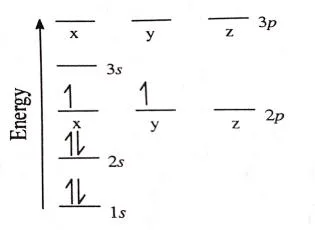
1s < 2s <2p < 3s < 3p
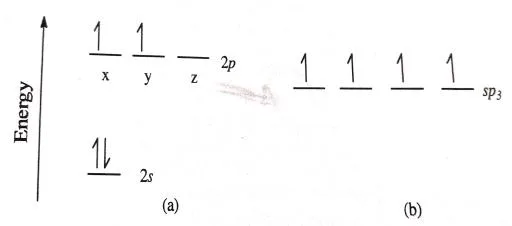
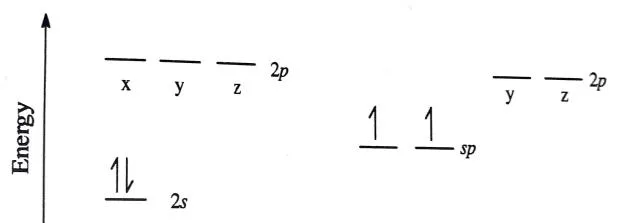
The Aufbau principle suggests the order in which electrons fill up various atomic orbitals, while
the Pauli Exclusion Principle limits the number of electrons in an orbital to two, and the Hund’s
rule dictates how to fill degenerate orbitals of a subshell. Figure 1.2 below summarizes these
principles.
Bond formation involves overlapping of atomic orbitals in the valence energy levels, such that
each bonded atom attains a full outer shell (The octet rule). The bond formation processes
prefer less energetic pathways. Therefore, carbon forms covalent bonds, almost exclusively,
because of the great amount of energy that would be required to transfer or add four electrons.
Figure 1.2: Ground electron configuration of a carbon atom