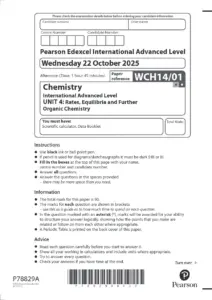
Unit 4A of the Chemistry curriculum focuses on rates, equilibria, and further organic chemistry concepts. This question paper is designed for students preparing for their chemistry examinations, featuring a variety of questions that assess understanding of key topics. Topics include reaction mechanisms, entropy changes, equilibrium constants, and organic reactions. Ideal for students studying for the Edexcel International Advanced Level Chemistry exam.

Key Points

  • Includes questions on reaction mechanisms and their steps.
  • Covers entropy changes and calculations related to chemical reactions.
  • Features equilibrium constant problems and their implications.
  • Explores organic chemistry reactions and their mechanisms.
Dandeldew
40 pages
Language:English
Type:Past Paper
Dandeldew
40 pages
Language:English
Type:Past Paper
210
/ 40
Turn over
*P87626A*
P87626A
©2026 Pearson Education Ltd.
C:1/1/1/1/1/
Pearson Edexcel International Advanced Level
Friday 9 January 2026
Afternoon (Time: 1 hour 45 minutes)
WCH14/01A
Paper
reference
Chemistry
International Advanced Level
UNIT 4: Rates, Equilibria and Further Organic Chemistry
Question Paper
You must have:
Answer Book (sent separately)
Scientific calculator, Data Booklet, ruler
2
P87626A
SECTION A
Answer ALL the questions in this section in the Answer Book.
You should aim to spend no more than 20 minutes on this section.
For each question, select one answer from A to D and put a cross in the box
in the
AnswerBook. If you change your mind, put a line through the box
and thenmark your new
answer with a cross
.
1 The halogenoalkane, 2-bromo-2-methylbutane, was hydrolysed with
sodiumhydroxide solution, NaOH(aq).
Which suggestion about the mechanism of this reaction is correct?
A
B
C
D
Type of mechanism Number of steps in mechanism
S
N
2 one
S
N
2 two
S
N
1 one
S
N
1 two
(Total for Question 1 = 1 mark)
2 Which of these gases would have the greatest standard molar entropy?
A H
2
B N
2
C NH
3
D SO
2
(Total for Question 2 = 1 mark)
3 Which of these changes has the largest increase in the entropy of the system?
A H
2
O(s) H
2
O(l)
B Hg(l) Hg(g)
C C(graphite) C(diamond)
D H
2
O(l) + HCl(g) H
3
O
+
(aq) + Cl
(aq)
(Total for Question 3 = 1 mark)
3
Turn over
P87626A
4 What is the standard entropy change of the system, in J K
–1
mol
–1
, for the reaction
between nitrogen and hydrogen to form ammonia?
N
2
+ 3H
2
2NH
3
Standard molar entropy / J K
–1
mol
–1
H
2
130.6
N
2
191.6
NH
3
192.3
A −198.8
B −129.9
C +129.9
D +198.8
(Total for Question 4 = 1 mark)
5 The enthalpy change of solution of sodium sulfate, Na
2
SO
4
, may be calculated using
three pieces of data.
Which of these pieces of data is not required?
A lattice energy of Na
2
SO
4
B enthalpy change of formation of Na
2
SO
4
C enthalpy change of hydration of Na
+
D enthalpy change of hydration of SO
4
2−
(Total for Question 5 = 1 mark)
6 Equal amounts of W and X are mixed and allowed to reach equilibrium.
W + X Y + Z
The value of the equilibrium constant K
c
= 4.85.
At equilibrium, the mixture will contain
A almost all Y and Z
B almost all W and X
C W, X, Y and Z but there is less Y and Z than W and X
D W, X, Y and Z but there is more Y and Z than W and X
(Total for Question 6 = 1 mark)
/ 40
End of Document
210

FAQs

what is the Chemistry Unit 4A Question Paper about

The Chemistry Unit 4A Question Paper focuses on key concepts in chemistry, including rates, equilibria, and further organic chemistry.

  • It includes various types of questions such as multiple-choice, short answer, and structured questions.
  • The paper assesses students' understanding of chemical principles and their ability to apply these principles in problem-solving scenarios.
  • Topics covered may include reaction rates, chemical equilibrium, and organic reaction mechanisms.

what topics are covered in the Chemistry Unit 4A Question Paper

The Chemistry Unit 4A Question Paper covers a range of topics essential for understanding advanced chemistry.

  • Rates of Reaction: Factors affecting reaction rates, rate equations, and mechanisms.
  • Equilibria: Dynamic equilibrium, Le Chatelier's principle, and calculations involving equilibrium constants.
  • Further Organic Chemistry: Functional groups, reaction mechanisms, and synthesis of organic compounds.

how to prepare for the Chemistry Unit 4A Question Paper

Preparing for the Chemistry Unit 4A Question Paper involves several effective strategies to enhance understanding and retention of material.

  • Review Key Concepts: Focus on understanding the fundamental principles of rates, equilibria, and organic chemistry.
  • Practice Past Papers: Work through previous Chemistry Unit 4A Question Papers to familiarize yourself with the question format and types.
  • Utilize Study Groups: Collaborate with peers to discuss challenging topics and share insights.
  • Consult Resources: Use textbooks, online resources, and study guides to reinforce your knowledge.

what are the key formulas in the Chemistry Unit 4A Question Paper

Key formulas in the Chemistry Unit 4A Question Paper are essential for solving various problems related to rates and equilibria.

  • Rate Equation: Rate = k[A]^m[B]^n, where k is the rate constant and m and n are the orders of reaction.
  • Equilibrium Constant (Kc): Kc = [products]^[coefficients] / [reactants]^[coefficients].
  • pH Calculation: pH = -log[H+], where [H+] is the concentration of hydrogen ions.

what are some tips for answering the Chemistry Unit 4A Question Paper

To effectively answer the Chemistry Unit 4A Question Paper, consider the following tips.

  • Read Questions Carefully: Ensure you understand what each question is asking before answering.
  • Manage Your Time: Allocate time wisely to each section and question to ensure you complete the paper.
  • Show Your Work: For calculations, always show your working steps to earn partial credit.
  • Review Your Answers: If time permits, revisit your answers to check for mistakes or incomplete responses.

what is the format of the Chemistry Unit 4A Question Paper

The format of the Chemistry Unit 4A Question Paper typically includes various question types to assess student understanding.

  • Multiple Choice Questions: Quick questions that test knowledge of key concepts.
  • Short Answer Questions: Require concise responses, often involving calculations or explanations.
  • Structured Questions: These may involve longer, more detailed responses, often requiring the application of concepts.

how is the Chemistry Unit 4A Question Paper scored

The Chemistry Unit 4A Question Paper is scored based on the accuracy and completeness of the answers provided.

  • Marking Scheme: Each question has a specific mark allocation, and points are awarded for correct answers.
  • Partial Credit: In some cases, partial credit may be awarded for showing correct working even if the final answer is incorrect.
  • Overall Assessment: The total score is used to determine students' understanding of the material and their readiness for further studies in chemistry.

what are common mistakes in the Chemistry Unit 4A Question Paper

Common mistakes in the Chemistry Unit 4A Question Paper can hinder performance and understanding.

  • Misreading Questions: Failing to understand what is being asked can lead to incorrect answers.
  • Calculation Errors: Simple arithmetic mistakes can result in lost points, so careful checking is essential.
  • Neglecting Units: Not including or converting units correctly can lead to incorrect conclusions.