Energy (H) Question Paper provides a comprehensive assessment of thermal energy concepts, including thermal conductivity, energy transfer, and electrical power calculations. This paper is designed for students preparing for their energy-related examinations, covering essential topics such as specific heat capacity and current calculations. It includes practical problems and theoretical questions, making it a valuable resource for high school physics students. The content aligns with curriculum standards, ensuring relevance for exam preparation.
Key Points
Explores thermal conductivity of different metals through practical experiments.
Includes calculations related to energy transfer and specific heat capacity.
Covers electrical power concepts, including current and resistance calculations.
Features a variety of questions suitable for high school physics students.
This link leads to an external site. We do not know or endorse its content, and are not responsible for its safety. Click the link to proceed only if you trust this site.
Chemistry Unit 4 Question Paper – Edexcel International A LevelPast Paper
PDFPast Paper
Chemistry Questions Paper – Class 12Past Paper
PDFPast Paper
Combined Civil Services Examination II – Question Paper PatternPast Paper
PDFPast Paper
Mumbai University Digital Forensics Honours Question Paper December 2024Past Paper
PDFPast Paper
Grade 11 Life Orientation June 2025 Exam PaperPast Paper
PDFPast Paper
Grade 11 Life Orientation Term 2 Exam Paper May 2025Past Paper
PDFPast Paper
January 2019 IAL Mark Scheme Paper 5 Edexcel Chemistry A LevelPast Paper
PDFPast Paper
2026 Practice Paper 3 Higher Tier CalculatorPast Paper
PDFPast Paper
Cambridge O Level Biology 5090/12 Past Paper May/June 2025Past Paper
PDFPast Paper
Cambridge O Level Biology 5090/42 Paper 4 Alternative to Practical October/November 2025Past Paper
FAQs
What is the method used to investigate thermal conductivity in metals?
The method involves measuring the mass of an ice cube, placing it on a metal block at room temperature, and measuring the mass of the ice cube after one minute. This process is repeated with different metal blocks of the same mass to compare results. The change in mass of the ice cube indicates the thermal conductivity of the metals tested.
Which metal had the highest thermal conductivity according to the results?
Copper had the highest thermal conductivity among the metals tested, with a change in mass of 5.93 grams after one minute. This indicates that copper is more effective at conducting heat compared to aluminum, lead, and steel, which had lower mass changes.
How is the mean energy transferred from the National Grid calculated?
To calculate the mean energy transferred from the National Grid each second, the total energy transferred over a year (1.25 × 10^18 J) is divided by the number of seconds in a year (3.16 × 10^7 seconds). This provides the average energy transferred per second.
What is the specific heat capacity of ice mentioned in the document?
The specific heat capacity of ice is stated as 2100 J/kg °C. This value is crucial for calculating the thermal energy required to raise the temperature of ice, as well as for determining the mass of the ice cube based on the energy needed to melt it.
What is the efficiency of the solar cells as mentioned in the document?
The efficiency of the solar cells is noted as 0.15, meaning that only 15% of the input power is converted into useful electrical energy. This efficiency is an important factor when evaluating the performance of solar power systems compared to other energy sources.
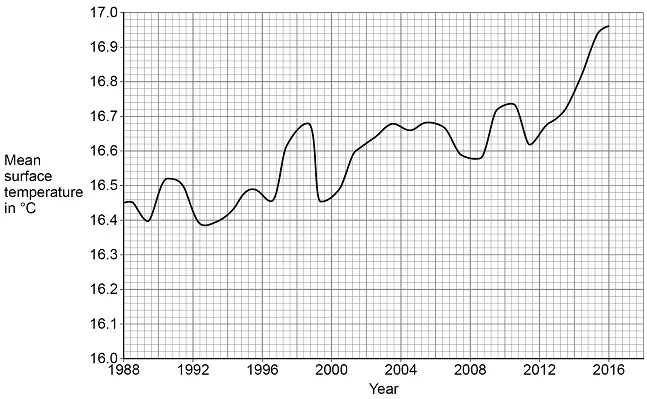
What does the graph of the mean surface temperature of the sea indicate about climate change?
The graph shows a rising trend in the mean surface temperature of the sea from 1988 to 2016, indicating a significant increase over the years. This data suggests that climate change is occurring, as the continuous rise in temperature reflects the impacts of global warming.
What are the advantages of using nuclear power compared to shale gas for electricity generation?
Nuclear power has several advantages over shale gas, including lower carbon emissions and a more stable energy supply. Unlike shale gas, which contributes to greenhouse gas emissions and can cause environmental issues like minor earthquakes from fracking, nuclear power provides a cleaner alternative with less environmental impact.